Exam 2
 Call Kai
 Learn
 Practice Test
 Spaced Repetition
 Match
 Flashcards
 Knowt Play
1/107

There's no tags or description
Looks like no tags are added yet.
108 Terms
Sponge structure
Aquiferous system powered by choanocytes supports feeding, gas exchange, and waste expulsion.
• Pinacoderm made up of pinacocytes form the outer surface of sponge.
• Mesohyl layer between dermal layers. May contain spicules, amebocytes, and other cell types.
• Choanoderm layer of choanocytes creates water current through sponge

Skeletal Support
Sponges may be supported by spicules and/or collagen including a unique form of collagen called “spongin”
• Spicules may be siliceous or calcium carbonate.
• Skeletal make-up up and shape is important for classifying sponges
Asconoid Body Form

Syconoid Body Form

Leuconoid Body Form

Class Hexactinellida
Spicules composed of silica and six rayed
• Spicules often fused into an intricate lattice; cup or vase shaped
• Most tissues in one giant multinucleate single-celled syncytium.
• Sycon or leucon body form
• Often found at 450 to 900 m depths in tropical West Indies and eastern Pacific. Glass sponges.
• Trichimella larvae

Class Demospongiae
>80% of extant sponges
• Brilliantly colored sponges with needle-shaped or four-rayed siliceous spicules or spongin or both.
• Most with leucon body form; may be up to 1 m in height and diameter.
• Includes one family of freshwater sponges, Spongillidae, and the bath sponges. Cliona, Spongilla.

Class Homoscleromorpha
Anatomically simple and encrusting in form. Leuconoid body form.
• Loss of spongin skeleton.
• Siliceous spicules small and simple in shape or absent.
• Occur at depths ranging from shallow marine shelves to depths of 1,000 m. Oscarella, Plakina.
• Cinctoblastula larvae

Class Calcarea
Spicules composed of calcium carbonate.
• Spicules are needle shaped or have three or four rays.
• Ascon, leucon, or sycon body forms; all marine. Calcareous sponges. Grantia(=Scypha), Leucosolenia.

Sponge Reproduction
Can reproduce asexually through fragmentation.
• Primarily reproduce sexually
– Release sperm and egg into water, external fertilization, oviparity.
– Sperm released, swim to another sponge, internal fertilization, viviparity.
– Extreme diversity in sexual differentiation: sequential hermaphroditism, gonochoristic, switch sexes regularly.
Characteristics of Phylum Placozoa
Placozoa = “flat animals”
• Minute, flattened metazoans composed of ciliated upper and lower cell layers; ameboid and fibrous cells in a “gel” layer in between; adults discoidal and asymmetrical or with polytomous branching.
• With six somatic cell types. (Possibly more)
• Cells with desmosome cell-cell connections
• With unique shiny spheres, possibly defensive structures, in upper cell layer.
• Without a structural nervous system, muscles, or digestive system.

Placozoa Reproduction
Asexual
– Fission
– Swarmer formation: budding process that yields numerous multicellular flagellated “swarmers” each of which forms a new individual.
• Sexual
– Known to occur but not well studied
Phylum Ctenophora
Greek: Cten = “comb”, Phero = “to bear”
• Diploblastic, biradial symmetry
• ~130 Species
• Common names: Comb jellies, sea gooseberries, sea walnuts.
• Most are small but some can up to a meter
• Exclusively marine, mostly pelagic
• Most are predators
• Movement through beating of cilia in Ctenes (comb-like rows

Ctenophore Feeding, Digestion, and Transportation
Most are predatory, trapping prey with Colloblast cells on tentacles.
• Highly branched system of Gastrovascular canals throughout body.
• Lack dedicated respiratory and circulatory systems but gastrovascular system distributes nutrients to and probably collects waste from rest of body
Colloblasts
Multicellular structures used for prey capture.
• Produce sticky “glue” to capture prey

Ctenophore Reproductions and Development
High regenerative ability. Possible asexual reproduction through damage/fragmentation.
• Most species hermaphroditic, some gonochoristic. Typically, gametes released through mouth, and fertilization is external but internal fertilization occurs in some species.
• Diploblastic (maybe triploblastic?) development
Cnidarian Characteristics
Radial symmetry or variations thereof
• Diploblastic, tissue-level organization
• Gelatinous mesoglea between the epidermal and gastrodermal tissue layers, acellular or with scattered
ectodermally derived cells.
• Single gastrovascular cavity.
• Nerve cells organized into subepidermal and subgastrodermal nerve nets
• Specialized cells, called cnidocytes, used in defense, feeding and attachment.
• Most are predators

Cnidarian Circulation, Gas Exchange. Excretion, Osmoregulation
No specialized circulation, gas exchange, excretion, or osmoregulatory systems.
• Circulate water and nutrients through gastrovascular cavity.
• May be folded into mesenteries (i.e.Anthozoa) or branched into radial canals (i.e. Medusozoa) to increase surface area.
• Freshwater species periodically expel excess water through gastrovascular cavity
Class Anthozoa
• Subclasses: Octocorallia, Hexacorallia
• ~7,200 species
• Colonial or solitary polyps
• Medusae absent
• Cnidocytes present in epidermis & gastrodermis
• Tripartite series of flaps on cnidae
• Gametes gastrodermal in origin
• Gastrovascular cavity divided by mesenteries that bear nematocysts
• Thick mesenchyme
• Marine. Anemones and corals.

Anthozoan Reproduction
Diverse mechanisms of asexual reproduction including fission, fragmentation, budding, etc.
• Sexual reproduction typically gonochoristic, though Scleractinia corals are hermaphroditic. External fertilization typical, but internal fertilization in some species
Subclass Octocorallia
~3,000 species
• Soft corals, sea fans, sea pens
• Polyps with 8 hollow tentacles, and 8 mesenteries

Subclass Hexacorallia
• ~4,300 species
• Sea anemones (Order Actiniaria)
• Stony corals (Order Scleractinia)
• Mesenteries in multiples of 6.
Subphylum Endocnidozoa, Class Myxozoa
• Highly reduced intracellular parasitic Cnidarians.
• One species Henneguya salminicola has no mitochondrial genome and does not require oxygen! (Yahalomi et al. 2020 PNAS)
• Typically have an Annelid and a Vertebrate host

Subphylum Medusazoa
• ~3,900 species
• Class Hydrozoa
• Class Staurozoa
• Class Cubozoa
• Class Scyphozoa
Class Hydrozoa
~3,500 species
• Cnidocytes present in the epidermis
• Gametes produced epidermally and always released to the outside of the body
• Mesoglea is largely acellular
• Medusae usually with a velum
• Many polyps colonial
• Diverse mechanisms of sexual and asexual reproduction in both polyp and medusae.
• Mostly marine with some freshwater species. Hydra, Obelia. Gonionemus, Physalla.

Class Scyphozoa
• Medusa prominent in the life history
• Polyp small or absent
• Gametes gastrodermal in origin and released into the gastrovascular cavity
• Cnidocytecs present in the gastrodermis as well as epidermis
• Medusa lacks a velum
• Mesoglea with scattered cells of epidermal origin
• Marine

Scyphozoan Reproduction

Class Staurozoa
• “Stalked jellyfish”
– Sessile Stauromedusae
• Develop from benthic planula larvae
• Eight tentacles surrounding the mouth
• Attachment to substrate by adhesive disk
• Sexual reproduction dominant (gonochoristic, free spawning)
– Asexual reproduction only known in one species
• Marine only

Class Cubozoa
• Box jellyfish or Sea wasps
• Medusa prominent in life history, with velarium
• Mating between males & females in some species. Polyps small, directly metamorphize into medusae
• Highly toxic venom, potentially deadly to humans!
• Medusa cuboidal in shape with tentacles that hang from each corner of the bell
• Marine only

Scyphozoan and Cubozoan Sensory Structures
Rhopalia with multiple sensory structures for detecting light and in some cases images (Ocelli), orientation and pull of gravity (Statocyst), and chemosensory organs.

Organismality Concepts/Criteria
• Genetic homogeneity: Do all members of the group have the same genotype or is the group genetically diverse?
• Genetic uniqueness: Is the group genetically distinct from other similar groups or may other groups have the same genotype?
• High cooperation-low conflict: Are members of the group highly cooperative with one another or is there internal group conflict, competition, or cheating?
• Boundedness: Is the group bounded in a specific area with clear separation from the external environment and other groups or diffuse?
• Division of labor: Do different members of the group specialize on different tasks to support the whole group?
• Physiological unity & integration: Are members of a group physiologically integrated through sharing nutrients, other resources, providing essential functions for other group members, etc.?
• Inseparability/Emergent functions: Are there functions the group can perform that individuals cannot? If members of the group were to be removed would a key function of the group no longer be possible?
• Immune recognition: Can the group and its members recognize each other as distinct from other groups or non-group members?
Coral Reefs
• Polyps physically connected and capable of sharing
nutrients/resources.
• Reef structure arises from multiple polyp skeletons fusing together.
• Generally new reefs formed by sexual reproduction, but reefs can form through fragmentation as well.
• Polyp polymorphism typically absent.
• Immune recognition present, polyps of same species from different reefs can fuse into a single reef but only if closely related or clones of one another

Bilateria

Xenacoelomorhpa Characteristics
• Small (<mm to a few cm) acoelomate worms. Mostly marine.
• Acoelan Nemertodematida, and Xenoturbella
• Lacks anus, nephridia, and circulatory system. Sometimes lacks mouth.
• Hermaphroditic sexual reproduction with direct development.
• Simple semi-diffuse nervous system with ganglia (very primitive brain?)
• Circular and longitudinal muscles
• Ciliated epidermis with unique “shelfed” cilia
• Unique epidermal pulsatile bodies involved in resorbing cilia

Nephrozoa
Two major clades: Protostomes & Deuterostomes
• Through gut (lost in some)
• Specialized excretory structures (nephridia)
• Probably evolved coelom body cavity twice: once in protostomes and once in deuterostomes

Protosomes
Protostomes typically:
• Spiral cleavage in Spiralia clade
• Blastopore develops into mouth
• Coelom formation through schizocoely
• Determinant early development
• 23 Phyla in two major clades
• Ecdysozoa
• Spiralia (15 phyla and develop through spiral cleavage)

Dueterostomes
Deuterostomes typically:
• Radial cleavage
• Blastopore develops into anus
• Coelom formation through enterocoely
• Indeterminant early development
Three Phyla
• Echinodermata
• Hemichordata
• Chordata

HOX Genes
• Hox genes encode transcription factor proteins that regulate the Anterior-Posterior body axis development
• Homologous HOX genes act as master regulators of body segments across all bilaterian taxa
• Their function is so conserved that the mouse Pax6 gene that controls eye development can be swapped in for the Drosophila eyeless gene and the flies will develop normal fly eyes

Urbilateria Hypothesis
Hypothetical common ancestor of all bilaterians is often called “Urbilateria”.
• Proposed to have a trochophore/dipleurula-like swimming larval stage that would later develop into a crawling adult stage.
• Larval stage is lost or highly modified in many groups
• Gut/blastopore may have been opening spanning length of animal that closed into a tube by meeting in the middle (called “amphistomy” development). Later this develops into mouth-first vs. anus first development of protostomes vs. deuterostomes.
• The D-V axis becomes inverted between Protostomes and Deuterostomes

Chordata Characteristics
• Our Phylum!
• Urochordata, Cephalochordata, and Vertebrates!
• At some stage of development, all members of Chordata have:
• Notochord
• Pharyngeal slits or pouches
• Dorsal tubular nerve cord
• Muscular postanal tail
• An endostyle or thyroid gland

Class Ascidiacea, Urochordata (Tunicates)
• Tunicates a.k.a. sea squirts, and salps.
• Marine filter feeders.
• Heart changes direction of blood flow every few beats!
• Notochord, nerve cord and postanal tail present only during free swimming larval stage.
• Most have a cellulose containing body wall, called a “tunic”
• Only animal to produce cellulose

Class Appendicularia, Urochordata (Tunicates)
• Adults retain tail and notochord
• Lack a cellulose tunic
• Secrete gelatinous “house” around body that assists in filter feeding
• Likely only sexual reproduction.

Tunicate Reproduction and Development
• Asexual reproduction by budding.
• Hermaphroditic, external fertilization. Typical deuterostome development leads to a swimming tadpole that settles on to substrate and reduces notochord and neural cord during metamorphosis into sessile adult. (Exceptions exist)
Sub-Phylum Cephalochordata
• Common name = Lancelets
• Only group of Chordates where all five Chordate characters are present in adult form.
• Name refers to unique extension of notochord past the animal’s head.
• Filter feeders. Most of body buried in sand with ciliated “wheel organ” sweeping water into pharynx and pharyngeal slits.
• Closes circulatory system lacking respiratory pigments moves nutrients through body.
• Respiration mostly through body wall.
• Gonochoristic, spawning with external fertilization

Phylum Hemichordata
• Class Enteropneusta (Acorn worms) and Class Pterobranchia
• Three-part body plan: Proboscis, collar and trunk.
• Semi-open circulatory system
• Unique excretory structure, the glomerulus
• Complete gut, deposit and/or suspension feeding
• Stomochord, analogous to chordate notochord?
• Dorsal nerve cord
• Pharyngeal gill slits, homologous with Chordata

Hemichordata Circulation, Respiration, and Excretion
• Semi-open circulatory system: Colorless to pinkish blood flows anteriorly via dorsal vessel and posteriorly via ventral vessel.
• Respiration structures not clear, gills not likely involved.
• Unique glomerulus excretory structure: series of small sinuses lined with specialized podocyte filtration cells. High pressure from heart forces filtration through sinuses and podocytes where wastes can be excreted through pores at base of proboscis

Hemichordata Reproduction and Development
• Asexual reproduction through fragmentation by damage.
• Sexual reproduction typically gonochoristic with external fertilization, gametes released by spawning.
• Typically indirect development with tornaria larval stage, though some species with direct development.
• Blastopore closes during development and mouth and anus derived secondarily.
General Echinoderms Characteristics
• Adults with pentaradial symmetry
• Eucoelomate, deuterostomous development with enterocoely.
• Unique water-vascular system
• Stereom Endoskeleton composed of separate ossicles and plates that form a meshwork with interstices filled with living tissue.
• Body wall with mutable collagenous tissue.
• Complete gut, but anus sometimes lost.
• No specialized excretory organs, excretion through specialized coelomocyte cells.
• Circulatory structures, when present, derived from hemalsystem.
• Diffuse nervous system with subepithelial nerve net, radial nerves and nerve ring.
• Mostly gonochoristic, development direct or indirect

Echinoderms Circulation
• Circulation through movement in body coelom and hemal system, usually using cilia and through water vascular system
Water-Vascular System
Madroporite —> stone canal —> ring canal —> radial canal —> lateral canal —> ampullae —> tube feet

Pedicellariae
• Unique external skeletal structures of Echinoderms.
• Perform a range of functions including defense, self-cleaning, and prey capture.
Class Asteroidea
• Central disk with lateral arms. Arms (rays) and disc not distinctly separated.
• Tube feet with suction/sticky disks.
• Tube feet in ambulacral grooves
• Pedicellariae present.
• Feed by extruding their stomachs from mouth to envelop and partially digest food then transport food into pyloric cecae for further digestion and absorption
Gas Exchange (Extensions of body wall called papulae. Also exchange through tube feet)

Class Ophiuroidea
• Brittle stars (unbranched arms) and sea baskets (branched arms).
• Arms (rays) and central disk distinct.
• Madreporite on oral side
• Water vascular system not used for movement. Instead, arms move in snake-like motion.
• Anus lost
• Gas exchange (Invaginations of body wall called bursae that open to outside via ciliated slits)

Class Echinoidea
• Sea Urchins and Sand Dollars
• Closely fitted or fused skeletal plates formed into ridged test.
• Internal jaw apparatus called Aristotle’s lantern (lost in some)
• Pedicellariae present, many types.
• Movable spines present.
• Typically, globose of flattened discoid body
• Aristotles Lantern (sea Urchina mouth parts)
•Gas exchange primarily through specialized respiratory tube feet

Class Holothuroidea
• Sea cucumbers
• No arms (rays), elongate along oral-aboral axis.
• Microscopic ossicles embedded in muscular body wall.
• Circumoral tentacles (modified tube feet), often with sticky mucous, used for feeding.
– Some species filter feeders.
– Some species deposit feeders.
• Gas exchange through respiratory trees attached to rectum.
• Madreporite internal
• Gas exchange respiratory trees attached to anus. Water pumped through contracting and relaxing anal sphincter

Class Crinoidea
• Sea lilies and feather stars.
• Super abundant and diverse in Paleozoic (200 – 600 million years ago) but much less so today.
• Arms radiate from central cup (calyx) with mouth directed upward.
• In sea lilies, stem is attached to aboral side of calyx. In feather stars, root-like cirri used for attachment are connected to calyx on aboral side.
• Tube feet in double row along each arm, used for filter feeding.
• No singular madreporite WV openings, mouth and anus on oral side of calyx
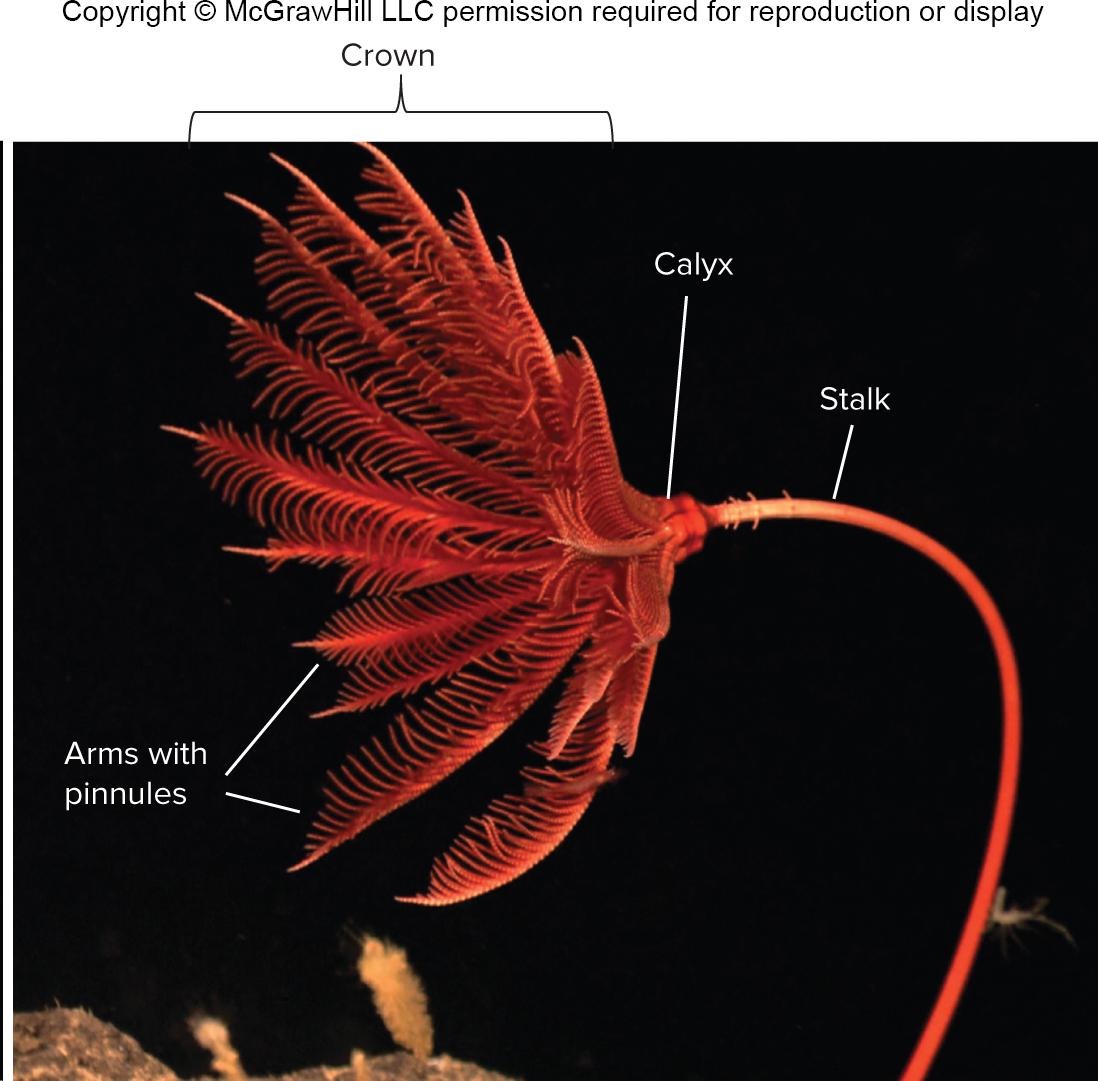
Echinoderms Reproduction
• Most commonly, Echinoderms are gonochoristic but some asteroids, holothuroids, and ophiuroids are hermaphroditic.
• Typically reproduce by free spawning with external fertilization in water developing into free swimming larvae.
• But brooding occurs in some species, with eggs/young getting attached to female body surface and young developing with parental care. Particularly among artic species.
• Development usually indirect with bilaterally symmetrical larvae, but direct development common in brooding species
Ecdysozoa
• Clade of Protostome animals with outer cuticles that they molt during
growth/development
• Includes Phyla Nematoda, Arthropoda, Tardigrada, Onychophora, and others
Arthropod Characteristics
• Paired, jointed appendages
• Growth accompanied by ecdysis or molting
• Cuticle (exoskeleton) made of chitin
• Ventral nervous system
• Coelom reduced to cavities surrounding gonads and sometimes excretory organs.
• Open circulatory system in which blood is released into hemocoel (body cavity derived from blastocoel).
• Complete gut with regional specialization.
• Mostly gonochoristic, with direct, indirect or mixed development.

Arthropod Segmentation and Tagmatization
• Arthropods exhibit segmentation (metamerism).
• Segments may have paired appendages.
• Segments can be specialized to specific functions, tagmatization.
• Specialized groupings of multiple segments are called tagmata

General Crustaceans Characteristics
• Six-segmented head (cephalon)
• Tagmata: Cephalon, thorax and abdomen
• Cephalon and thorax often fused into a cephalothorax
• Two pairs of antennae
• Uniramous or biramous appendages
• Gas exchange through gills or specialized regions of body surface.
• Excretion structures derived from nephridia (antennal glands, maxillary glands)
• Nauplius larva (lost in some

Superclass Oligostraca: Class Ostracoda
• Body segmentation reduced, head and trunk (not head, thorax, abdomen).
• Bivalved carapace
• Small size, 0.1 - 2.0 mm
• About 13,000 species
• Fewest appendages of any crustacean, 4
– 5 head appendages, 3 trunk appendages
• Males in tropical species excrete bioluminescent mucus to attract females

Superclass Oligostraca: Class Branchiura
• Compact oval body mostly covered by broad carapace.
• Reduced antennae
• Mouthparts modified for parasitism.
• Ectoparasites of fish, including many fish important for food and commercial fishing.
• “Fish lice”

Superclass Altocrustacea: Class Malacostraca
• Highly diverse class of crustaceans, with over 40,000 described species.
• Order Decapoda: crabs, lobsters, crayfish, shrimp, prawns. Over 15,000 species.
• Order Euphausiacea: Krill
• Order Isopoda: Includes free living marine isopods, parasitic species, and pill bugs
• Order Stomatopoda: Mantis shrimp

Superclass Altocrustacea: Class Copepoda
• Most with a single median ocellus (simple eye in middle)
• First antennae modified for swimming
• Abdomen free of appendages
• Highly diverse, over 14,500 species
• Most are very small, ~0.5 – 10mm but a few can be over 1.5 cm.
• Like krill, highly abundant and play important role in marine ecosystems.
• Includes ~2,800 freshwater species and some parasitic species

Superclass Altocrustacea: Class Theocostraca
• Barnacles
• Head and abdomen reduced
• Thoracic appendages modified for filter feeding
• Calcareous plates cover larval carapace in adult stage
• Most are monoecious
– Why do barnacles have the longest penis relative to body size?

Superclass Altocrustacea: Class Branchiopoda
• Daphnia, Fairy shrimp, Brine shrimp, Triops, Clam shrimp, etc.
• Generally freshwater filter feeders, but some marine or predatory species.
• Always with naupliar larval stage during development.
• Abdomen usually lacks appendages

Non-Insect Hexapods and Non-Winged Insects
• There are 3 orders of Non-Insect Hexapods (Springtails, Proturans, Diplurans) and 2 orders of Insects that do not have a winged ancestor (Jumping bristletails & Silverfish)
• Key difference between Non-insect Hexapods and insects is that insects have exposed projecting mouthparts

Class Insecta General Characteristics
• Body divided into head, thorax, and abdomen
• Five pairs of head appendages
• Three pairs of uniramous appendages on thorax
•“Hexapoda” derived from greek for “6 legs”
• Tracheal gas exchange
• Mouth appendages exposed and projecting from head
• Large fat body concentrated in abdomen
• Malpighian tubules for excretion
Trachea and Spiracles
• Many terrestrial Arthropods breathe through a system of tracheae and spiracles.
• Though these structures appear to be independently evolved in Hexapods, Myriapods, and some Spiders

Malpighian Tubules
• Found in tardigrades and some insects and spiders.
• Extract wastes from hemocoel and empty them into the gut
Hemimetabolous Metamorphosis
• A species-specific number of molts between egg and adult stages during which immatures (nymphs) gradually take on adult forms.
• Seen in Grasshoppers, Chinch bugs, cicadas, termites, praying mantis, and more

Infraclass Palaeoptera
• “Ancient winged,” wings cannot be folded. At rest they stick straight out or straight up.
• Includes mayflies, dragonflies, and damselflies.
• Possibly not monophyletic, more research needed

Infraclass Neoptera: Superorder Polyneoptera
• “Neoptera” = “New wing”. Wings are foldable against the body.
• Polyneoptera have hemimetabolous development and chewing mouthparts
• Includes Mantids, Earwigs, Cockroaches, Termites, Grasshoppers and more

Infraclass Neoptera: Superorder Acercaria
• “Neoptera” = “New wing”. Wings are foldable against the body.
• Acercaria have hemimetabolous development and sucking mouthparts
• Includes “true bugs,” lice, thrips, cicadas, and more

Infraclass Neoptera: Superorder Holometabola
• “Neoptera” = “New wing”. Wings are foldable against the body.
• Holometabola have holometabolous development
• 11 orders. You need to know the “big four”: Lepidoptera, Hymenoptera, Diptera, and Coleoptera

Holometabolous Metamorphosis
• Immatures, called larvae, are different in form and habitats from adult. The last larval molt results in the formation of a pupa. Radical cellular changes in the pupal stage end in adult emergence.
• Seen Holometabola including the “Big four” Orders and others

Order Lepidoptera
• Moths and butterflies
• ~180,000 described species
• Wings broad and covered with scales
• Mouth parts formed into sucking tube

Order Coleoptera
• The beetles
• Comprise 40% of all insect species and 25% of all Animal species! (Described so far)
• ~350,000 described species
• Front wings modified into hardened protective elytra

Order Diptera
• Flies and mosquitoes
• ~125,000 described species
• Hindwings modified into club-like mechanosensory organs called halteres that assist in precise aerial movement

Order Hymenoptera
• Ants, Bees, and Wasps
• ~150,000 described species
• Wings (if present) coupled together by hooklike hamuli
• Sex determination through haplodiploidy
– Males are haploid (unfertilized egg)
– Females are diploid (fertilized egg)
• Females with specialized ovipositor, sometimes modified into stinger
• Many species are highly social with a caste system

Sub-Phylum Myriapoda
• From the Greek: myriad = 10,000 + podus = foot. So, basically, arthropods with a lot of feet!
• Two tagmata: Head and trunk
• Breathe through tracheae and spiracles (convergent with Hexapoda)
• Class Chilopoda (Centipedes)
– Fast moving predators
– Venomous maxillipeds on first trunk appendage
– 1 pair of legs per trunk segment
• Class Diplopoda (Millipedes)
– Fused diplosegments, with two leg pairs each
– Many with repugnatorial glands that produce noxious chemicals including hydrogen cyanide

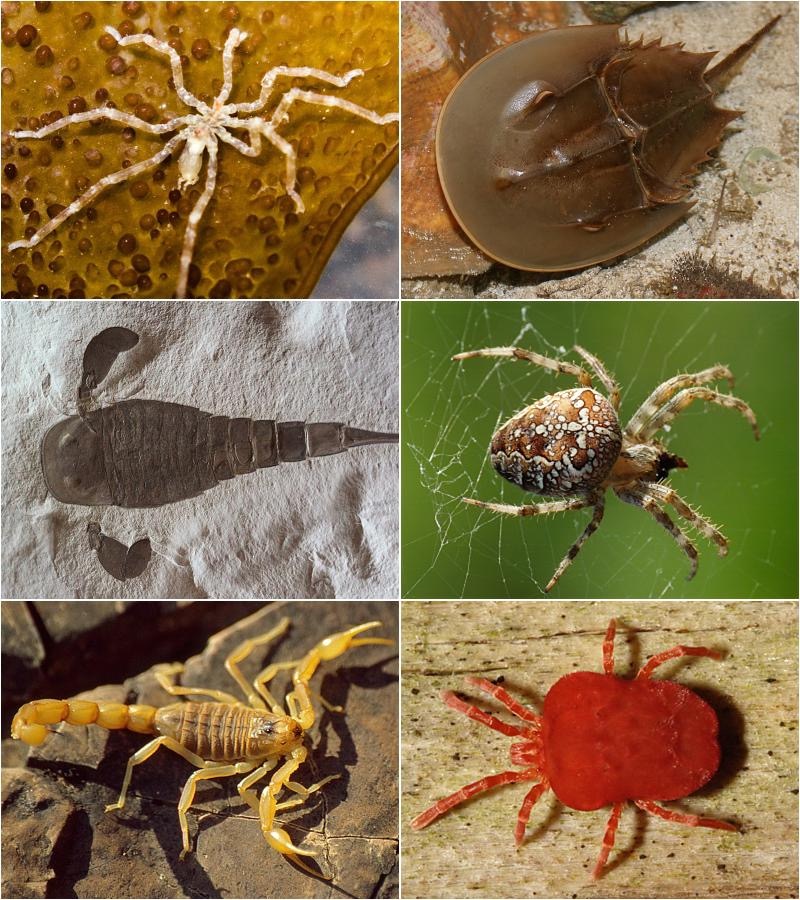
Sub-Phylum Chelicerata
• First pair of appendages piercing or pincer-like chelicerae used for feeding followed by palps/pedipalps and typically 4 pairs of legs. Antennae absent.
• Body usually divided into prosoma (cephalothorax/head & thorax) and
opisthosoma (preabdomen & postabdomen).
• Gas exchange through book lungs, tracheae, or cuticle & gut
• Most gonochoristic
• Excretion through coxal glands (Horseshoe crabs) or malpighian tubules (terrestrial species
Book Lungs/Gills
• Many (but not all) chelicerates breathe with “book lungs” or “book gills”
• Modified flattened appendages or infoldings of exoskeleton with thin walls that provide a large surface area for gas exchange. Resemble the pages of a book.
• Tracheae also often present in terrestrial species

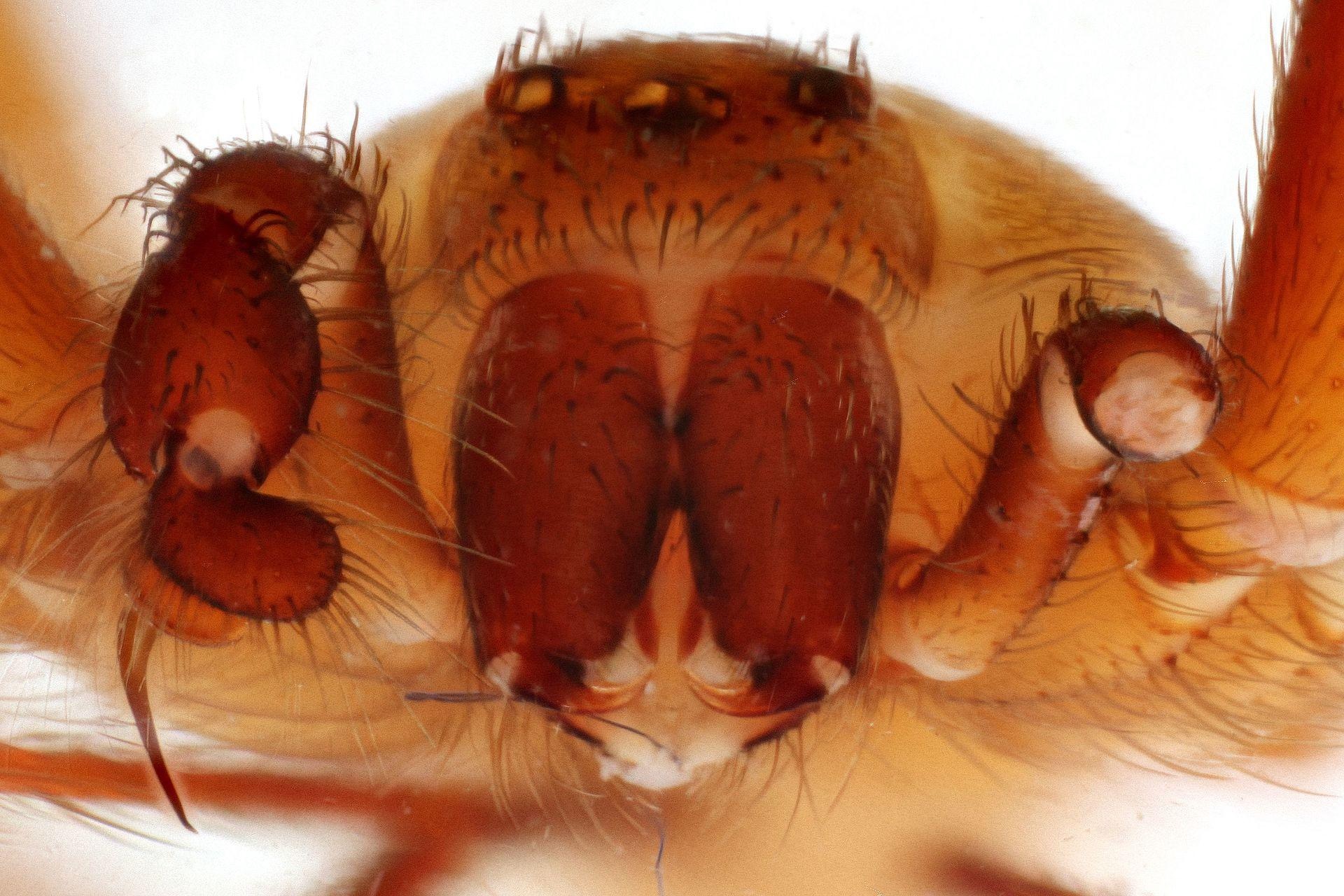
Chelicerae
Class Pycnogonida
• “Sea spiders,” not actually spiders
• ~1,400 species
• Marine & estuarine, mostly predators or scavengers
• Long legs relative to body
• Gut extends into legs, assists with circulation
• Pores in exoskeleton allow for gas exchange
• Gonochoristic, males typically brood young, holding onto them with special appendages called “ovigers”

Order Xiphosura
• Commonly known as “horseshoe crabs”
• Four extant species. Geographically isolated from each other.
– East coast of North America
– 2 species in Southeast Asia
– Malaysia, Thailand, and the Philippines
• Live in ocean but come ashore to mate and lay eggs.
• In North America, horseshoe crab eggs are an important food resource for migratory birds, including some endangered bird species

Order Scorpionida
• Scorpions
• Common from tropical to warm temperate climates.
• Nocturnal.
• Prosoma fused into shield-like carapace.
• Small chelicerae project anteriorly.
• Large pedipalps with pincers.
• Opisthosoma divided into two sub-segments
– Preabdomen with book lungs and sensory organs.
– Postabdomen with stinger

Order Araneae
• True Spiders!
• Chelicerae modified into fangs.
• Leg like pedipalps, modified for sperm transfer in males.
• Prosoma and Opisthosoma connected by thin waist-like pedicel.
• Large abdomen with opening for reproductive tract, book lungs or tracheae, and modified appendages called spinnerets that produce silk
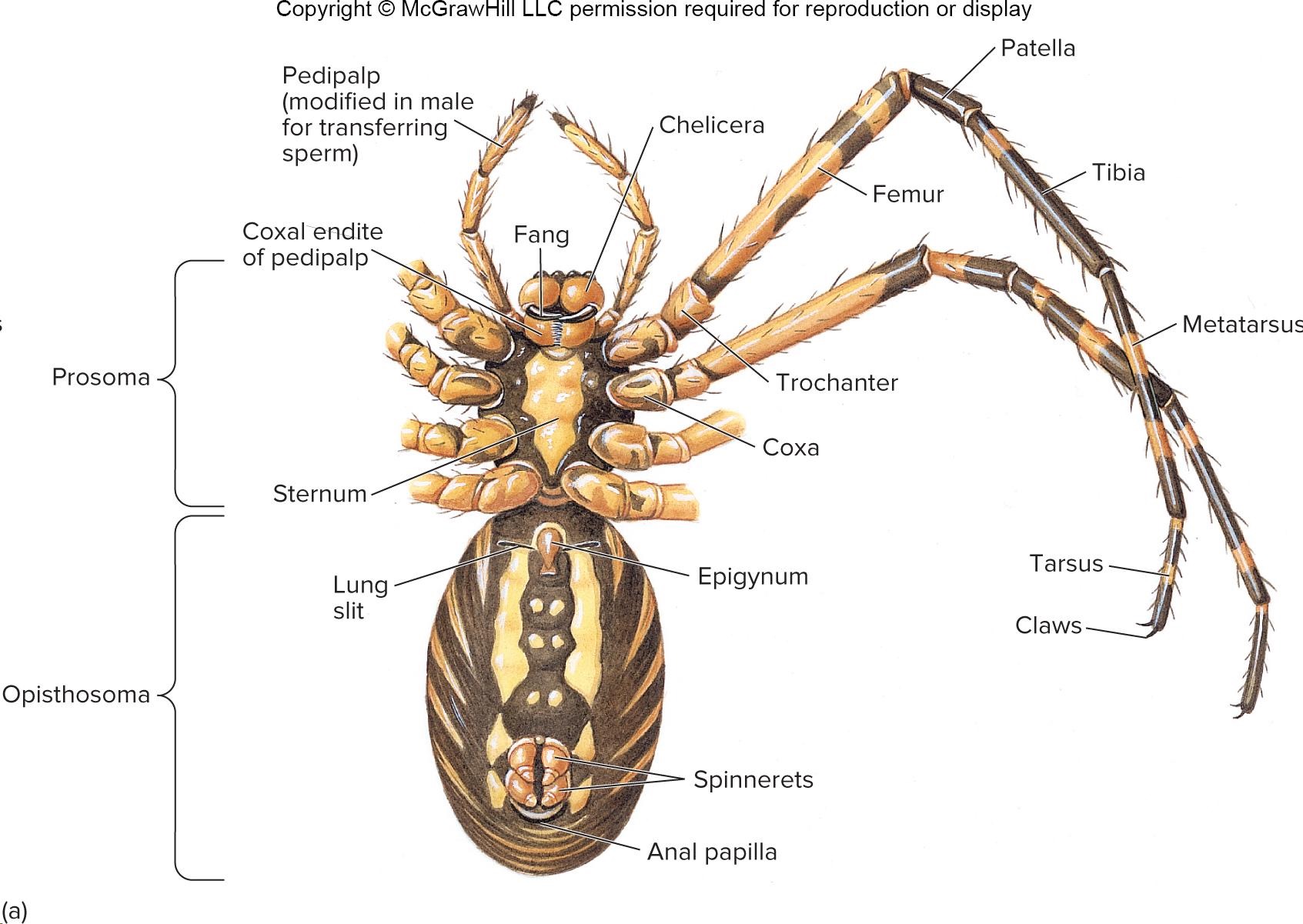
Acari Orders
• Polyphyletic grouping of ticks, chiggers, and mites.
– Parasitiformes: mites and ticks
– Acariformes: mites, dust mites & “chiggers”
• Prosoma and opisthosoma are fused and covered with single carapace.
• Chelicerae and pedipalps modified into specialized feeding structures for piercing, biting, anchoring or sucking

Phylum Onychophora: The Velvet Worms
• Onyches = “claws,” Phora = “to carry”
• Segmented body
• Mixocoel
• Nonjointed, telescopic, lobopodal legs lacking intrinsic musculature. Legs with terminal claws
• Cerebral ganglion (brain) dorsal to pharynx.
• Simple camera eyes, and sensory antennae.
• Jaws probably homologous to chelicerae/first antennae of arthropods
• With slime papillae
• Gas exchange through spiracles/trachae

Velvet Worm Feeding
• Predators
• Sneak up on prey then ensnare in quick drying slime produced from unique slime glands.
• Slime glands thought to be modified nephridia
• Jaws slice into prey, saliva released into prey to partial digest insides which are sucked into velvet worm mouth.
• Salivary glands also thought to be modified nephridia

Velvet Worm Circulation, Gas Exchange, Excretion, and Osmoregulation
• Arthropod-like open circulatory system
• Unique subcutaneous vascular channels called hemal channels
• Breathe through tracheal system, independently derived from Arthropods
• Each pair of legs associated with a pair of nephridia
Velvet Worm Reproduction and Development
• Nearly all gonochoristic
• Variety of different mating systems including dermal and vaginal insemination
• May be oviparous, viviparous, or ovoviviparous
• Direct development
Phylum Tardigrada
• Tardigrada = “slow walkers”
• Segmented body with four pairs of legs
• Coelomate, but coelom reduced or lost
• Nonjointed, telescopic legs lacking intrinsic musculature
• Thin uncalcified cuticle
• Without circulatory or respiratory systems
• Malpighian tubules for excretion. Independently derived from Arthropods
• Capable of anabiosis/cryptobiosis and entering a “tun” state

Tardigrade Feeding and Digestion
• Feed on fluids inside plant, algal or animal cells.
• Pierce cells with stylets then suck out fluids.
• Food travels through digestive system: mouth → muscular pharynx
→ esophagus → Intestines →anus/cloaca
Tardigrade Reproduction and Development
• Most species gonochoristic, mating habits not well described for most species or not described at all.
• Direct development
• In some species, female lays eggs after molting in her shed cuticle which she may carry with her

Panarthropoda Nervous Systems
• Onychophora have a simple ladder-like nervous system lacking ganglia in trunk
• Tardigrades and Arthropods have multiple ganglia in trunk. Tardigrades have four trunk ganglia located anteriorly to each pair of legs.
• All three phyla have ventral nerve cords and a dorsal cerebral ganglion (i.e. “brain”).

Nematoida
• Two Phyla
• Phylum Nematoda
• Phylum Nematomorpha
• Both are round thread-like worms

Phylum Nematoda
• Triploblastic unsegmented worms.
• Blastocoelomate.
• Outer cuticle mostly collagen, chitin absent or only in pharyngeal region
• Round in cross section
• Longitudinal muscles only
• Complete digestive track
• Excretory system typically with collecting tubules and renette cells
• No specialized circulatory or gas exchange structures
• Unique sense organs, amphids and phasmids
• Detritovores, animal parasites, plant parasites, fungivores, bacterivores,
other nematodes, nutritional symbioses, etc
