SOGC Clinical Practice Guidelines: GTD, Recurrent Pregnancy Loss, and Ectopic Pregnancy
 Call Kai
 Learn
 Practice Test
 Spaced Repetition
 Match
 Flashcards
 Knowt Play
 Podcast
1/29

Earn XP
Description and Tags
Comprehensive practice flashcards defining essential vocabulary, classifications, diagnostic criteria, and management terms across SOGC Clinical Practice Guidelines for Gestational Trophoblastic Diseases, Recurrent Pregnancy Loss, and Ectopic Pregnancies.
30 Terms
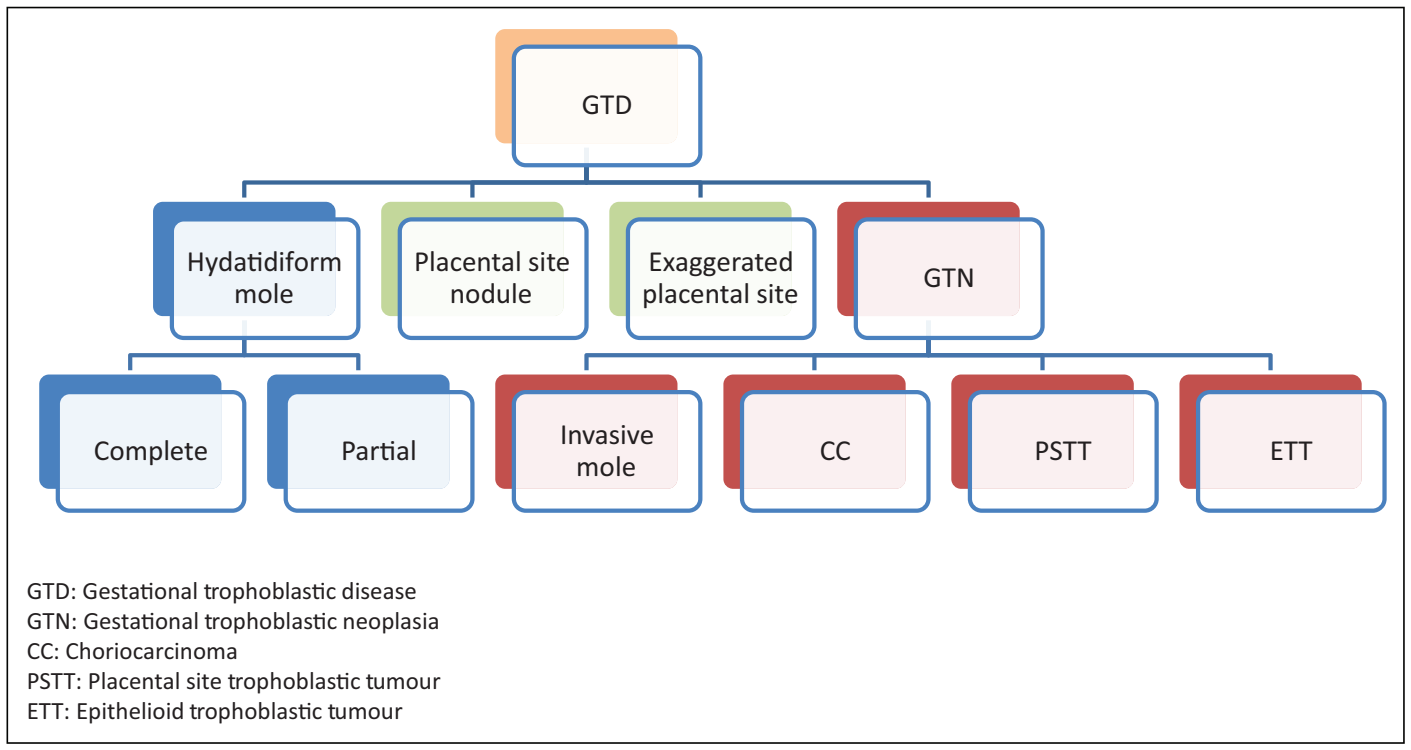
Gestational Trophoblastic Disease (GTD) Classification
Complete Hydatidiform Mole
An androgenetic gestation devoid of maternal chromosomes, formed by the fertilization of an enucleated ovum by a single sperm (46,XX monospermy) or two sperm (46,XX or 46,XY dispermy), characterized by absent fetal tissue, diffuse trophoblastic hyperplasia, and generalised hydropic swelling showing a classic "cluster of grapes" appearance.
Partial Hydatidiform Mole
A triploid gestation (69,XXX, 69,XXY, or 69,XYY) resulting from the dispermic fertilization of a normal haploid ovum, characterized by focal trophoblastic proliferation, scalloped chorionic villi with a "Swiss cheese" appearance, and the presence of nonviable embryonic or fetal tissues.
p57KIP2 Immunohistochemistry
A diagnostic nuclear biomarker encoded by the maternally expressed and paternally imprinted gene CDKN1C, which is absent in the villous stroma and cytotrophoblast of androgenetic complete hydatidiform moles but expressed in partial hydatidiform moles and hydropic abortuses.
Familial Recurrent Hydatidiform Mole
A rare autosomal recessive disorder associated with biallelic mutations in NLRP7 or KHDC3L, which disrupts maternal imprinting and causes recurrent diploid biparental complete hydatidiform moles that necessitate donor egg in vitro fertilization for a viable pregnancy.
Quiescent Gestational Trophoblastic Disease
A premalignant state characterized by stable, low-level elevations of serum total hCG (typically around 55mIU/mL and <1000mIU/mL) for ≥3 months without a downward or upward trajectory and with no demonstrable pelvic or metastatic disease on clinical imaging.
Phantom hCG
A false-positive serum human chorionic gonadotropin measurement caused by non-specific interference from circulating human heterophile antibodies; it is confirmed when a concurrent urine hCG test is negative.
FIGO Staging for GTN
An anatomical staging framework for gestational trophoblastic neoplasia consisting of four stages: Stage I (disease strictly confined to the uterus), Stage II (extension outside the uterus limited to genital structures), Stage III (pulmonary metastases with or without genital involvement), and Stage IV (all other distant metastatic sites, such as brain or liver).
Modified WHO Prognostic Scoring System for GTN
A risk-assessment algorithm adapted by FIGO that incorporates age, antecedent pregnancy, interval from pregnancy, pretreatment hCG, largest tumor size, metastatic sites, number of metastases, and previous failed chemotherapy to categorise GTN into low risk (≤6), high risk (≥7), and ultrahigh risk (≥12 or ≥13).
EMA-CO
A multi-agent systemic chemotherapy regimen for high-risk gestational trophoblastic neoplasia comprising etoposide, methotrexate, and dactinomycin administered on Days 1 and 2, followed by cyclophosphamide and vincristine on Day 8, alongside folinic acid (leucovorin) rescue.
Placental Site Trophoblastic Tumour (PSTT)
A rare malignant gestational trophoblastic neoplasm arising from intermediate trophoblasts at the placental bed that characteristically secretes low concentrations of hCG, exhibits relative insensitivity to chemotherapy, and is primarily treated with surgical extirpation via hysterectomy.
Recurrent Pregnancy Loss (RPL)
The spontaneous loss of two or more pregnancies prior to 20 weeks of gestation, including consecutive or non-consecutive clinical losses, biochemical losses, and pregnancies of unknown location, while excluding confirmed ectopic and hydatidiform molar gestations.
Biochemical Pregnancy Loss
A spontaneous pregnancy demise diagnosed exclusively on the basis of a transient rise and subsequent fall in serum or urinary β-hCG concentrations without ultrasonographic confirmation of an intrauterine or extrauterine gestational sac.
Chronic Endometritis (CE)
A persistent endometrial mucosal inflammatory condition linked to pathogenic bacterial colonization and proinflammatory cytokine production, diagnosed by identifying ≥3–5 stromal plasma cells per 10 high-power fields via Syndecan-1 (CD138) immunohistochemical staining on a luteal-phase biopsy.
Antiphospholipid Syndrome (APS) in RPL
An acquired autoimmune thrombophilia defined by high-titre antiphospholipid antibodies (anticardiolipin, anti-β2-glycoprotein 1, or lupus anticoagulant) accompanied by recurrent pregnancy loss or vascular thrombosis, managed antepartum with low-dose aspirin and prophylactic heparin.
Preimplantation Genetic Testing (PGT) in RPL
An embryonic biopsy and cytogenetic screening technique coupled with in vitro fertilization utilized for couples with balanced reciprocal or Robertsonian translocations to select structurally balanced or euploid embryos, reducing time to live birth and decreasing miscarriage frequency.
Early Pregnancy Assessment Clinics (EPACs)
Dedicated outpatient clinical services delivering specialized, trauma-informed, and expedited diagnostic evaluation (including ultrasound and serial biomarker surveillance) for individuals experiencing complications of early pregnancy.
Sperm DNA Fragmentation (DFI)
An assessment of paternal reproductive integrity measuring breaks in sperm chromatin; elevated fragmentation rates are correlated with recurrent pregnancy loss and are linked to advanced paternal age, elevated BMI, varicocele, and toxicant exposure.

M6 Decision Support Model
A validated two-step regression triage protocol for pregnancies of unknown location that incorporates initial serum β-hCG, a 48h β-hCG ratio, and baseline progesterone to risk-stratify cases into high risk (≥5% probability of ectopic pregnancy) versus low risk (probable failed PUL or probable intrauterine pregnancy).
Pregnancy of Unknown Location (PUL)
A transient clinical classification denoting a patient with a confirmed positive serum β-hCG in whom transvaginal ultrasonography identifies neither an intrauterine pregnancy nor an extrauterine gestational structure.
Persistent Pregnancy of Unknown Location
A classification where serial serum β-hCG levels remain sustained or plateau without spontaneous resolution, and repeated transvaginal ultrasound evaluations consistently fail to visualize an intrauterine or extrauterine gestation.
Salpingotomy
A conservative laparoscopic or open surgical intervention in which a linear antimesenteric incision is made along the fallopian tube to evacuate an ectopic gestation while preserving the tubal architecture.
Salpingectomy
The definitive surgical extirpation of the affected fallopian tube bearing an ectopic pregnancy, carrying negligible risk of persistent trophoblast compared to salpingotomy.
Spiegelberg's Criteria
Four historical criteria required to diagnose an ovarian ectopic pregnancy: an intact ipsilateral fallopian tube, a gestational sac residing entirely within the ovary, an ovary connected to the uterus via the utero-ovarian ligament, and histological demonstration of ovarian tissue in the specimen wall.
Timor-Tritsch Criteria
Three ultrasonographic diagnostic parameters for an interstitial (cornual) ectopic pregnancy: an empty uterine cavity, a gestational sac situated >1cm from the lateral boundary of the uterine cavity, and a surrounding myometrial wall thickness of <5mm.
Interstitial Line Sign
A precise, hyperechoic ultrasonographic line visible in the cornual region running from the endometrial canal toward the interstitial ectopic mass, representing the interstitial segment of the fallopian tube.
Sliding Organ Sign
A dynamic transvaginal ultrasound manoeuvre in which pressure is applied to the cervix: sliding of the gestational sac indicates an ongoing spontaneous abortion in transit through the endocervical canal, whereas fixity confirms a true cervical ectopic pregnancy.
Cesarean Scar Pregnancy (CSP)
An ectopic blastocyst implantation within the myometrial defect of a prior hysterotomy scar, subclassified into Type I (endogenic growth toward the uterine cavity) and Type II (exogenic deep invasion into the anterior myometrium toward the bladder).
Heterotopic Pregnancy
The rare simultaneous presence of an intrauterine gestation alongside one or more coexisting extrauterine ectopic gestations, occurring in approximately 1 in 30000 spontaneous conceptions and up to 1 in 1111 assisted reproductive technology pregnancies.
Cornuotomy
A surgical incision directly into the myometrium over an interstitial or cornual pregnancy to excise the gestational tissue without performing full wedge resection of the uterine cornu.