Addition and Condensation Polymers: Structures, Properties, Uses & Reactions
 Call Kai
 Learn
 Practice Test
 Spaced Repetition
 Match
 Flashcards
 Knowt Play
1/25

There's no tags or description
Looks like no tags are added yet.
26 Terms
What is the structure of LDPE?
[-CH₂-CH₂-]ₙ with highly branched chains.

What are the properties of LDPE?
soft and flexible due to branching
What is a common use of LDPE?
Squeeze bottles due to flexible walls.
What is the structure of HDPE?
[-CH₂-CH₂-]ₙ with mostly linear chains and little branching.
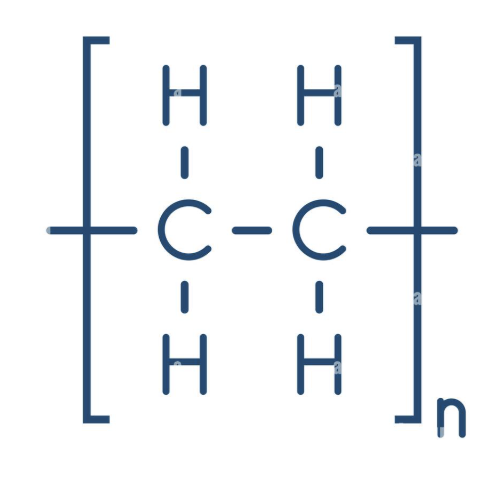
What are the properties of HDPE?
Denser, stronger, more rigid, and has a higher melting point than LDPE.
What is a common use of HDPE?
Rubbish bins as its rigid and durable
What is the structure of PVC?
[-CH₂-CHCl-]ₙ with polar C-Cl bonds that produce dipole-dipole attractions.

What are the properties of unplasticised PVC?
Rigid and durable; adding plasticisers makes it softer and more flexible.
What is a common use of unplasticised PVC?
Rigid water pipes.
What is the structure of polystyrene (PS)?
[-CH₂-CH(C₆H₅)-]ₙ with bulky benzene side groups.

What are the properties of solid polystyrene?
Rigid and brittle
What is a common use of solid polystyrene?
Rigid CD cases.
What is the structure of PTFE (Teflon)?
[-CF₂-CF₂-]ₙ with fluorine atoms surrounding the carbon backbone.
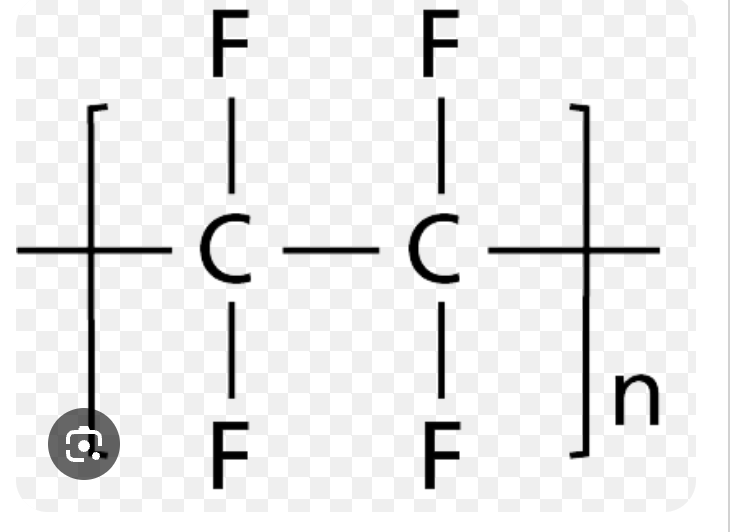
What are the properties of PTFE?
High melting point, -
unreactive, and
non-stick.
What is a common use of PTFE?
Non-stick frying-pan coating.
What is the structure of Nylon 6,6? just say what links
[-NH-(CH₂)₆-NH-C(=O)-(CH₂)₄-C(=O)-]ₙ with amide links. (condensation)
What are the properties of Nylon 6,6?
High tensile strength
high melting point due to hydrogen bonding.
What is a common use of Nylon 6,6?
Ropes due to its high tensile strength.
What is the structure of PET (polyester)? Just say what links it has
[-O-CH₂-CH₂-O-C(=O)-C₆H₄-C(=O)-]ₙ with polar ester links. (condensation)
What are the properties of PET?
Strong and lightweight
What is a common use of PET?
Soft-drink bottles.
What is addition polymerization?
Unsaturated monomers join by reaction of their C=C bonds without eliminating small molecules.
What is condensation polymerization?
Monomers with suitable functional groups join, eliminating a small molecule like water.
What is the difference between crystalline and amorphous regions in polymers?
Crystalline is regularly arranged, closely packed;
amorphous lack order.
What is the effect of plasticisers on polymers?
They reduce effective interchain attractions and increase flexibility.
What is vulcanisation?
Heating rubber with sulfur to form covalent cross-links, improving strength and elasticity.