lec 2 systems thinking
 Call Kai
 Learn
Learn Practice Test
 Spaced Repetition
 Match
Match Flashcards
 Knowt Play
1/18

There's no tags or description
Looks like no tags are added yet.
Name | Mastery | Learn | Test | Matching | Spaced | Call with Kai | Chat |
|---|
No analytics yet
Send a link to your students to track their progress
19 Terms
system
set of interacting or interdependent components forming an integrated whole/collective entity
elements/components
entities, state variables, or reservoirs

linkages/couplings
relationships, connections or flows linking elements
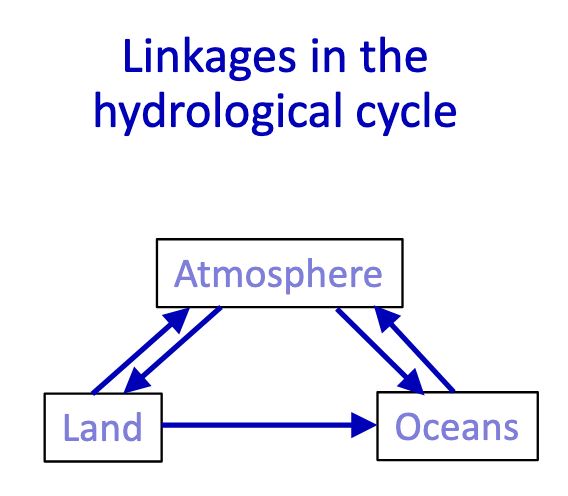
boundaries
where the system ends (earth for the hydrological cycle example)
open system
porous boundary allowing inputs and outputs
closed system
non-porous boundary, rarer than opens
simple system
few, linear relationships with predictable outcomes
complicated systems
linear relationships and loops, carefully predictable outcomes
complex systems
many nonlinear branching relationships and loops, resilient but surprises occur, has subsystems
qualitative systems
deal with linked concepts e.g. social groups, circumstances
quantitative systems
deal with linked measurable quantities of components and transfers between them
change in element's state depends on
balance between input and output
component sources (I)
inputs/net inflows, units per unit time
component sinks (O)
outputs/net outlows, units per unit time
element (E)
quantity in a reservoir, units of stuff
dE/dt =
I - O
system is in steady state if
I = O for elements such that E will not changet
transient state
if there is any difference in I and O
systems easier to understand in steady state because
we don't have to worry about changing inputs or outputs