4 Macromolecules: Carbohydrates, Lipids, Proteins, and Nucleic Acids
 Call Kai
 Learn
 Practice Test
 Spaced Repetition
 Match
 Flashcards
 Knowt Play
1/22

There's no tags or description
Looks like no tags are added yet.
23 Terms
Carbohydrates
These are sugars and starches. They are all composed of only three atoms: CHO, in a ratio of 1:2:1.
Three types of these which are:
1. Monosaccharides
2. Disaccharides
3. Polysaccharides

Lipids
Composed of CHOP.
Energy-rich organic compounds, such as fats, oils, and waxes. Supply long-term energy and are primary source of fat in the body.
Proteins
Composed of CHON.
All are composed of the same twenty amino acids.
Make up more than 50 percent of the dry mass of cells in the body.

Nucleic Acids
Composed of CHOPN.
DNA and RNA. The genetic information within cells that determines what we look like. Composed of nucleotides.

Monosaccharides
Single sugar molecule. Simplest forms of carbohydrates. Glucose, fructose, and galactose. Examples include corn syrup and maple syrup.
Disaccharides
Double sugar molecules. Require some digestion to break them into two one-sugar units for absorption. Example is table sugar.
Polysaccharides.
Carbohydrates having three or more sugar molecules.Two types called structural (cellulose) and storage (starch) polysaccharides.

Polymers
Large molecules composed of many identical or similar subunits called monomers.
Starch
A polysaccharide formed by plants as a way to store the large amounts of glucose produced during photosynthesis.
Animals are able to break down starch into individual glucose molecules.
Cellulose
A polysaccharide made up of glucose, is a very strong material that serves as the primary structural component of plants.
Most animals are not able to break cellulose down into glucose. Is in the food that we eat and serves as dietary fiber that regulates digestion.
Glycogen
The polysaccharide that animals and fungi use to store excess glucose molecules from their food.
It serves as an energy reserve that can be broken down into individual glucose molecules when they are needed.
Chitin
A structural polysaccharide made up of glucose molecules.
Found in the exoskeletons of arthropods such as insects, spiders, lobsters, and crabs. These protective exoskeletons cannot be digested by animals.

Triglycerides
The fatty acids in most foods and in the body occur in the form of these.
Circulate in the blood and are made up of three fatty acids attached to a glycerol.

Phospholipids
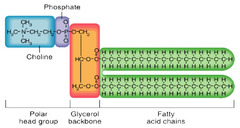
Have two fatty acids and one phosphate group bonded to the glycerol molecule.
Having a phosphate group instead of the third fatty acid gives phospholipids a hydrophilic end and a hydrophobic end to the molecule.

Hydrophobic
Lacking affinity for water. Tending to not mix well with water.
Amino Acids
Building blocks of protein.
Compounds with an amino group on one end and a carboxyl group on the other end.

Enzymes
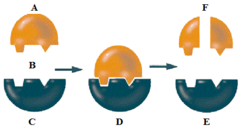
Special proteins that increase the rate of a reaction by decreasing the amount of energy needed to get a reaction started. End in -ase.
Biological catalysts, molecules that increase the speed of a reaction without being used up in the reaction.
Nucleotides
Basic units of DNA molecule, composed of a sugar, a phosphate, and one of 4 DNA bases.
DNA
Known as deoxyribonucleic acid. A long linear polymer found in the nucleus of a cell and formed from nucleotides and shaped like a double helix. Sugar is dioxyribose.

RNA
Ribonucleic Acid. Sugar is ribose. Single stranded.The material involved in protein synthesis. Has three types which are messenger, transfer, and ribosomal.

Saturated Fats
Fatty acid chains lack double bonds; therefore, the chains pack tightly, solid at room temp and bad fats, major source is animals

Peptide Bond
The chemical bond that forms between the carboxyl group of one amino acid and the amino group of another amino acid.
A covalent bond that links amino acids together.
Unsaturated Fats
Fats that contain one or more double bonds between carbon atoms, liquid at room temp, from plants rapeseed, olive etc.. Fish oils shown to lower blood pressure
