Biology
 Call Kai
 Learn
 Practice Test
 Spaced Repetition
 Match
 Flashcards
 Knowt Play
1/34

35 Terms

Punnett Square
diagram showing the gene combinations that might result from a genetic cross

monohybrid cross
a cross that involves one pair of contrasting traits
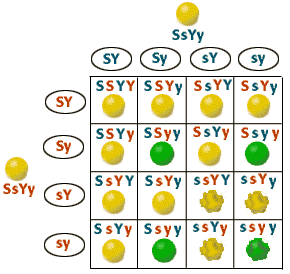
dihybrid cross
a cross involving two traits
allele
different forms of a gene
gametes
reproductive cell
somatic cells
any cells in the body other than reproductive cells
phenotype
an organism's physical appearance, or visible traits.
genotype
an organism's genetic makeup, or allele combinations.
dominant trait
a genetic factor that blocks another genetic factor
recessive trait
a trait that is apparent only when two recessive alleles for the same characteristic are inherited
heterozygous (hybrid)
having two different alleles for a trait
homozygous (purebred)
having two identical alleles for a trait
codominant
two genetic traits are fully expressed and neither dominates
incomplete dominance
one allele is not completely dominant over another allele
sex-linked traits
traits that are inherited with sex chromosomes
mendelian trait
a trait completely determined by a single gene
non mendelian trait
traits that are not determined by dominant and recessive alleles and can involve more than one gene
independent assortment
the random distribution of genes on different chromosomes to the gametes
crossing over
the exchange of genes between homologous chromosomes, resulting in a mixture of parental characteristics in offspring.
meiosis
a type of cell division that results in four daughter cells each with half the number of chromosomes of the parent cell
haploid (n)
having a single set of unpaired chromosomes
diploid (2n)
contain 2 copies of each chromosome
autosome
any chromosome that is not a sex chromosome
homologous chromosomes
pair of chromosomes that are the same size, same appearance and contain the same genes
sister chromatids
replicated forms of a chromosome joined together by the centromere and eventually separated during mitosis or meiosis II.
phenotypic ratio
the ratio of phenotypes that could appear in offspring
genotypic ratio
the ratio of the genotypes that appear in offspring
chromosome
a threadlike, gene-carrying structure found in the nucleus
law of segregation
pairs of alleles for a trait separate when gametes are formed during meiosis
chromatid
one half of the chromosome
autosome
chromosome that is not a sex chromosome
Meiosis I
The first division of a two-stage process of cell division that results in cells with half the number of chromosomes as the original cell; crossing over occurs in Meiosis I
Meiosis II
the second phase of meiosis consisting of chromatids separating, along with the two diploid cells splitting in two
F1 generation
the first generation of offspring obtained from an experimental cross of two organismssexual reproduction (meiosis)
sexual reproduction (meiosis)
one division twice to make four genetically different cells
all 4 cells are haploid cells (n) meaning they have 1/2 of the chromosomes of the parent cells
makes gametes
