GENE223 Mod 4 - Biotechnology + Maori beliefs
 Call Kai
 Learn
 Practice Test
 Spaced Repetition
 Match
 Flashcards
 Knowt Play
1/70

There's no tags or description
Looks like no tags are added yet.
71 Terms
What is an example of a negative stereotyping on the Maori population?
Warrior gene saga -> negative stereotyping of Māori based on nonsignificant differences on MAO-A variant frequencies.
Describe the importance of Māori concepts of hereditary inheritance in Te Ao Māori
Concepts of whakapapa are important, ones ancestry and family tree is a part of them, so often this knowledge itself is taonga. An organisms genetic information is a part of it and belongs to it. A big no-no is crossing the lines between species or kingdoms, as they belong to different domains, under different atua.
What is heterologous protein expression? And why is it done?
The expression of a gene in a host organism that doesn't naturally have it. This is a super common method of gene editing for industrial purposes, to help produce chemicals at far more efficient rates than others.
what are the genetic features of GE yeast that make them useful compared to bacteria - including post-translational modifications
Yeasts are simple eukaryotic organisms with the following cell features that make them useful:
They have a nucleus and membrane, bound organelles
Endoplasmic Reticulum (rough, ribosomes) Major site of protein synthesis
Golgi Apparatus - Storage, packaging, sorting and modification of proteins before exportation\
Vesicles for Transport.
Yeasts follow the general eukaryotic post-translational modification pattern of expressed proteins, bacteria do not. In yeast we can do PTM’s on our products which is very important.
What are the genetic and production advantages of Yeast for gene-editing
Production
Easy to grow in bioreactors
Using established fermentation technology
Can secrete proteins
Genetics
Easy isolation and selection of mutants
Small genome size with whole sequence determined
Host-vector system established
Many characterized strains
Decsribe the advantages due to genetic structure of an alternative yeast used in GE
Pichia Pastoris is a methylotroph which has a promoter for its AOX (aox1 gene), which is tightly regulated and induced by methanol. Very high levels of expression (typically >30% of the total soluble protein). We can put production genes of interest like insulin downstream of the promoter, the protein of interest is produced as a fusion product to the secretion signal from S. cerevisiae.

What is the biggest disadvantage with using yeast to produce proteins for human medicine?
Yeast often have more simple glycosylation patterns on their proteins, so absorption may not be perfect, and a lot of more complex proteins are not able to be made in yeast cells.
What is one use of GE yeast that is not strictly for medicinal purposes being researched heavily for the future?
One big aim with GE yeast is to make it break down cellulose (the most common biomolecule in the world) to turn it into usable energy for fuel.
What is genetic engineering and what are the base requirements?
Is the process of altering an organisms DNA - typically including the
addition of DNA from another organism – e.g., transgenesis
The gene is on a plasmid, delivered into the cell.
In the cells the plasmid can be stable or the DNA can be randomly incorporated into the host genome.
Also need a selectable marker – e.g., gene encoding antibiotic resistance to select for cells that have taken up the DNA
What are common uses for genetic engineering and one example of each?
1. Heterologous protein expression - introduction of a gene from one organism to another, transcription and translation of gene e.g. insulin production or Bt corn, the cry gene being put in to hurt insects.
2. Transgenesis but not protein production
For example: virus resistant papaya (viral gene (encoding coat protein) into plants
What is genome editing
A precise technique that makes targeted changes within an organism’s DNA
Does not have to involve the transfer of DNA from one organism to another
What are the techniques used for genome editing?
CRISPR-Cas9
you would need:
• To design guide RNAs (near PAM sites)
• Cas9 or other Cas-like protein
Describe the cellular process of CRISPR Cas-9 splicing
Once released into the organism:
CRISPR Cas9 searches the DNA for a PAM binding site (3 nt’s long specific to every Cas9 protein)
If PAM is found, Cas9 binds and forms an R-loop with the DNA
Cas9 generates a double stranded DNA break
The DNA is left for repair by other enzymes, and incorrect repair of the ds DNA can knock out genes
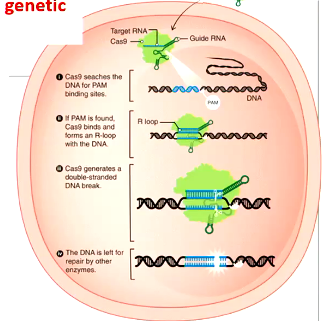
What is the actual mechanism that knocks out genes using CRISPR Cas9?
Non-homologous end joining is the main way that genes are knocked out. DNA is repaired by an error-prone system - either by adding or removing bases - so that the gene can no longer be translated.

What are the added elements and the process that allow the use of Cas9 knockout to insert different regions into genes or completely new genes?
Need to add:
gRNA and Cas protein donor DNA (pink) with flanking DNA that matches the location of insertion, and the DNA repair system is likely splice it in to fill the gap.

What are the advantages and downside of the CRISPR-Cas9 system? (4)
Specificity is provided by the guide RNA
Rapid, straightforward, cheap
Works in a broad range of organisms
BUT potentially more off-target effects

Contrast Genome editing vs Genetic Engineering results
Genetic engineering results are less predictable in terms of where DNA is inserted and can give unexpected phenotypes
Genome editing can have off-target effects
Genome editing can be used for the targeted alteration of one or a few nucleotides
Genetic engineering can not be targeted in the same way
Genome editing can produce novel plants – these plants can be similar to plants produced using methods that are not considered engineering, such as use of chemical mutagens or exposure to radiation.
Genome editing has a broader potential host range – but is still challenging
High-throughput sequencing can be used to evaluate this in both cases
Describe the process and use of Base editing
Base editing can generate targeted point mutations without Double stranded DNA break
• A modified Cas (nCAS) produces a single-stranded break
• nCas is fused to an enzyme (deaminase) that modifies a single nucleotide
• The resulting base mismatch is then resolved through cellular repair mechanisms
• Potential to treat genetic disorders by correcting single nucleotides, which represent the largest class of human pathogenic genetic variant

Give a simplified plan for heterologous protein production using GE
Isolate Gene of Interest
Insert gene of interest into cell
Grow cells in a bioreactor
Purify protein of Interest
Fill/package protein of interest
What are the four main platforms for heterologous protein production
• Microbes – bacteria and yeast
• Insect cell lines
• Mammalian cells line and mammals
• Plant cell lines and plants
Give an example of heterologous protein production to make antibodies in plant platforms
Making Secretary Immunoglobulin (SIgA) in plants: May be useful for passive immunotherapy. Secretary Immunoglobulin is a complex protein, requiring many genes to express its peptides. A plant that could express the full functional protein was made by selectively crossing transgenic plants, all transformed with one gene for one of the peptides for the protein, so the final offspring from the crosses could produce functional SIgA
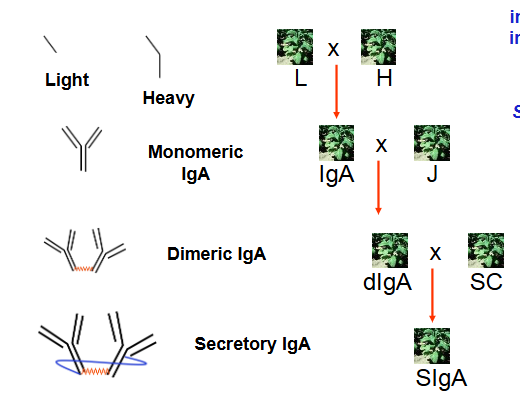
What are the dis/advantages of producing antibodies in transgenic plants
Advantages
High yield, low cost
Can use existing infrastructure
Eukaryotic folding and processing – need to test these for each protein
Disadvantages
Containment
Glycosylation patterns are plant-specific – can modify for plant host genes involved in glycosylation
Herbicide, pesticide contamination
What is an example of heterologous proteins being made in mammalian cell lines?
A gene encoding an enzyme that breaks down hyaluronan (HA) which is part of the ECM of cells and blocks antibody injections, called PH20. They expressed this gene in CHO cells (for glycosylation) to make a product that can make cells more viable to uptake exogenous antibodies.
What were the changes made to the transgenic PH20 gene in CHO that made it better suited for infusing people with heterolously produced antibodies?
• Kept ZPRD (A recognition domain for a bacteria) as was important for stability of protein
• Kept signal peptide for targeting to ER and golgi for glycosylation
• Removed GPI anchor so not membrane bound and can be secreted

What is an alternative to integrating into plant genomes to produce lots of heterologous protein?
Transient transfection using Agrobacterium, so more like plasmid transformation into bacteria. This does not integrate the gene of interest into the plant genome so is not germline, but is much quicker and so in a rush can be very effective.
How did we make transgenic Bt corn?
Bt corn has transgenic proteins from Bacillus thuringiensis is a soil bacterium that synthesises an insecticidal crystal protein. This allows it to produce this insecticide naturally, decreasing requirements for insecticides which are enormously expensive.
What are some specific advantages of Bt corn?
The toxins produced by different strains of Bacillus thuringiensis are specific for certain insect types
The insecticide they produce is natural and much less harmful to humans and other animals than pesticides/insecticides
Describe the early work of expressing CRY proteins in maize and the problem they ran into
Researchers transformed maize with a truncated cry gene, keeping only the sequence for Domains I (membrane insertion and pore formation) II, and III (both for receptor binding), which is all that is required for toxin activity. Truncated genes were expressed in maize, conferred some insect resistance in the lab., but toxin levels were not high enough to work with plants in the field. Changing promoters and/or leader sequences had no significant effect on expression
When transforming cry genes into Bt corn for the first time, why were CRY protein expression levels low? (4)
It is due to the plants different genetic environments:
Plant processing:
1. Unwanted polyadenylation signal within the coding region– cleavage of RNA and addition of polyA tail
2. localised A+T rich regions resembling plant introns, causing Potential splicing of mRNA
3. ATTTA sequences (destabilises mRNA) causing Potential DNA degradation
4. Codon usage bias:
differences in the frequency of occurrence of synonymous codons
in coding DNA between different organisms
Introducing infrequently used codons into an organism can reduce protein expression (less tRNA of the rare ones)
What are the two approaches taken in the process of making the first Bt corn to increase CRY protein expression and their effect on CRY expression
1) PM (partially modified): Remove DNA sequences predicted to inhibit efficient expression of either the mRNA or protein by site-directed mutagenesis. This caused a 5-10 fold increase in expression
i.e., partially modify (PM) the gene while minimising changes in the amino acid sequence.
2) FM (fully modified): Major changes in the DNA sequence. This caused a 100-fold increase in expression
i.e., produce fully modified (FM) synthetic genes
What are 3 problems associated with transgenic Bt corn?
• Resistance - will insects become resistant to Bt?
• Pollen - will the transgenes escape?
• Will the Bt alter Butterflies/soil fauna
What is introgression?
“permanent incorporation of genes from one differentiated
population into another compatible population via hydridization and
backcrossing over multiple generations”
How would transgene escape occur in plants?
Cross-pollination of weedy relatives could result in the formation of hybrids containing the transgene, and this may result in transgene introgression
What are the some optimistic signs against the risks of transgene escape of herbicide resistance?
HR doesn't necessarily translate into increase in weediness
HR gene only a selective advantage to the plant if you spray the herbicide
So transgenic weeds can still be killed with other herbicides.
Describe some of the risks and considerations of the transgenic salmon escaping farms example
There are three gene flow scenarios
– Purging (GMO has lower net fitness) - safest
– Spread (GMO has equal or higher net fitness, muddy gene pool)
– Trojan gene (GMO has mating advantage but transgene decreases fitness and triggers population decline)
What is one popular method to ensure containment of gene flow via pollen that takes advantage of maternal inheritance?
The maternal inheritance of chloroplast DNA is common in many crop plants.
Maternal inheritance of transgenes offers biological containment by stopping gene flow through pollen.
Describe the process of transforming chloroplast DNA
Single or multigene vectors can be made, Particle bombardment is used to introduce DNA
A selectable marker is required
At least 2 rounds of selection are required to select for homoplasy (successful gene transformation)
This is the bottleneck!
There are no commercially grown crops with engineered chloroplasts
What is the most common and least effective method of containment for transgene escape?
Spatial containment is the main method used today, keeping transgenic crops isolated so their pollen doesn’t spread and hybridise with wild species, passing on the transgenes
Describe the B/B biocontainment strategy for transgene escape
Engineering pollen sterility by transforming the barnase gene from Bacillus amyloliquefaciens. The enzyme barnase is a ribonuclease – it cleaves the RNA. No pollen produced. Fertility restored by crossing with genetically engineered plant to express barstar which represses barnase.
How is pollen inviability due to genetic engineering to prvent transgene escape rescued to restore fertility to plants?
Fertility restored by crossing with genetically engineered plant to express barstar which represses barnase (barnase protein cleaves pollen RNA). Viable pollen as the barnase and barstar genes are both transcribed and then translated into protein and barnstar binds barnase and inactivates it.

Outline the concept of terminator technology for gene escape prevention, with an example
IDEA: Construct a terminator gene that makes seeds that are not viable
Isolate a promoter from a gene produced late in embryo development (after the seeds have formed)
Example: Late Embryogenesis Abundant (LEA) gene.
Attach the LEA promoter to a gene that produces a toxic product, for example, a Ribosome Inhibitor Protein (RIP) gene. You then have a protein that is expressed only in the last stage of development.

Describe the three genetic elements that a plant must be transformed with so its seed viability can be turned on and off using terminator technology
A terminator gene where the blocker is flanked by recombinase recognition site
A recombinase gene with upstream tetO DNA sequences. The recombinase gene cannot be activated if TetR repressor protein is present. When the recombinase gene is active the blocker DNA is removed from the toxic gene construct and fertility can be expressed in the later phase of seed development
A gene that continually makes TetR repressor protein. The repressor protein blocks the expression of the recombinase gene
How is seed fertility turned on or off in transgenic plants containing terminator technology?
Treatment with tetracycline mars the active site of the tetO sequences, meaning that TetR cannot bind to it. This means recombinase protein is produced and it recognises the recombination sites on a blocker protein and excise it. This allows for expression of the toxic product gene, by the LEA promoter which only expresses late in development, rendering seeds inviable.
What is the main two platforms being used for Biotech currently?
Uses CRISPR Technology
Another such tool is SHARC™, a proprietary enzyme that works well for cutting, base editing, and REDRAW editing, and is becoming the foundation for a proprietary genome editing too
“Proprietary tool is REDRAW™, a precise templated editing toolbox that can make any type of small edit at CRISPR-targeted sites.
What are benefits to different groups from potential applications of Biotech strategies
For the consumer: Tastier, Improved nutrition
For the farmer: Higher yield
Name the 5 crops that biotech company Cibus mainly works on, and the five traits that Cibus works on augmenting
Top 5 crop plants in america:
Rice
Wheat
Soybean
Canola
Corn
Cibus augments them by:
Fungal disease resistance
Weeds
Insects/Nematodes
Nutrient use efficiency
Agronomy (environment protection)
How has Aotearoas regulating of Genome Edited organisms changed over time?
1930s – Chemical techniques and ionising radiation start to be used to accelerate the rate of genetic change.
• 1998 – Regulations under the HSNO Act specify that organisms resulting from the use of chemical or radiation treatments in use before 1998 are not genetically modified.
• 2001 – Royal Commission on genetic modification finds that the basic institutional structures and regulatory framework for dealing with genetic modification technologies is appropriate, needing only fine-tuning, which takes place in 2003.
• 2019 – New Zealand established a panel to consider the implications of gene editing -suggest GMO and non-GMO categorisation is not enough
What are the three parts of producing GMO’s that are regulated on an international stage?
1. Process: regulation applies to GMO products and products from using GMO at any stage of the production process;
2. Product: regulation of products with GM and/or novel traits and require safety assessments on GM foods before being approved for release in market;
3. Hybrid: products resulting via NBTs are exempt from GMO regulatory restrictions that apply to GMOs (i.e. the presence of transgenic material).
Why is it possible to buy products in new zealand that say they may contain some GMO ingredients when the HSNO act bans this?
Some processed foods may contain GMO crops that have changes made that are indistinguishable from crops that could mutate this way in the wild, so there is no way to test for GMO in this way. This means the EPA cannot necessarily ban all GMO crops, so they require food companies to display if food possibly could contain GMO’s, so consumers can still be informed.
What is synthetic biology?
“Synthetic biology involves the design and construction of novel artificial biological pathways, organisms and devices or the redesign of existing natural biological systems.”
What is an example of a rudimentary synthetic biology technique done by a company today?
Impossible Burger, they made fake meat with a plant version of haemoglobin called leghemoglobin, which is produced in legume roots to help them fix nitrogen.
Describe the synthetic biology/genetic engineering done by the researchers to make the Impossible burger?
They added leghemoglobin DNA to Pichia Pastoris which has some strong promoters with the following changes:|
no introns
modified sequence to correct for codon bias
added strong or inducible promoter
added multiple copies to the genome
They tried some different combinations of promoters and found that the strongest promoter actually negatively impacts LegH activity and cell growth.
They also added all 8 genes for the heme biosynthesis pathway under a strong methanol-induced promoter.
What is one practical application of AI use in testing genome editing?
Gene editing
• Predicting off-targets of guide sequences
• Optimizing target sites and guide RNA sequence design, to increase accuracy and reduce off-target effects
• Predicting repair outcomes
What are some examples of AI use in synthetic biology?
• Gene sequence optimisation
Analyze large amounts of genetic data to determine the ideal gene sequences for specific biological systems à synthetic genes with increased efficiency and stability
• Protein design
Predicting protein structure and function according to their amino acid sequences à create new proteins with specific characteristics. E.g., AlphaFold
What are some potential concerns for synthetic biological tools? (5)
Safety and security: could pose a significant threat to national security if it were used for nefarious purposes, e.g., developing new biological or chemical weapons.
Computational: tools used for synthetic biology could be vulnerable to cyberthreats such as automation hacking.
Environmental effects. Organisms made using synthetic biology and released into the environment could have unknown, unintended, and potentially irreversible effects on ecosystems. Effects could be widespread if, for example, these organisms negatively affected food or water systems.
Public acceptance and access. The public may hesitate to accept certain applications of synthetic biology due to concerns about interfering with nature and about unintended effects. In addition, some medical applications could be inaccessible for some patients due to cost or location of treatment centers.
Regulators – experience and expertise
Why do we make gene vectors and gene therapies? (4)
▪ To understand gene function – mis-express or knockdown (RNAi) or knockout (CRISPR-Cas9)
▪ To treat a genetic disease by replacing/adding a functional copy of a defective gene
▪ Provide therapeutic agent to enhance cell survival or growth or to kill unwanted cells (tumours).
▪ To produce useful protein products (cell bioreactors or tg animals/plants)
What are vectors and what are the three main ways we put them into organsism?
Vehicles used to carry material, i.e. DNA or RNA (transgene) into a cell
Can be Non-viral or viral
Transformation (for prokaryotes) vs. Transfection (for eukaryotes) vs. Transduction (using viruses carrying the DNA)
Describe the traits and advantages/disadvantages of Adenoviruses as vectors
▪ DNA virus
▪ Large capacity, 10-30 kb
▪ Fibre-knob can be modified to alter tropism
BUT
▪ Induces a significant immune response
▪ Does not integrate into host genome

Describe the traits and advantages/disadvantages of Adeno-associated viruses as vectors
DNA-dependovirus
▪ Approx 100 serotypes (capsids)
– wide tropism
BUT
▪ Small capacity (4.4kB)
▪ Recombinant vector generally does not integrate, because we had to gut so much of the virus to get the transgene in there
Describe the traits and advantages/disadvantages of retro-viruses as vectors
▪ RNA virus
▪ Medium capacity 10kB
▪ Envelope can be pseudotyped (taken from the organism it infects) to alter tropism
▪ BUT
▪ Wild-type virus causes disease (e.g. HIV)
▪ Inserts randomly, could cause Insertional mutagenesis
Doesn’t work in non-dividing tissue

Describe the basic genes on a transgenic retrovirus genome and their structure
All thats in the transgenic retrovirus is the 5’ and 3’ LTRs and in between them is a promoter and the gene of interest that we transform into there. It used to have genes Env (to make the envelope), Pol (polypeptides production) and Gag (proteins for capsid), but the roles these genes play are taken by the organism we use to produce these viruses.
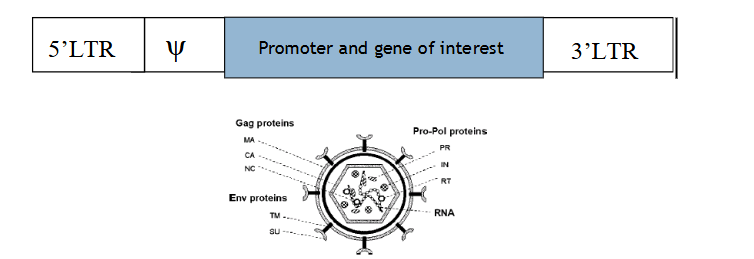
Break down the requirements for successful gene therapy
Requirements for successful gene therapy
• Expression of the target gene - cDNA
• Delivery - targeting viral vector to the right tissue/cells (this is where vector choice is most important, ie we have a blood-brain barrier so a lot of transgenes need to be injected directly.
• Disease natural history and clinical outcome measures
What is the only difference between retroviruses and Lentiviruses
Retroviruses cannot transduce into non-dividing cells, so has to be in areas of high division. This is bad for tissues like the brain that don’t divide much.

What is the tropism of a bacteria/vector?
The tropism of a vector is the set of tissues in an organism that it can affect/transform into.
Why are adenoviruses currently mostly used in cancer treatments?
Adenoviruses cause a significant localised immune response where it transforms into. This usually has deleterious effect for the transformation success rate and the organism health, but when targeted to a tumour, the transformation and the immune response are both helpful.
Describe the molecular basis of haemophilia
Haemophilia occurs when people have loss of function mutations in genes relating to the blood clotting pathway. The most common mutations causing haemophilia occur in Factor 8 and 9, which are cofactors to produce factor 10 which produces thrombin. Thrombin works to recruits platelets and fibrin cords across the cut site that patch it up.
Answer the following questions:
▪ How big is Factor 8?
▪ Does it need regulated expression?
▪ Which tissue/s should it be expressed in?
▪ How should the vector be delivered?
7 kbp
Not necessarily, a constitutive promoter is fine as other parts of the bloodclotting cascade are regulated.
The tissue where it is usually endogenously expressed, so the liver
Using a mid-low strength constitutive promoter that only is expressed in liver tissue.
Lentivirus would be method since it doesn’t require constant cell division. Actual one is AAV
What is the actual delivery mechanism used to produce recombinant factor 8, and why is it unconventional?
Adeno-associated Virus is used to carry the factor 8 genome, even though the normal factor 8 gene is 7 kb and AAV has a max space of 4.4 kb. This is made possible by cutting out lots of contents of F8 gene to still form a functional product, while massively decreasing the length of the gene.
Describe the three phases of clinical trials
1: This trial is with around 30 people, tests if the drug is safe enough to be administered to humans at all
2: more people, measures if the drug has an effect
3: 100-1000s of people, compares the new drug treatment to current drugs.
phases 1 and 2 often combined.
Why do we have a broad spectrum of disease severity when it comes to Spinal-muscular atrophy?
SMN1 encodes survival motor neuron 1 which when mutated would be lethal, except that this gene is flanked by inverted repeats so has been duplicated in the human genome, many times in some people. SMN2 has a mutation causing alternative splicing so only produces about 10% of the survival motor neuron as SMN1. A child born with two SMN2 copies has infantile onset of symptoms, a child with 3 has later onset, and a child with 3-4 may be even later though the kids don’t survive to adulthood. These are associated with Type 1, 2, and 3 SMA.
Compare and contrast the two methods to treat spinal musculature atrophy
ASO - using single stranded RNAs, specifically antisense oligonucleotides that bind to intron 7 of the SMN2 mRNA, preventing splicing of exxon 7. This fixes the cause of the weak production of SMN2’s protein, it usually has its exxon 7 removed, making it much less effective. This restores survival of motor neuron protein presence in a child. $1 million for initial and $125k every 4 months for repeated treatments.
AAV - using an adeno-associated virus, specifically intravenous AAV9 – single dose given over 60 min (repeat not possible currently due to immune response). The promoter drives constant protein production, has to be done before the kid is 2. $2 million USD
