week 7: infectious disease research - study designs & measures of association
 Call Kai
 Learn
 Practice Test
 Spaced Repetition
 Match
 Flashcards
 Knowt Play
1/54

There's no tags or description
Looks like no tags are added yet.
55 Terms
what is a study design?
plan for selecting participants and deciding how + when to collect info to answer a research question
exposure: factor being studied
outcome: health event or condition being measured
exposure vs. outcome examples
exposure may be harmful, protective, or unrelated to outcome
exposure ex: broad-spectrum antibiotic use, influenza vaccination, injection drug use
outcome: c. diff infection, influenza infection, hep c infection
descriptive vs. analytic studies
descriptive studies describe patterns, analytic studies examine associations
descriptive studies: main question, purpose, example
mq: how common is condition? who is affected, where, when?
p: describe disease patterns by person, place, and time
ex: # of influenza cases by age grps
analytic studies: main question, purpose, example, types
mq: is an exposure associated w/ an outcome
p: examine associations
ex: compare influenza occurrence in vaccinated + unvaccinated grps
two types: observational, experimental
observational (type of analytic study)
researchers measure exposures + outcomes without assigning exposure
cross-sectional, cohort, and case-control studies
ex: clinicians choose antibiotic a or b during routine care. researchers compare recovery btwn grps
experimental (type of analytic study)
researchers assign intervention + measure outcomes
ex: randomized controlled trials (RCTs)
ex: researchers randomly assign antibiotic a or b + compare recovery btwn grps
cross-sectional study
researchers sample ppl from defined population
researchers assess exposure + current outcome during same assessment period
ex: during one-day survey, UM nursing students report their usual hand hygien frequency (exposure) + current respiratory symptoms (outcome)
key limitation: researchers usually cannot determine which came first - exposure or outcome
overall: snapshot of exposure + current outcome
common measures of cross-sectional studies
point prevalence
prevalence ratio and prevalence difference
point prevalence (cross-sectional study measure)
proportion w/ outcome at specified point in time
ex: percentage of surveyed UM nursing students who have respiratory symptoms on survey day
prevalence ratio + prevalence difference
compare prevalence btwn exposure grps
ex: compare respiratory symptom prevalence btwn students reporting less frequent + more frequent hand hygiene
cohort study
researchers select + group participants by exposure w/o assigning exposure
researchers compare risk or rate of developing outcomes over defined period
ex: researchers compare risk of developing influenza (outcome) over 12-week period btwn nurses who were vaccinted before that period + those who were not (exposure)
key limitation: grps may differ in age, underlying conditions, or other factors that may affect results
overall: cohort studies compare subsequent outcomes btwn exposure grps
two types of approaches for cohort studies:
prospective studies follow participants into future
occurs after study begins
retrospective reconstruct events from past
already occurred before study begins
both examine outcomes after exposure
example of prospective (approach to cohort studies)
researchers identify vaccinated + unvaccinated nurses now
then follows them for next 12 weeks to compare risk of developing influenza
example of retrospective (approach to cohort studies)
researchers use records to identify vaccinated + unvaccinated nurses at start of completed 12 week period
then compare their risk of dev influenza during that period
common measures of cohort studies
incidence risk
incidence rate
calculate each measure within vaccination grp, then compare grps using ratio or difference
incidence risk: denominator + comparison measure (common measure of cohort studies)
d: people initially at risk
cm: risk ratio and risk diff
% of nurses who dev influenza during 12 week period
incidence rate: denominator + comparison measure (common measure of cohort studies)
d: total person-time at risk
cm: rate ratio and rate diff
new influenza cases per 1000 person-weeks at risk
case-control study
researchers select participants by outcome: cases have outcome + ctrl do not when selected
ctrls come from same population as cases
researchers compare prior exposure btwn cases + ctrls
ex: researchers select nurses who dev influenza during a 12 week period (cases) + sample of nurses from same hospital who did not ctrls. they compare influenza vaccination before that period
key limitation: poor ctrl selection + inaccurate exposure info can distort the result
case-control studies: common measures
exposure odds
odds ratio (OR)
why not risk or rate? researchers select participants by outcome; typical caes-ctrl sample counts do not directly provide population risk, incidence rate, or prevalence
exposure odds (common measure of case-ctrl studies)
# prev exposed ÷ by number of unexposed, calculated separately for cases + ctrls
ex: odds of having received influenza vaccination (exposure)
odds ratio (OR) (common measure of case-ctrl studies)
exposure odds among cases ÷ exposure odds among ctrls
ex: odds of prior vaccination (exposure) among nurses who dev influenza (cases) relative to odds among nurses who did not (controls)
cohort study: starting point, assessment, ex, useful for, common measures
sp: defined group, classified by exposure
a: whether exposed + unexposed participants develop outcome
ex: compare new UTIs (outcome) among patients w/ and w/o catheter (exposure) at baseline
uf: measuring incidence; studying rare exposures or multiple outcomes
cm: risk or rate ratios + differences
case-control study: starting point, assessment, ex, useful for, common measures
sp: cases + ctrls, selected by outcome
a: whether cases + ctrls had exposure before outcome
ex: compare prior catheter use (exposure) among patients w/ UTI (cases) and w/o UTI (ctrls)
uf: studying rare outcomes or several possible prior exposures
cm: odds ratio
randomized controlled trial (RCT)
researchers randomly assign participants by chance (randomization) to an intervention grp or comparison grp
randomization helps balance other factors that may affect outcome
researchers follows both grps + compare outcomes over defined period
ex: researchers randomly assign nurses to receive new influenza vaccine (intervention) or standard influenza vaccine (comparison). they compare new influenza cases over 12 weeks (outcome)
key limitation: missing outcome data (ex: loss to follow up) can bias results
assign intervention by chance, then compare outcomes!
common measures of RCT: frequency measure; denominator + comparison measure
incidence risk: ppl initially at risk
cm: risk ratio + risk diff
incidence rate: total person-time at risk
cm: rate ratio + rate diff
compare incidence risk and incidence rate within each assigned grp (ex: new vaccine vs. standard vaccine), then compare grps using ratio of diff
RCT vs. cohort
both compare outcomes over time
main diff is whetehr researchers randomly assign intervention
RCT: study type, researcher’s role, assessment, common measures
st: experimental
rr: randomly assign intervention
a: outcomes after assigned intervention
cm: incidence risk + rate, ratios + diff
cohort studies: study type, researcher’s role, assessment, common measures
st: observational
rr: record exposure w/o intervention
a: outcomes after observed exposure
cm: incidence risk + rate; ratios + diff
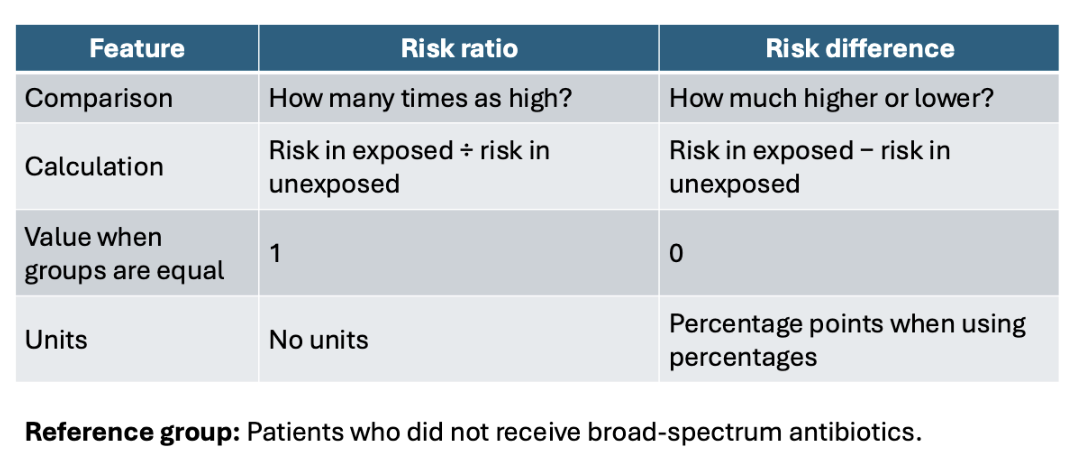
picture of ways to compare grps

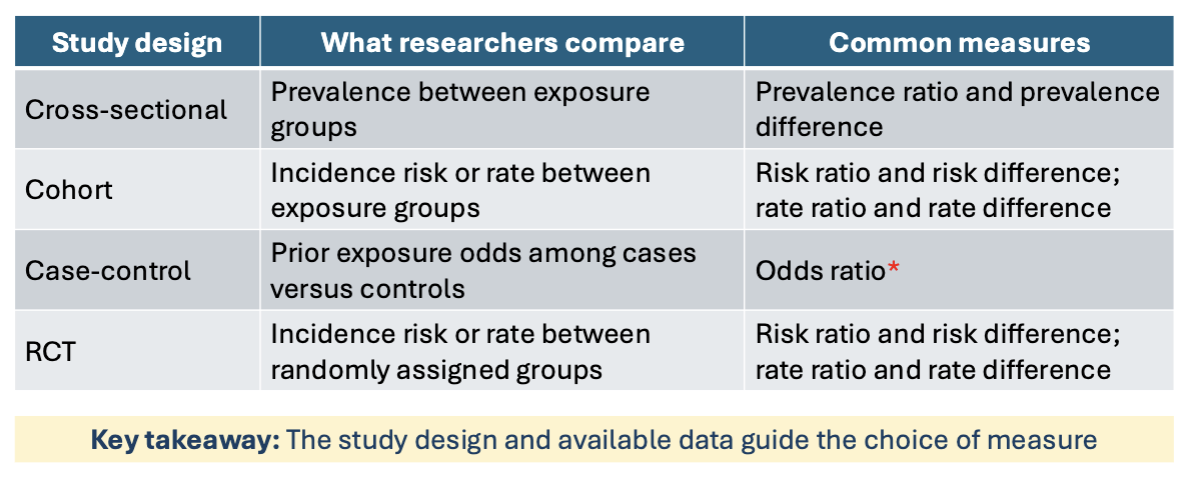
picture of study designs + common measures
picture of comparing prevalence - ratio and diff:

calculating prevalence

picture comparing risk - ratio and diff:
picture of calculating incidence risk:

picture comparing incidence rates - ratio & diff:

picture of calculating incidence rates:

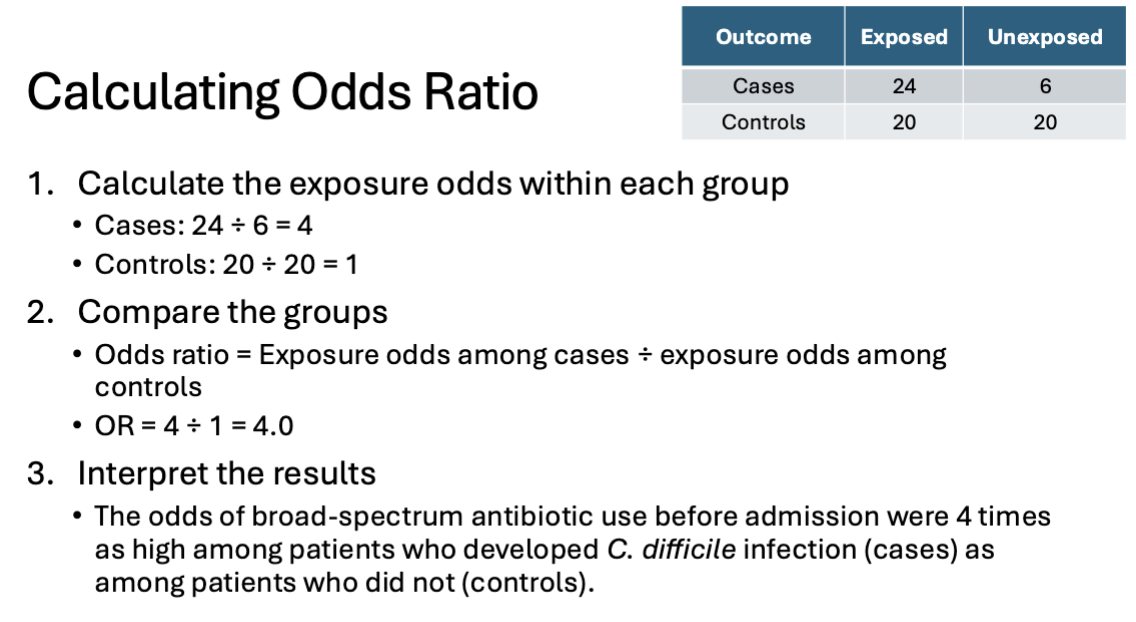
picture of odds ratio ex + interpretation

picture of calculating odds ratio
a clear interpretation of a finding identifies:
measures of association: risk, rate, prevalence, or odds
exposure
grps: who is being compared?
outcome: what condition was measures?
time: when or over what period?
association: meaning + example
observed statistical relationship btwn variables
vaccinated nurses had lower influenza risk than unvaccinated nurses
correlation: meaning + example
type of association describing how 2 numerical variables vary together
hospitals with higher staff vaccination coverage had lwr staff influenza rates
causation: meaning + example
changing an exposure changes the likelihood of outcome
causal claim: vaccination reduces influenza risk
association, correlation, and causation as a whole:
association + correlation describes relationships
neither alone establishes causation
association doesn’t prove causation; what are the three factors to consider?
confounding
bias
chance
confounding: meaning + example
another factor related to both exposure and outcome distorts their association
vaccinated nurses also practiced other infection-prevention measures more consistently, which could contribute to their lower risk
bias: meaning + example
systemic error in participant selection or measurement
unvaccinated nurses were tested more often, so more infections were detected
chance: meaning + example
random variation in findings
more infections occurred in one group by chance, especially in small sample
research ethics, what to consider?
ethical review
informed choice
voluntary participation
privacy and confidentiality
safety
fair selection
ethical review
obtain institutional review board (IRB) review when required
informed choice
explain study’s purpose, procedures, risks, and potential benefits
obtain informed consent when required; for minors, obtain parental/guardian permission and child assent as required
voluntary participation
respect right to decline or withdraw without penalty
privacy and confidentiality
protect participants and their personal information
safety
minimize risk, monitor safety as appropriate, and use an ethically appropriate comparison group
fair selection
select participants fairly + provide additional protections when needed