Schizophrenia Spectrum and Psychotic Disorder
 Call Kai
 Learn
 Practice Test
 Spaced Repetition
 Match
 Flashcards
 Knowt Play
1/71

There's no tags or description
Looks like no tags are added yet.
72 Terms
Psychosis
-A mental state characterized by a loss of contact with reality, affecting thoughts, perceptions, and behaviors
-Hallucinations: Sensory experiences without external stimuli (hearing voices)
-Delusions: strongly held false beliefs despite evidence to the contrary
-Disorganized Thinking: Illogical, fragmented, or incoherent speech and thought patterns
-Disorganized or abnormal behavior: unpredictable, inappropriate, or catatonic movements
Disorders of Psychosis
-Schizotypal Personality Disorder
-Brief Psychotic Disorder
-Schizophreniform Disorder
-Schizophrenia
-Schizoaffective Disorder
-Delusional disorder
-Substance/medication-induced psychotic disorer
-Psychotic disorder due to another medical condition
Psychosis: Conditions which feature severity or progression
-Bipolar disorder: Psychotic features in manic or severe depressive episodes
-Major Depressive Disorder: Psychotic depression involves delusions/hallucinations
-Dementia: Psychotic symptoms in moderate to severe stages
-Huntington’s Disease: Can cause paranoia, hallucinations, delusions
-Delirium: Acute onset psychosis with fluctuating consciousness
-Parkinson’s Disease: Hallucinations
Schizophrenia: Etiologies Schizophrenia Mortality
-Concern: Life expectancy estimated at approximately two decades less than their peers
Causes:
-high rates of comorbidities
-High rates of smoking and substance use
-High rate of suicide
-Poor health support
-Stigma
How do genetics contribute to schizophrenia?
A genetic predisposition may increase vulnerability to schizophrenia
What is the estimated heritability of schizophrenia?
-79%
-indicating a strong genetic component.
Which ages are the sensitive (critical) periods for developing schizophrenia? What happens during the sensitive period?
-Adolescence and early adulthood (ages 15–30).
-Genetic and environmental factors may interact with the predisposition, increasing the risk of developing schizophrenia
What factors can trigger the onset (activation) of schizophrenia?
Triggers include:
• Trauma – psychological or physical trauma can contribute
• Limited coping skills – difficulty managing stressors
• Substance use – #1 risk is cannabis (strongest evidence for triggering onset and acute psychosis)
• Chronic stress – prolonged exposure to high-stress environments
• Lack of social support – weak or absent protective factors
• Environmental factors – exposures like pollution may play a role
Which substance is the #1 risk factor for triggering onset and acute psychosis?
Cannabis (strongest evidence)
What is the long-term disease trajectory of schizophrenia?
The long-term trajectory includes:
• Progressive atrophy of frontal brain regions
• Negative symptoms, including cognitive dysfunction, worsen over time
• Declining ability to maintain daily functioning and independence
Prodromal Period
-Symptomatic period prior to the diagnosis of a psychotic disorder
-Represents a definite change from premorbid functioning and is identified as problematic
Psychosis has 3 distinct phases
-Acute: florid psychosis, for example, active delusions, hallucinations, and disorganized thoughts
-Stabilization: six to eighteen month period following acute psychosis
-Maintenance: a period when negative and residual symptoms typically remain but are less severe
Psychosis vs Other Mental States
•Psychosis vs. Neurocognitive Disorders: Psychosis involves altered perception, while dementia/delirium involves cognitive decline.
•Psychosis vs. Dissociation: Dissociation is detachment from reality but without hallucinations or delusions.
•Psychosis vs. Drug Effects: Some substances mimic psychotic symptoms but resolve after intoxication wears off.
Schizophrenia: DSM
•Two+ of the following, each present for a significant portion of time during a 1-month period. At least one of these must be 1, 2 or 3.
•Delusions.
•Hallucinations.
•Disorganized speech (e.g., frequent derailment or incoherence).
•Grossly disorganized or catatonic behavior.
•Negative symptoms (i.e., diminished emotional expression or avolition).
•Functioning in key areas is significantly impaired compared to before the onset, or in childhood/adolescence, expected developmental milestones are not met.
•Symptoms persist for at least 6 months, including at least 1 month of active-phase symptoms (or less if treated), with possible prodromal or residual phases showing negative or attenuated symptoms.
•Schizoaffective disorder and mood disorders with psychotic features are ruled out
•Symptoms are not caused by substance use or another medical condition.
•If there is a history of autism spectrum disorder or a childhood communication disorder, psychosis must be distinct
Schizophrenia Spectrum Disorders
-Brief psychotic disorder→ presence of one symptom (negative symptoms not included in diagnostic criteria); Disturbance is at least 1 day but less than one month
-Schizophreniform disorder→ presence of two symptoms (negative symptoms included in diagnostic criteria); Disturbance lasts at least 1 month but less than 6 months
-Schizophrenia→ two or more of the hallmark symptoms (delusions, hallucinations, disorganized speech, disorganized behavior, negative symptoms); Symptoms present for at least 6 months
Symptoms of Schizophrenia are categorized into 3 general categories
-Positive symptoms: Excess or distortion of normal function, treat with medications
-Negative symptoms: Reduction or loss of normal function, difficult to treat, some medications help by minimally
-Cognitive symptoms: Impairments in thinking and processing information, Easier to treat with medications
Positive Symptoms
-Additions to normal experiences
-Can treat with medications
Positive Symptoms: Hallucinations
-Abnormal perceptual experiences occurring without external stimuli
-Neuro: Thalamus not filtering junk sensory information and everything is being processed
-Auditory: Experienced as voices, can be familiar or unfamiliar, but distinct from one’s own thoughts
-Visual: Commonly occur with auditory hallucinations
-Tactile: May report the sensation of bugs crawling in/under their skin
-Olfactory: May report sensation of smell, particularly odors/smells that have meaning
-Gustatory: Taste- rare hallucination, may occur due to medical condition
Positive Symptoms: Delusions
-False beliefs based on incorrect inference or perception
-Neuro: Thalamus filtering failure and subsequent processing of coincidence as truth
•Persecutory: Belief of being conspired against, cheated, spied on, harassed, or obstructed.
•Grandiose: Belief of having great (but unrecognized) talent, insight, or important discovery.
•Erotomanic: Belief that another person is in love with the individual.
•Jealous: Belief that a spouse or partner is unfaithful.
•Somatic: Belief involving bodily functions or sensations.
•Religious: Belief of a special divine relationship or mission.
•Nihilistic: Belief that the self, others, or the world does not exist or is destroyed.
Cognitive Symptoms
-Deficits in thinking and processing
-Tangentiality: Difficulty maintaining logical progression in conversation
-Circumstantiality: Excessive, unnecessary details before reaching a point
-Incoherence (word salad): Severe cognitive disorganization leading to unintelligible speech
-Executive Dysfunction: Loss of planning abilities
Disorganized Symptoms
-Behaviors and Speech
•Derailment (Loose Associations) – Jumping between unrelated topics.
•Echolalia – Repeating words or phrases of others (more common in catatonia and autism).
•Childlike “silliness” – Bizarre, unpredictable behaviors.
•Unpredictable agitation – Sudden, purposeless movements.
Negative Symptoms
-A loss of reduction of normal behaviors and significantly impact daily life
Negative Expressive Symptoms
-Diminished verbal/emotional expression
-Blunted/Flat Affect: Reduced emotional expression (monotone voice, blank facial expression)
-Alogia (poverty of speech): minimal speech output or delayed responses
Negative Motivational and Behavioral Symptoms
-Decreased drive and goal-directed activity
•Avolition – Loss of motivation for work, hygiene, or daily tasks.
•Anhedonia – Inability to experience pleasure.
•Asociality – Reduced interest in social interactions.
•Neglect of ADLs – Poor self-care, hygiene, and organization.
•Negative Symptoms are a source of long-term disability compared to positive symptoms which are easier to treat.
Catatonia
-A syndrome that can occur in schizophrenia, mood disorders, and medical conditions
-In schizophrenia, it aligns with positive symptoms, as they reflect excessive or abnormal behaviors
-Beware: DSM does not classify as positive, it has its own classification
Decreased Responsiveness:
•Waxy flexibility – Maintaining imposed positions.
•Posturing – Holding rigid or bizarre body positions.
•Mutism or stupor – Minimal or no response to stimuli.
Excessive or Abnormal Movements:
•Catatonic excitement – Purposeless, excessive movement.
•Stereotyped movements – Repetitive, non-goal-directed actions.
•Echolalia – Repeating last words spoken to
Dopamine
•Synthesized from tyrosine
•Dopamine receptors: The most extensively studied being D2 receptors, which form the basis of treatment
Dopamine Hypothesis: Psychosis
•Dopamine is in excess in pathways in the brain leading to issues with cognition and sensory processing.
•As the thalamus becomes overwhelmed due to too much dopamine, it begins to lose its ability to filter information
•Sensory artifacts are processed as real (Hallucinations)
•Coincidental information processed as connected (Delusions)
Dopamine pathways with varying degrees of effects in psychosis pathology:
•Mesolimbic pathway: Too much
•Mesocortical pathway: Too little
•Nigrostriatal pathway: Functional
•Tuberoinfundibular pathway: Functional
Important related to:
•Implicated in the development and expression of schizophrenia,
•Implications with the adverse effects of treatment
Positive Symptoms: Mesolimbic pathway
•Location: VTA to the ventral striatum
•Thought to be involved in positive symptoms of psychosis
•Hyperactivity/increases dopamine precipitates/exacerbate positive symptoms of psychosis
Other: Functioning with
•Pleasure
•Rewards
•Incentive salience
•Motivation
•Filtering stimuli
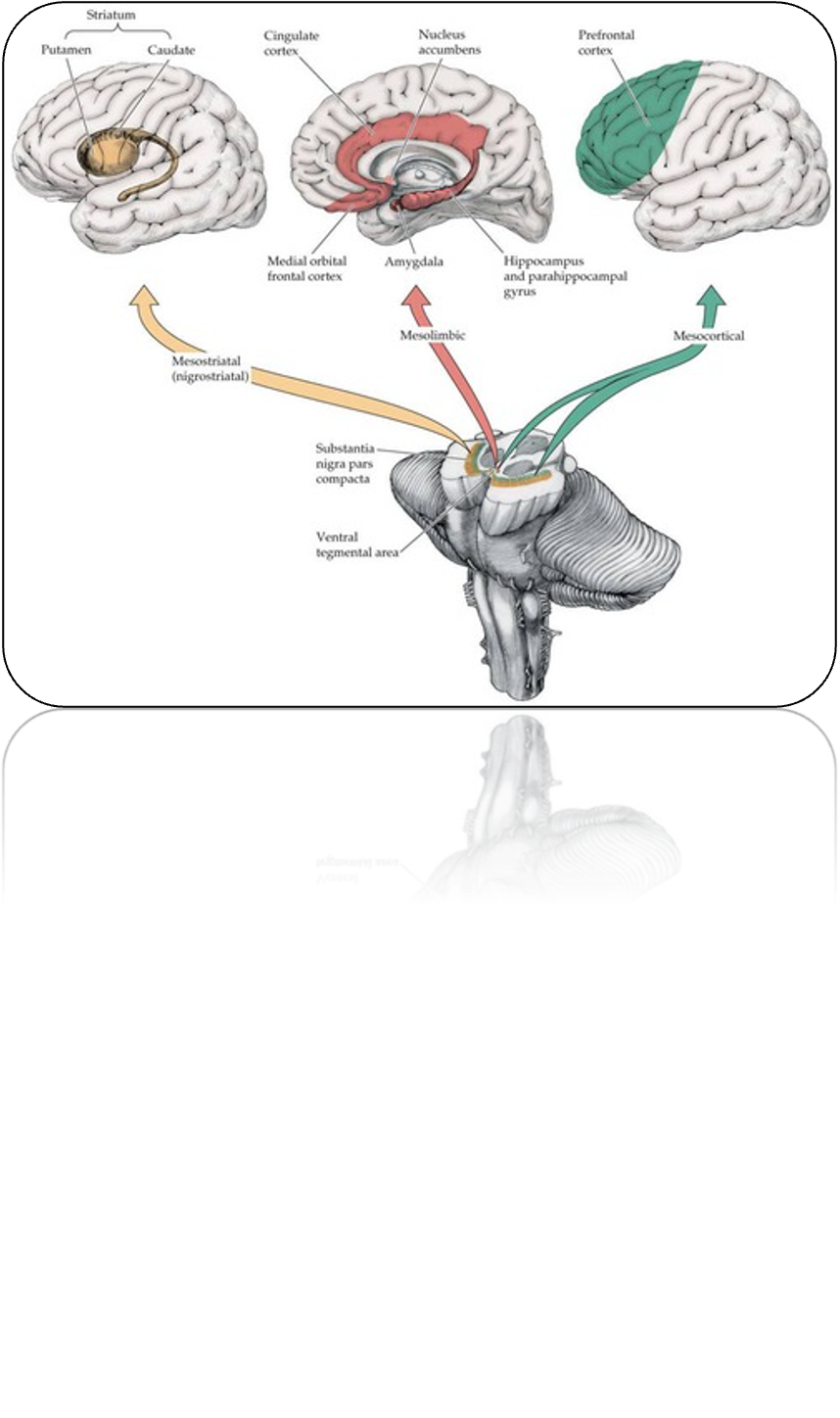
Negative Symptoms Hypofrontality: Mesocortical pathway
•Location: VTA to prefrontal cortex
•Pathology: Negative symptoms & Cognitive symptoms may arise from a deficits of dopamine
•Responds to atypical antipsychotic treatment
Functioning with:
•Emotions
•Cognition
•Social drive
•Impulse control
•Information processing
•Executive functions

Negative Symptoms Neural Atrophy:
•Location: Prefrontal Cortex
•Pathology: Negative symptoms arise from neurotrophy of grey matter in the frontal lobe
•Ventricles will expand to take up the space
•Does not respond to treatment
Nigrostriatal Pathway
•Normal functioning in schizophrenia
•Function: Behavioral movement coordination
•Location: Substantia Nigra to Ventral Striatum
Side effects:
•Antipsychotics, particularly typical (1st gen) can block functioning of this area
•Blocking dopamine leading to “Extra Pyramidal Symptoms (EPS)
•Behavioral Movement symptoms also seen in Parkinson’s

Tuberoinfundibular Pathway
•Normal functioning in schizophrenia
•Function: Prolactin secretion
•Location: hypothalamus to the pituitary gland
Side effects:
•Hyperprolactinemia
•Gynecomastia
•Breast tenderness
•Galactorrhea

Schizophrenia: Recovery Oriented Treatment Paradigm
-Focuses less on symptom control, more on increasing independence, autonomy, and quality of life. Prioritizes functional ability over symptom remission.
Supportive Psychotherapy | Therapy to assist with daily problem-solving, not formal or intensive. |
Social Rehabilitation | Improves social communication and interpersonal skills. |
Drop-in Centers | Reduce isolation (a major negative symptom and risk factor for psychotic relapse). |
Family Education | Enhances understanding and support, reducing stress and relapse risk. |
Vocational Rehabilitation | Supports employment and skill-building for better independence. |
Community Development | Supports recovery and increases personal satisfaction. |
Non-Pharmacological Treatment- Outpatient
•Supports individuals over a lifetime due to the chronic nature of schizophrenia.
•Escalation Goal: Work towards a modality that is the least restrictive setting for the patient
•Referral and services are escalated in a progressive protocol to adhere to the least restrictive setting
Non-Pharmacological Treatment: Traditional Outpatient Care
•The least restrictive setting
•Psychiatric – Medication management
•Therapy – Supportive psychotherapy
•Case management (Optional) – Supportive services
•Goal: Maintain stability with consistent outpatient support
Treatment Facilities, Treatment Levels: Intensive Outpatient (IOP)/ Partial Hospitalization (PHP)
•More intensive outpatient care with frequent contact throughout the week with longer sessions.
•Includes psychiatrists, therapists, and structured programming.
•Goal: Prevent symptom deterioration and hospitalization.
Treatment Facilities, Treatment Levels: Community Treatment Team (CTT) / Assertive Community Treatment (ACT)
•Multidisciplinary teams providing comprehensive outpatient treatment and mobile care for severe cases.
•Most intensive outpatient setting before hospitalization-level care
•Focus on crisis intervention, medication adherence, and case management in the community.
•Goal: Reduce emergency visits and prevent inpatient hospitalization.
Treatment Facilities, Treatment Levels: DAS/Respite Care (Crisis Stabilization Units)
•DAS: Diversion and Acute Stabilization
•Short-term, locked units designed to stabilize acute symptoms.
•Functions as an intermediate step to prevent full inpatient admission.
•Goal: Provide temporary intensive care for decompensation without hospitalization.
Treatment Facilities, Treatment Levels: Community Hospitalization (Short-Term Inpatient Care)
•Inpatient units for acute symptom management and stabilization.
•WPIC, St Clair, Forbes, etc.
•Less restrictive than state hospitals, typically for short-term crisis intervention.
•Goal: Treat acute episodes and transition patients back to lower levels of care.
Treatment Facilities, Treatment Levels: Step-Down Units / Quasi-Inpatient Facilities
•Post-hospitalization facilities that support community reintegration.
•Includes: Extended Acute Care (EAC), Temporary Residential Units (TRU), Residential Treatment Facilities for Adults (RTFA).
•Goal: Provide structured support before full discharge to independent living.
Treatment Facilities, Treatment Levels: State Hospitalization
•Most restrictive setting
•Reserved for patients requiring long-term stabilization when all other levels of care have been insufficient.
Goal: Provide structured, long-term psychiatric treatment when community-based care is insufficient.
Treatments: Medication Therapeutic Mechanism
Dopamine & Psychosis:
•Since excess dopamine activity in the mesolimbic pathway contributes to positive symptoms of schizophrenia we will manage through affecting the action of dopamine.
Pharmacological Management:
•D2 receptor antagonists (dopamine blockers) reduce excessive dopamine improving positive symptoms.
Two class of antipsychotics
•Typical – also called 1st generation→ just dopamine
•Atypical- also called 2nd generation→ dopamine and serotonin
•There is a subgroup we call 3rd generation
Antipsychotics
•affect multiple dopamine pathways, leading to side effects:
•Different classes of antipsychotics have different side effect grouping based on its mechanism of action.
Side effects:
•Worsening Negative symptoms may persist or worsen ().
•Extrapyramidal side effects (EPS), including tardive dyskinesia (from nigrostriatal dopamine blockade).
•Hyperprolactinemia & galactorrhea (due to tuberoinfundibular dopamine blockade).
Typical Antipsychotics (1st Generation)
Mechanism of Action:
•Full D2 antagonism – Therapeutic effect
•Anti-cholinergic effects (What are these?)
•Histamine antagonism (weight gain, drowsiness)
•Alpha 1 adrenergic antagonism (orthostatic hypotension)
Side Effect Groups:
•Extrapyramidal Side effects: Acute blockade of Nigrostriatal pathways
•Tardive Dyskinesia: Chronic Blockade of Nigrostriatal pathways
•Hyperprolactinemia: Blockade of the tuberoinfundibular Pathway leading to prolactin abnormalities
•Worsening Negative Symptoms: mesocortical dopamine blockade of a hypofunctioning system
Types of Typical Antipsychotics (1st Generation)
Most Common:
•Chlorpromazine (Thorazine)
•Perphenazine (Trilafon)
•Fluphenazine (Prolixin)
•Haloperidol (Haldol)
Less Common only Used:
•Loxapine (Loxitane)
•Thioridazine (Mellaril)
•Thiothixene (Navane)
Typical Antipsychotic: Extrapyramidal Side Effects (EPS
Types:
•Dystonia – Sustained muscle contractions (e.g., spasms, torticollis, oculogyric crisis).
•Akathisia – Inner restlessness, inability to stay still.
•Parkinsonism – Tremors, rigidity, bradykinesia, postural instability.
•Cause: D2 receptor antagonism in the nigrostriatal pathway disrupts dopamine signaling, leading to Parkinsonian-like motor symptoms.
Treatment for EPS:
•Anticholinergics: Benztropine (Cogentin) *First line
•Antihistamines: Diphenhydramine, hydroxyzine.
•Dopamine modulation: Amantadine
•Beta-blockers: Propranolol (first-line akathisia).
Typical Antipsychotic: Tardive Dyskinesia
•Involuntary, repetitive movement symptoms:
•Face & Mouth: Lip-smacking, tongue movements, chewing motions.
•Limbs & Body: Jerky, uncontrolled movements in the arms, legs, or torso.
•Often permanent – Symptoms may not go away even if the medication is stopped.
•Why Does TD Happen: Long-term dopamine blockade leads to oversensitive dopamine receptors, causing too much movement (opposite of Parkinson’s).
Treatment Options:
•Medications to Reduce Symptoms (VMAT-2 Inhibitors):
•Deutetrabenazine (Austedo)
•Valbenazine (Ingrezza)
Atypical Antipsychotics (2nd Generation)
Mechanism of Action:
•D2 antagonism – Therapeutic effect
•Serotonin 2A receptor antagonism - Downstream increase in dopamine that doesn’t affect psychosis
•Anti-histamine, Anticholinergic and alpha antagonism same as typical.
Atypical Antipsychotics (2nd Generation): Benefits of Serotonin Antagonsism:
•Decreased EPS – Replacement of dopamine in nigrostriatal pathway
•Improvement in hypofunctioning mesocortical pathway decreasing 1 of the 2 pathologies of negative symptoms
Additional Therapeutics:
•Depression as adjunctive therapeutic interventions
•Bipolar as a mood stabilizing effect
Types of Atypical Antipsychotics (2nd Generation)
Medication List:
•Clozapine (Clozaril)
•Olanzapine (Zyprexa)
•Quetiapine (Seroquel)
•Risperidone (Risperdal)
•Paliperidone (Invega)
•Ziprasidone (Geodon)
•Lurasidone (Latuda)
Atypical Antipsychotics (2nd Generation) Side Effects: Metabolic Syndrome
•Weight gain/risks for obesity (central),
•Dyslipidemia
•Insulin Resistance
•Hypertension
•Long Term:
•Cardiovascular Disease & Diabetes Varying degrees of histaminergic, adrenergic, and cholinergic effects
•Other side effects same as typical Antipsychotic:
•Sedation, orthostatic hypotension, anticholinergic
•Hyperprolactinemia
Clozapine (Clozaril)
•First atypical antipsychotic, highly effective for treatment-resistant schizophrenia.
•Considered the most effective antipsychotic, but reserved as a last-line option due to serious risks.
•Due to this risk, clozapine is only used after failure of at least two other antipsychotics.
Risk Evaluation and Mitigation Strategy (REMS)
•Major Risk: Agranulocytosis (dangerous drop in white blood cells).
•Absolute Neutrophil Counts (ANC) before any medication can be dispensed (Pharmacy)
Clozapine REMS Monitoring Schedule:
•Weekly bloodwork for the first 6 months.
•Bi-weekly bloodwork for the next 6 months.
•Monthly bloodwork after 1 year if stable.
•Missed 3+ doses? Restart weekly monitoring to ensure safety.
Third-Generation Antipsychotics
•D2 partial agonists: Stabilize dopamine rather than fully blocking it.
•5HT-2a Antagonism: Excellent for depression adjunctive uses
•More effective for bipolar disorder & depression but still used in schizophrenia.
Medications:
•Aripiprazole (Abilify)
•Brexpiprazole (Rexulti)
•Cariprazine (Vraylar)
Third-Generation Antipsychotics: Side Effects
•Lower metabolic risk than 2nd-gen antipsychotics but still not risk-free.
•Lower risk of hyperprolactinemia compared to some 2nd-gen antipsychotics.
•Moderate EPS risk – More than most atypicals, but lower than 1st-gen (typical) antipsychotics.
Long-Acting Treatment
•LAIs are injectable formulations designed to release the drug over time,
•Duration: Varies by medication from weeks to 6 months,
•Benefits:
•Reducing oral dosing
•Improve adherence
•Reduce the risk of missed doses
•Reduce side effects
Treatment: Catatonia
•First-line treatment: Electroconvulsive Therapy (ECT)
•Most effective long-term intervention
•Risks: Requires frequent procedures, potential side effects
•Benzodiazepines (High-dose, e.g., lorazepam challenge test)
•Rapid symptom relief but only effective while in the system
•Often used as a diagnostic tool
Treatment: Neuroleptic Malignant Syndrome
•A rare, life-threatening reaction to both first- and second-generation antipsychotics.
•Key Symptoms:
•Rapid onset high fever (>105°F)
•Altered mental status (confusion, agitation, coma)
•Autonomic instability (hypertension, tachycardia, excessive sweating)
•Leukocytosis and elevated creatine kinase (CK)
•Severe muscle rigidity ("lead-pipe" rigidity)
•Treatment: Recognize and Act Quickly
Nursing: Recognizing and preparing for ER, Cooling measures (cooling blankets, ice packs)
Medical: Stop antipsychotic immediately, Dantrolene, IV fluids for hydration, Antipyretics (fever control)
Serious Complications: Rhabdomyolysis, renal failure, and death if untreated.
Assessment: History
•Physiological Functioning: Eating, Sleeping, Hydration, Injury
Psychological/Psychiatric History:
•Commitment Status
•Outpatient services
•History of psychiatric illness: Onset
•Medications and Adherence
•Hospitalization history including admission reason
•Psychiatric status of first-degree relatives
•Medical History: History of physical health illness
•Substance History: Substances used, last used, amount
•Social History: Home environment/Living situation, Financial status/income Source, Cultural and spiritual beliefs/practices
Assessment: MSE
•Signs/Symptoms to Identify
•Vital signs: Normal to metabolic issues
•Appearance: Disheveled, incongruent to season
•Thought process: Tangential to Word Salad
•Thought content: Delusional/Paranoid
•Perception: Hallucinations typically auditory
•Speech: Slowed, poverty of speech
•Judgement: Disorganized
•Affect: Flat
•Sleep patterns disrupted
Psychosis Nursing Diagnoses: Safety
-Risk for Suicide
-Risk of injury to self
-Risk of injury to others
Psychosis Nursing Diagnoses: Physiological Functioning
-Self-care deficit
-Decreased fluid intake
-Decreased nutritional status
-Impaired tissue integrity
-Disturbed sleep pattern
Psychosis Nursing Diagnoses: Psychiatric
-Non-adherence
-Impaired insight
-Deficient knowledge
-Overweight/obesity/exercise
-Fear
-Ineffective coping
-Impaired social interaction
Psychosis Nursing Intervention: Safety
Injury: Significant safety risk of homicide, suicide or self injury
Command Hallucinations: “What are the voices saying to you”
Personal safety
You need to be between the door and the patient; do not block off your exit
Clothing; nothing that can be grabbed or yanked
Safety in community
Patient – sometimes may be preparing a defensive plan (bat by door, knives ready etc) that may be unsafe if delusions take over; may need commitment
Nurse/Professional
People should know where you are
Plan for exit if we know pt is not well and has h/x of aggression when acute
Psychosis Nursing Intervention: Physiological Functioning
ADLs: may need support with hygiene depending on organizations
Eating& Hydration: reminders to eat, grounding to reality if delusional concerning foods or fluids
Sleep: tracking of sleep, providing medications
Safety: Significant safety risk of homicide, suicide or self injury
Command Hallucinations: “What are the voices saying to you”
Unsafe delusional behaviors: Not uncommon for something to be “poisoned” and they stop drinking and eating
Psychosis Nursing Intervention: Rapport Building
Developing trust and alliance
Psychosis Nursing Intervention: Medication adherence
More than “take your meds” but “why do you want to take your meds”
Psychosis Nursing Intervention: Patient education
On all aspects of normal life and problem solving (negative symptoms)
Psychosis Nursing Intervention: Isolation
-Encourage groups
-Encourage drop-in centers
Psychosis Nursing Intervention: How to respond to positive symptoms
•NOT “buy-in” to delusions or hallucinations, but conversely does not “argue”
•Reflect the emotion as if the event is true
•“I understand that this is very real to you, but I don’t hear the voices.”
•“I am sure this is frightening but I don’t see the evidence that supports the FBI is following you.”
Psychosis Nursing Intervention: Reality/Grounding
•Redirect conversation to reality topics
•Deescalation: “We are in the hospital; you are safe”
•Distraction: Listening to headphones to tune out the voices