BIOL Unit 3
 Call Kai
 Learn
 Practice Test
 Spaced Repetition
 Match
 Flashcards
 Knowt Play
1/127

There's no tags or description
Looks like no tags are added yet.
128 Terms
Which of the following statements is true regarding the behavior of lipids in cell membranes?
Membrane lipids diffuse laterally within the plane of the membrane.
The oligosaccharide chains found in the carbohydrates that are associated with the plasma membrane are incredibly diverse. All but one of the following options explain how this diversity is achieved. Which option is NOT a way that carbohydrates can vary at the plasma membrane?
variation in the side of the plasma membrane to which they are bound
Membrane lipids are capable of many different types of movement. Which of these does NOT occur spontaneously in biological membranes?
moving between lipid layers
Membrane proteins, like membrane lipids, can move laterally by exchanging positions with other membrane components. Which type of membrane protein is expected to be the least mobile, based on its function?
anchors
Cells utilize several mechanisms for restricting the movement of membrane proteins within the plasma membrane. One of these mechanisms allows cells to present antigens to other cells to trigger the adaptive immune response. Which of the following mechanisms describes how antigen-presenting cells perform this function?
Proteins interact with the proteins on the surface of another cell.
Both glycoproteins and proteoglycans contribute to the carbohydrate layer on the surface of the cell. In comparison to proteoglycans, which of the following statements about glycoproteins is FALSE?
They have long carbohydrate chains.
How does a bilayer arrangement of phospholipids result in higher entropy for the system and thus make membrane formation energetically favorable?
Water molecules form cagelike structures around hydrophobic molecules, thus encouraging the latter to cluster together and limit their contact with water.
Which of the following mechanisms describes the process by which neutrophils are recruited by endothelial cells lining blood vessels at the site of an infection?
Proteins interact with the proteins on the surface of another cell.
Plasma membranes are extremely thin and fragile, requiring an extensive support network of fibrous proteins. This network is called the
cortex.
Some lipases can cleave the covalent bonds between the glycerol backbone and the attached fatty acid. What final products do you expect to accumulate through the action of the enzyme monoacylglycerol lipase?
glycerol and free fatty acid
Membrane synthesis in the cell requires the regulation of growth for both halves of the bilayer and the selective retention of certain types of lipids on one side or the other. Which group of enzymes accomplishes both tasks?
flippases
Cholesterol serves several essential functions in mammalian cells. Which of the following is NOT influenced by cholesterol?
membrane thickness
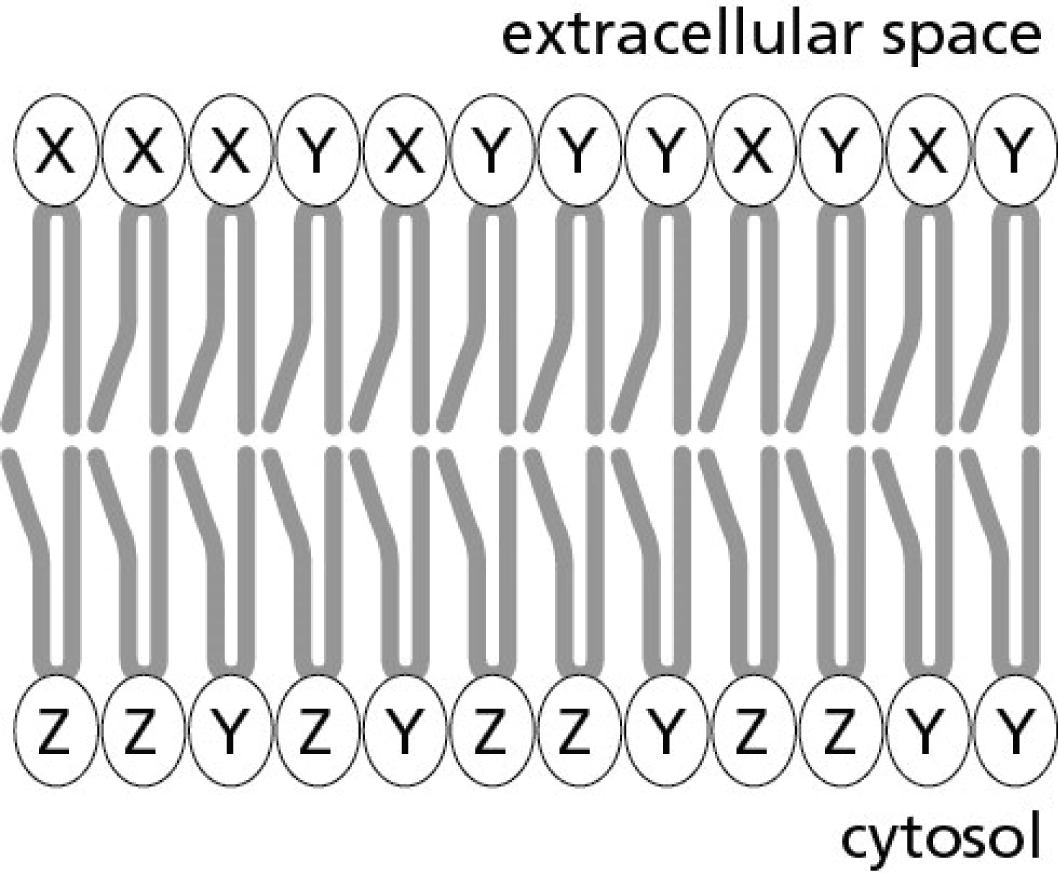
Three phospholipids, X, Y, and Z, are distributed in the plasma membrane as indicated in Figure 11-1. The composition of the extracellular (noncytosolic) layer is different from that of the cytosolic layer. Which of the following factors is responsible for establishing this compositional asymmetry?
flippase
Where does most new membrane synthesis take place in a eukaryotic cell?
in the endoplasmic reticulum
What determines the direction of passive transport via a transporter protein?
The concentration gradient of the solute across the membrane
What structural feature is most commonly associated with the function of transmembrane proteins?
Alpha-helices and beta-barrels
Inhibition of the Na+/K+ ATPase pump would have what effect on secondary active transport processes?
Decrease in secondary active transport efficiency due to a loss of the electrochemical gradient necessary for the transport of other molecules
Which of the following is a consequence of aquaporin dysfunction in human physiology?
Dehydration or overhydration
Which of the following best describes the mechanism by which voltage-gated ion channels operate?
They open in response to changes in membrane potential.
Which of the following describes the role of the sodium-potassium pump (Na⁺/K⁺-ATPase) in cellular homeostasis?
It actively transports Na⁺ out of the cell and K⁺ into the cell.
The structure of aquaporins is best described as:
A homotetrameric protein complex
What role do ion channels play in facilitated diffusion?
They allow specific ions to pass through the membrane according to their concentration gradient.
Phosphorylation can modulate ion channel gating by:
Altering the channel's response to voltage or ligands
How does the lipid solubility of a solute impact its ability to cross the plasma membrane?
Solutes that are lipid-soluble can easily diffuse across the membrane without the need for transport proteins.
Which of the following best describes the behavior of a gated channel?
It requires a stimulus to change from closed to open.
Transporters, in contrast to channels, work by
specific recognition of transport substrates.
What category of membrane transport are channels a part of?
facilitated diffusion
What is the primary purpose of the K+ leak channels in the gut epithelial cells?
to keep the Na+ pump fully functional
Which of the following gated ion channels are involved in inhibitory synaptic signaling?
glycine-gated Cl- channels
The electrochemical gradient for K+ across the plasma membrane is small. Therefore, any movement of K+ from the inside to the outside of the cell is driven solely by its concentration gradient.
False
Which of the following is required for the secretion of neurotransmitters in response to an action potential?
voltage-gated Ca2+ channels
Voltage-gated Na+ channels become automatically inactivated shortly after opening, which ensures that the action potential cannot move backward along the axon.
True
Most ion channels are gated, which allows them to open and close in response to a specific stimulus rather than allowing the constant, unregulated flow of ions.
True
If Na+ channels are opened in a cell that was previously at rest, how will the resting membrane potential be affected?
It becomes more positive.
Which of the following statements about GABA receptors is FALSE?
They promote neuronal uptake of Na+.
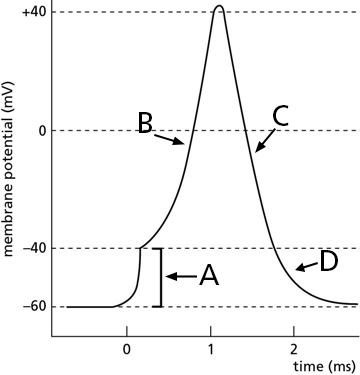
If a chemical blocks the voltage-gated K+ channels in an action potential, which region of the action potential will be the most affected?
C
Which of the following best describes the behavior of a gated channel?
It opens more frequently in response to a given stimulus.

Figure 12-1 illustrates changes in membrane potential during the formation of an action potential. What membrane characteristic or measurement used to study action potentials is indicated by the arrow?
threshold potential
Which of the following statements about resting membrane potential is true?
The resting membrane potential for most animal cells is negative, because the inside of the cell is more negatively charged than the outside of the cell.
Opening Na+ channels will cause
Influx of Na+ ions into the cell
Opening voltage gated K+ channels at +40mV will lead to
Efflux of K+ ions out of the cell
Which of the following might prevent the action potential from traveling back up the axon?
Na+ channels are temporarily inactivated
Which of the following steps in glycolysis involves the oxidation of a carbon atom?
Glyceraldehyde-3-phosphate dehydrogenase catalyzing the conversion of glyceraldehyde-3-phosphate to 1,3-bisphosphoglycerate
Which molecule undergoes carbon oxidation during glycolysis, and what is the direct energy consequence of this oxidation?
Glyceraldehyde-3-phosphate; production of NADH
The citric acid cycle is a critical sequence of reactions for energy production, which take place in the matrix of the mitochondria. The reaction cycle requires materials from the cytosol to be converted into acetyl CoA, which represents the starting point of a new cycle. Which of the following statements about acetyl CoA is true?
Amino acids can be converted into acetyl CoA.
The oxygen-dependent reactions required for cellular respiration were originally thought to occur in a linear pathway. By using a competitive inhibitor for one enzyme in the pathway, investigators discovered that these reactions occur in a cycle. Which enzyme was inhibited?
succinate dehydrogenase
In humans, glycogen is a more useful food-storage molecule than fat because
it can be utilized to produce ATP under anaerobic conditions, whereas fat cannot.
Glyceraldehyde 3-phosphate dehydrogenase operates by stripping a hydride ion from its substrate. Which molecule is the recipient of the proton and two electrons during this transfer?
NAD+
The primary reason that oxygen is required for the citric acid cycle to continue is that
NAD+ must be regenerated to keep the citric acid cycle going, and that requires the oxygen-dependent electron transport chain.
A dehydrogenase is an enzyme that catalyzes
the oxidation of a molecule by removing a hydride ion.
Pyruvate is an important metabolic intermediate that can be converted into several other compounds, depending on which enzyme is catalyzing the reaction. Which of the following CANNOT be produced from pyruvate in a single enzyme-catalyzed reaction?
citrate
A kinase is an enzyme that catalyzes
the addition of phosphate groups to other molecules.
In step 4 of glycolysis, a six-carbon sugar (fructose 1,6-bisphosphate) is cleaved to produce two three-carbon molecules (dihydroxyacetone phosphate and glyceraldehyde 3-phosphate). Which enzyme catalyzes this reaction?
aldolase
Despite its very different structure, FADH2, like NADH, is a carrier of
hydrogen atoms and high-energy electrons.
Which reaction does the enzyme phosphoglucose isomerase catalyze?
glucose 6-phosphate → fructose 6-phosphate
Step 6 of the citric acid cycle is catalyzed by succinate dehydrogenase. Keeping in mind that dehydrogenases catalyze redox reactions, which are the products of the reaction in which succinate is oxidized?
fumarate, FADH2
What is a primary reason that cells use enzymes in a series of steps to oxidize a fuel molecule such as glucose rather than oxidizing the fuel molecule in a single step (such as by direct burning in nonliving conditions)?
Energy is released in smaller packets that can be captured by carrier molecules.
In step 4 of the citric acid cycle, the reduction of NAD+ to NADH is coupled to the generation of CO2 and the formation of a high-energy thioester bond. Which molecule provides the sulfhydryl group necessary to form the thioester bond?
CoA
Which of the following cells rely exclusively on glycolysis to supply them with ATP?
anaerobically growing yeast
In the final step of the citric acid cycle, oxaloacetate is regenerated through the oxidation of malate. This is coupled with the production of which other molecule?
NADH
The conversion of glyceraldehyde 3-phosphate to 1,3 bisphosphoglycerate in step 6 of glycolysis generates a “high-energy” phosphoanhydride bond. Which of the following best describes what happens to that bond in step 7?
It is hydrolyzed to drive the formation of ATP.
Glycolysis generates more stored energy than it expends. What is the net number of activated carrier molecules produced in this process from one molecule of glucose (number and type of molecules produced minus the number of those molecules used as input)?
2 ATP, 2 NADH
When comparing the controlled, stepwise oxidation of sugar in cells with burning of the same fuel molecule in nonliving conditions, the free energy released by the complete oxidative breakdown of glucose to CO2 and H2O is
about the same.
Fatty acids can easily be used to generate energy for the cell. Which of the following fatty acids will yield more energy?
CH3-CH2-CH2-CH2-CH2-CH2-CH2-CH2-CH2-COOH
In step 2 of the citric acid cycle, the enzyme aconitase generates isocitrate from citrate. Which of the following statements about this reaction is true?
The reaction sequence first generates one molecule of water and then consumes one molecule of water.
Pyruvate can be converted into many other molecules by various biosynthetic and metabolic pathways, which makes it a central hub in the regulation of cellular metabolism. Which of the following molecules is NOT made from pyruvate?
NADH
Which of the following stages in the breakdown of the piece of toast you had for breakfast generates the most ATP?
oxidative phosphorylation
Which of the following best describes the structure of the inner mitochondrial membrane?
It is folded into cristae, increasing surface area for ATP production.
Which of the following processes occurs within the intermembrane space of the mitochondria?
Proton gradient establishment
What feature of the mitochondrial inner membrane allows it to maintain a high proton gradient essential for ATP production?
It is impermeable to most ions, preventing the free movement of protons.
Which of the following complexes in the electron transport chain directly contribute to the pumping of protons across the inner mitochondrial membrane?
Complex I, III, and IV
What is the primary source of energy that allows the complexes in the electron transport chain to pump protons across the inner mitochondrial membrane?
Electrons transferred from FADH2 and NADH
What is the role of Complex II in the electron transport chain with respect to proton pumping?
It transfers electrons from FADH2 without directly pumping protons
Which of the following components of the electron-transport chain does NOT act as a proton pump?
cytochrome c
Which of the following statements describes the mitochondrial inner membrane?
It contains transporters for ATP molecules.
What is the function of the heme groups in the complexes of the electron transport chain?
to provide a pathway for electrons to flow through the complex to reaction centers of higher redox potentials
Electron transport is coupled to ATP synthesis in mitochondria, in chloroplasts, and in the thermophilic bacterium Methanococcus. Which of the following is likely to affect the coupling of electron transport to ATP synthesis in all these systems?
an ADP analog that inhibits ATP synthase
NADH contains a high-energy bond that, when cleaved, donates a pair of electrons to the electron-transport chain. What are the immediate products of this bond cleavage?
NAD+ + H-
NADH and FADH2 carry high-energy electrons that are used to power the production of ATP in the mitochondria. These cofactors are generated during glycolysis, the citric acid cycle, and the fatty acid oxidation cycle. Which molecule, and from which biochemical pathway stated below, can produce the most ATP?
NADH from the citric acid cycle
Which of the following is NOT part of the process known as “oxidative phosphorylation”?
ATP molecules are produced in the cytosol as glucose is converted into pyruvate.
The generation of ATP from the proton gradient is a wonderful application of the first law of thermodynamics. What forms of energy are used to generate ATP during oxidative phosphorylation in mitochondria?
mechanical energy of the proton pumping to proton motive force to mechanical energy of ATP synthase to chemical bond energy in ATP
Which of the following statements describes the mitochondrial matrix?
It contains enzymes required for the oxidation of fatty acids.
Which of the following best describes the initial step in the synthesis of a transmembrane protein at the ER?
The signal recognition particle (SRP) binds to the ribosome translating the transmembrane protein
During the synthesis of a transmembrane protein, what role does the translocon play?
It facilitates the insertion of the protein into the lipid bilayer
What is the consequence of a mutation in the signal peptide of a protein destined for the ER?
The protein will remain in the cytosol and not enter the ER
What is the role of chaperone proteins in the rough endoplasmic reticulum?
To assist in protein folding and prevent aggregation
Which of the following is a consequence of a malfunctioning rough endoplasmic reticulum in a cell?
Impaired protein synthesis and secretion
After isolating the rough endoplasmic reticulum from the rest of the cytoplasm, you purify the RNAs attached to it. Which of the following proteins do you expect the RNA from the rough endoplasmic reticulum to encode?
All these answers are correct.
Which of the following statements about a protein in the lumen of the ER is FALSE?
Some of the proteins in the lumen of the ER can end up in the plasma membrane.
A large protein that passes through the nuclear pore must have an appropriate
sorting sequence, which typically contains the positively charged amino acids lysine and arginine.
Which of the following statements about the endoplasmic reticulum (ER) is FALSE?
Proteins to be delivered to the ER lumen are synthesized on the smooth ER.
Proteins that are fully translated in the cytosol do not end up in
transport vesicles.
Which of the following statements about peroxisomes is FALSE?
Most peroxisomal proteins are synthesized in the ER.
Which of the following statements is true?
Chaperone proteins in the mitochondria facilitate the movement of proteins across the outer and inner mitochondrial membranes.
Which of the following choices reflects the appropriate order of locations through which a newly synthesized protein destined for the plasma membrane travels?
ER → Golgi → plasma membrane
Which of the following organelles is NOT part of the endomembrane system?
mitochondria
Which of the following statements about the protein quality control system in the ER is FALSE?
Proteins that are misfolded are degraded in the ER lumen.
Which of the following statements about membrane-enclosed organelles is true?
In a typical cell, the area of the endoplasmic reticulum membrane far exceeds the area of plasma membrane.
Which of the following statements about nuclear transport is true?
Nuclear pores contain proteins with disordered segments that fill the channel and allow small water-soluble molecules to pass through in a nonselective fashion.
Signal sequences that direct proteins to the correct compartment are
encoded in the amino acid sequence and sufficient for targeting a protein to its correct destination.