anatomy chapter 2 test
 Call Kai
 Learn
 Practice Test
 Spaced Repetition
 Match
 Flashcards
 Knowt Play
1/79

There's no tags or description
Looks like no tags are added yet.
80 Terms
Matter
anything that occupies space and has mass
what are the 3 states of matter?
solid, liquid, gas
3 states of matter: solid
definite shape and definite form
3 states of matter: liquid
definite volume; shape of container
3 states of matter: gas
no definite shape or volume
what are the two ways matter can be changed?
physically and chemically
matter being changed physically
Changes do not alter the basic nature of a substance, examples include changes in the state of matter
matter being changed chemically
Changes alter the chemical composition of a substance
energy
the ability to do work, has no mass and doesn’t take up space
kinetic energy
energy is doing work
potential energy
energy is inactive or stored
What are the forms of energy
chemical, electrical, mechanical, radiant
forms of energy: chemical energy
stored in the chemical bonds of substances
forms of energy: electrical energy
results from movement of charged particles
forms of energy: mechanical energy
directly involved in moving matter
forms of energy: radiant energy
travels in waves; energy of the electromagnetic spectrum
what does energy form
conversions
what does ATP (adenosine triphosphate) do
traps the chemical energy of food in its bonds
elements
fundamental units of matter
what four elements is 96% of the body made out of
oxygen, carbon, hydrogen, nitrogen
periodic table
contains a complete listing of elements
atoms
building blocks of elements, atoms of elements differ from one another
atomic symbol
a chemical shorthand for each element
atomic subparticles: protons
positively charged
atomic subparticles: nuetrons
are uncharged or nuetral
atomic subparticles: electrons
are negatively charged
all atoms are ____ nuetral
electrically
what does the number of protons equal
the number of electrons in an atom
what do positive and negative charges do
cancel each other out
ions
atoms that have gained or lost electrons
planetary model
portrays the atom as a miniature solar system, protons and neutrons are in the atomic nucleus, electrons are in orbitals around the nucleus
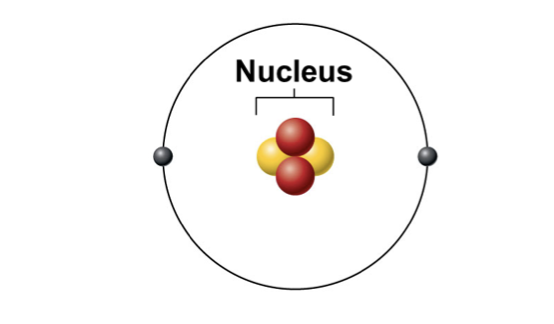
orbital model
electrons are depicted by an electron cloud, a haze of negative charge, outside the nucleus

what do electrons determine
an atom’s chemical behavior and bonding properties
identifying elements: atomic number
equal to the number of protons an atom contains, also tells the number of electrons in an atom
atomic mass number
sum of the protons and neutrons contained in an atom’s nucleus
atomic weight
approximately equal to the mass number of the element’s most abundant isotope
isotopes
Atoms that have the same number of protons and electrons but vary in the number of neutrons, have the same atomic number but different atomic masses
radioisotope
Heavy isotope of certain atoms, tends to be unstable, Decomposes to more stable isotope
Radioactivity
process of spontaneous atomic decay, Used to tag and trace biological molecules through the body
Molecule
two or more atoms of the same elements combined chemically
chemical equations
results in a molecule, reactants are atoms on the left, product is the molecule on the right
Compound
two or more atoms of different elements combined chemically to form a molecule of a compound
when do chemical reactions occur
when atoms combine with or dissociate from other atoms
chemical bonds
energy relationships involving interactions among the electrons of reacting atoms
what do electrons occupy
energy levels called electron shells (or energy levels)
electrons closest to the nucleus are
most strongly attracted to its positive charge
Distant electrons further from the nucleus are
likely to interact with other atoms
what is the maximum number of electrons the electron shells can hold?
1st shell can hold 2, second shell can hold 8, 3rd shell can hold 18
how does electron bonding work
involves interactions only between electrons in the outermost (valence) shell, atoms with full valence shells don’t bond
rule of eights
the key to chemical reactivity, atoms are considered stable and inactive when their outermost (valence) shell has 8 electrons
what is the exception to the rule of eights?
shell 1 which holds 2 electrons
types of chemical bonds: ionic bonds
Form when electrons are completely transferred from one atom to another, Allow atoms to achieve stability through the transfer of electrons
Ions
result from the loss or gain of electrons
anions
have negative charge due to gain of electrons
cations
have a positive charge due to loss of electrons
types of chemical bonds: covalent bonds
Atoms become stable through shared electrons, Electrons are shared in pairs, Single covalent bonds share one pair of electrons, Double covalent bonds share two pairs of electrons
what can covalent bonds be described as
polar and non polar
non polar covalent bonds
Electrons are shared equally between the atoms of the molecule, Electrically neutral as a molecule
polar covalent bonds
Electrons are not shared equally between the atoms of the molecule, Molecule has a positive and negative side, or pole
types of chemical bonds: hydrogen bonds
Extremely weak chemical bonds, Responsible for the surface tension of water, Important for forming intramolecular bonds, as in protein structure
how are hydrogen bonds formed?
when a hydrogen atom is attracted to the negative portion, such as an oxygen or nitrogen atom, of a polar molecul
synthesis reaction (a+b → ab)
Atoms or molecules combine to form a larger, more complex molecule, Energy is absorbed for bond formation, Underlies all anabolic (building) activities in the body
decomposition reaction (ab → a + b)
Molecule is broken down into smaller molecules, Chemical energy is released, Underlies all catabolic (destructive) activities in the body
Exchange reaction (ab+c→ac + b) (ab+cd→ad+cb)
Involves simultaneous synthesis and decomposition reactions as bonds are both made and broken, Switch is made between molecule parts, and different molecules are made
reversibility
most chemical reactions are reversible, Reversibility is indicated by a double arrow
inorganic compounds
lack carbon, tend to be small simple molecules, include water, salts, and many acids and bases
organic compounds
contain carbon, all are large, covalent molecules
water
most abundant inorganic compound in the body, accounts for 2/3rds of the body’s weight
what are the vital properties of water
high heat capacity, polarity/solvent properties, chemical reactivity, cushioning
properties of water: high heat capacity
Water absorbs and releases a large amount of heat before it changes temperature, Prevents sudden changes in body temperature
properties of water: polarity/solvent properties
water is a universal solvent
solvents
liquids or gases that dissolve smaller amounts of solutes
solutes
solids, liquids, or gases that are dissolved or suspended by solvents
properties of water: chemical reactivity
Water is an important reactant in some chemical reactions
chemical reactivity: hydrolysis reactions
reactions that require water
properties of water: cushioning
Water serves a protective function
inorganic compounds: salts
ionic compound, easily break apart into ions in the precense of water, vital to many body functions,
electrolytes
this is what all salts are,