Affective Disorders: Neurobiology and Treatment
 Call Kai
 Learn
 Practice Test
 Spaced Repetition
 Match
 Flashcards
 Knowt Play
1/33

There's no tags or description
Looks like no tags are added yet.
34 Terms
What is the Aetiology of Depression?
Multifactorial
Incompletely understood
Interactions of: genetic factors, personality, early environment, childhood adversities, life events, psychological predisposition and biological factors
Complex and Multifactorial Aetiology

What are the Genetic Causes of Depression?
The risk of depression in 1st relatives of a proband is approx. 3-fold increased
The heritability of major depression has been estimated at 37%, less than that of bipolar disorder or schizophrenia
Genome-wide association studies now identify hundreds of risk variants (697 in Adams et al., Cell 2025), each of very small effect
Polygenic inheritance: genetic liability results from the combined action of many genes of small effect, in interaction with the environment
What is the Neurobiology of Depression?
Dysfunction of neural circuitries involved in mood regulation
Abnormal monoamine systems
Gaba, Glutamate and excitatory-inhibitory balance
HPA Axis, Glucocorticoids and stress biology
Neuroplasticity, synapses loss and brain atrophy
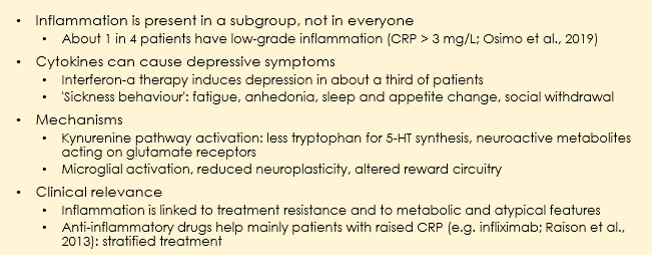
Immune-brain interactions
Neural Circuitries in Depression

What are the Serotonin and Noradrenaline Pathways in the Human Brain?
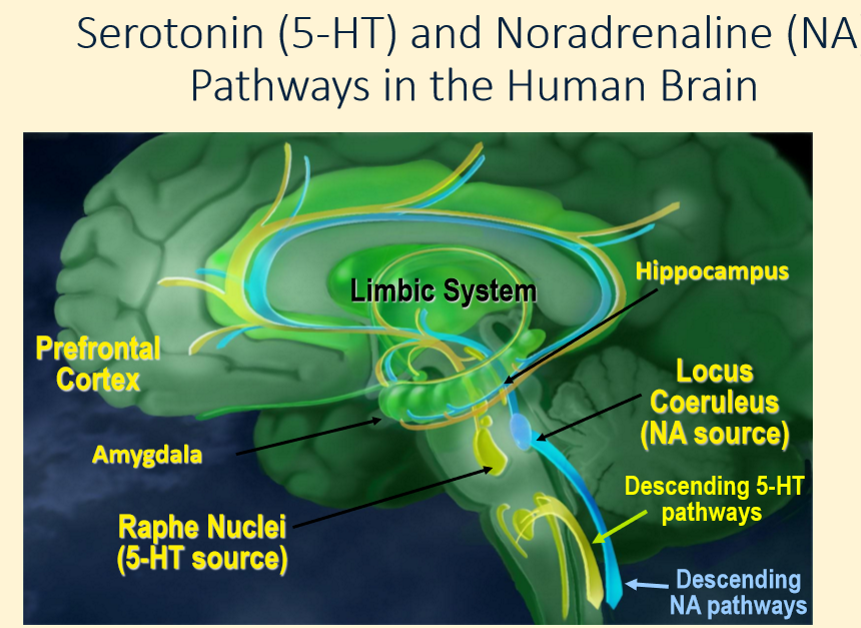
Serotonin (5HT) Dysfunction in Depression
All traditional antidepressants act on 5-HT/NA systems (indirect evidence, inferred from drug action)
Relapse after experimentally lowering brain 5-HT (acute tryptophan depletion) in recovered patients
Reduced 5-HT transporter in post-mortem suicide studies
Reduced brain 5-HT release in depressed patients (PET; Erritzoe et al., 2023)
'low serotonin’ is not a single cause of depression; serotonin is one part of a more complex picture
HPA Dysfunction in Depression

Neuroplasticity Alterations and Subcortical Atrophy

Ketamine in Depression

Immune-Brain Interaction in Depression
Bipolar Disorder- Genetic Causes
Familial aggregation: about 5–10% risk in first-degree relatives (roughly 7–10 times the population risk)
Heritability 60–85% (twin studies)
Polygenic inheritance: thousands of genetic variants of small effect
GWAS: 298 risk loci (O’Connell et al., Nature 2025), including CACNA1C (L-type calcium channel subunit), a well-replicated finding
Genetic overlap with schizophrenia is greater than with depression
Bipolar Disorder- Role of Environment
Monozygotic twins concordance rate around 60%—>environmental factors likely to be important
Stressful life events or sleep disturbance can trigger episodes
Life trauma increases the risk of bipolar disorder (as of any other psychiatric disorder), i.e. it seems non-specific
What is Neurobiology of Bipolar Disorder?
Neurochemistry (excessive dopamine in mania, and 5HT abnormalities in depression)
HPA Axis and cortisol
Neuroprogression (in a subset of patients)
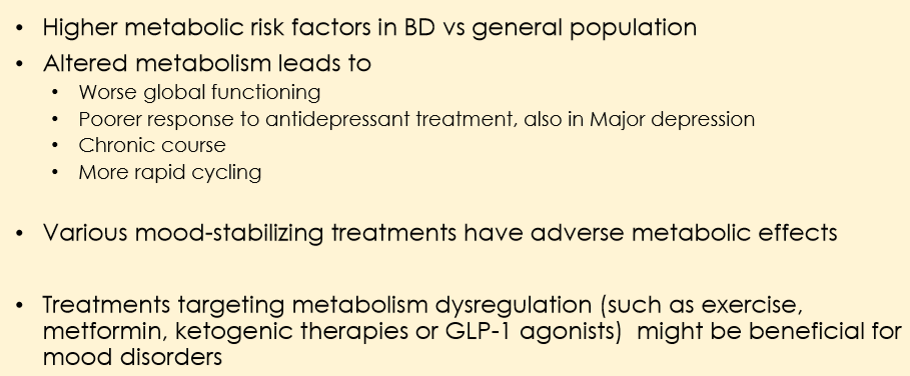
(Neuro)metabolic and mitochondrial abnormalities
Dopamine and Neuroprogression in Bipolar Disorder

What is the Bidirectional Relationship Between Metabolic Dysregulation and Bipolar Disorder?
Depression Treatment- Types and Phases

Antidepressants- 1st Generation (Non-Selective)

Antidepressants- 2nd Generation
2nd generation
SSRIs – selective serotonin reuptake inhibitors (sertraline, citalopram, escitalopram, fluoxetine, paroxetine)
SNRIs – serotonin–noradrenaline reuptake inhibitors (venlafaxine, duloxetine)
Mirtazapine – α2-adrenoceptor antagonist (↑ NA and 5-HT release); also blocks 5-HT2, 5-HT3 and H1 receptors
Vortioxetine – multimodal: serotonin reuptake inhibitor plus 5-HT receptor modulator
Others: agomelatine, trazodone
How do Antidepressants Work?
Acute action (hours)
SSRIs/SNRIs block the serotonin (SERT) and/or noradrenaline (NET) transporter → ↑ synaptic 5-HT/NA
MAOIs block monoamine breakdown; TCAs block SERT/NET but also H1, muscarinic and α1 receptors (side effects)
Mirtazapine blocks presynaptic α2 receptors → ↑ NA and 5-HT release
Why does Clinical Improvement take 2-6 Weeks?
Raised 5-HT first activates inhibitory 5-HT1A autoreceptors on raphe neurons; these gradually desensitise → ↑ firing and release
Downstream changes in gene expression, BDNF and synaptic plasticity
An early shift towards positive emotional processing comes before mood improves (cognitive neuropsychological model; Harmer et al.)
Efficacy and Tolerability of SSRIs- Advantages
Advantages
Efficacy equal to tricyclics in outpatients
Large spectrum of action (OCD, PTSD, Panic, GAD, social anxiety)
Low toxicity and safe in overdose
Efficacy and Tolerability of SSRIs- Side Effects
Side effects
Initial treatment phase most delicate: side effects come before benefits
Gastrointestinal symptoms (nausea, diarrhoea)
Headache, irritability, anxiety
Reduced libido and sexual dysfunction
Taper gradually: withdrawal symptoms can be severe and prolonged in some people; worst with short half-life drugs (venlafaxine, paroxetine)
Antidepressant Safety- What to Watch For?

Bipolar Disorder Treatment- Short-term
Short-term treatment
To reduce the severity and shorten the duration of the acute episode and achieve remission of symptoms
Bipolar Disorder Treatment- Long-term
Long-term treatment
Prevention of new episodes and to achieve adequate inter-episode control of residual or chronic mood symptoms
Bipolar Disorder Treatment- Overview of Drug Categories

Lithium- Mechanism
A simple element, also present in food and drinking water
Mechanisms (incompletely understood)
Multiple intracellular second-messenger pathways (e.g. inositol depletion, GSK-3 inhibition)
Indirect effects on several neurotransmitter systems
Neurotrophic factors and cellular signalling
Lithium- Clinical Efficacy
Clinical efficacy
Strongest evidence for preventing relapse of either polarity – first-line long-term treatment (NICE)
Anti-suicidal effects and reduced impulsivity
Possible neuroprotective effects
Lithium- Monitoring
Monitoring (NICE)
Target level 0.6–0.8 mmol/L, 12 hours after the last dose
Levels every 3 months for the first year, then every 6 months (every 3 months if older, interacting drugs, renal impairment or poor adherence)
Renal and thyroid function, calcium and weight every 6 months
Narrow therapeutic index: needs regular blood-level monitoring
Lithium- Toxicity
Usually above 1.5 mmol/L, but can occur at 'therapeutic' levels
Coarse tremor, vomiting, diarrhoea, ataxia, slurred speech, confusion, seizures
Precipitated by dehydration, intercurrent illness, NSAIDs, ACE inhibitors/ARBs and thiazide diuretics
Lithium- Long-term Adverse Effects
Long-term adverse effects
Reduced eGFR/chronic kidney disease, nephrogenic diabetes insipidus, hypothyroidism, hyperparathyroidism (raised calcium), weight gain
What are the Adverse Effects and Pharmacological Treatments for BPAD?
Lithium toxicity – narrow therapeutic index; requires monitoring of plasma levels
Kidney and thyroid dysfunction (lithium, especially with poorly controlled levels)
Weight gain and metabolic syndrome (many second-generation antipsychotics, e.g. olanzapine and, to a lesser extent, quetiapine; valproate)
Liver damage and pancreatitis (valproate)
Serious skin rash, including Stevens–Johnson syndrome (lamotrigine – titrate slowly)
Hyperprolactinaemia (dopamine antagonists)
Tardive dyskinesia (much reduced risk with second-generation antipsychotics)
Teratogenicity (valproate)
What are the Other Disadvantages of Pharmacological Treatments for BPAD?
Stopping lithium abruptly can cause rebound mania
Antidepressants can induce mania or rapid cycling
Poor adherence and long-term engagement are common without psychoeducation and support for self-management
Valproate in pregnancy: about 10% risk of major congenital malformations and 30–40% risk of neurodevelopmental disorders