All Slides Animal Form and Functions
 Call Kai
 Learn
 Practice Test
 Spaced Repetition
 Match
 Flashcards
 Knowt Play
1/52

There's no tags or description
Looks like no tags are added yet.
53 Terms
Why do smaller animals require a higher basal metabolic rate (BMR) per kilogram of body mass compared to larger animals?
Smaller animals have a higher surface-area-to-volume ratio, causing them to lose heat and exchange materials with the environment at a faster rate per unit mass.
As an animal's body size increases, its volume grows faster than its surface area, resulting in a _____ surface-area-to-volume ratio.
lower (or smaller)
Why can single-celled organisms and simple animals like sponges (Porifera) exchange gases and nutrients directly across their cell membranes without specialized organs?
All or most of their cells are in direct or very close contact with the external environment, providing an adequate surface-area-to-volume ratio for diffusion.
What body structural adaptation allows flatworms (Platyhelminthes) to perform direct gas exchange without circulatory or respiratory systems?
A flattened body shape, which minimizes internal diffusion distances and maintains a high surface-area-to-volume ratio across cells.
What is the primary evolutionary advantage and trade-off of specialized exchange systems (e.g., respiratory, digestive, circulatory) in large chordates?
Advantage: Highly efficient exchange and transport of materials in large bodies; Trade-off: Requires metabolic energy to construct and maintain these systems.

Subdividing volume into multiple smaller cells increases total surface area while keeping total volume constant, maintaining a high surface-area-to-volume ratio.
List the levels of biological organization in order from the smallest unit to the biosphere.
Molecules → Organelles → Cells → Tissues → Organs → Organ Systems → Organisms → Populations → Communities → Ecosystems → Biosphere.
Which embryonic germ layer gives rise to skin epidermal cells, pigment cells, and the nervous system?
Ectoderm
Which embryonic germ layer gives rise to muscle tissue, bone, cartilage, blood, and kidneys?
Mesoderm
Which embryonic germ layer gives rise to the epithelial lining of airways, the digestive tract, and glands like the thyroid and pancreas?
Endoderm
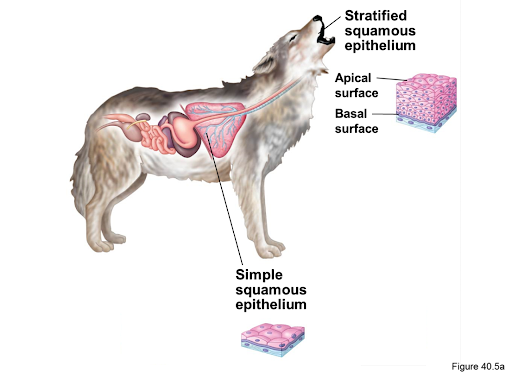
Simple Squamous Epithelium
A single layer of flattened epithelial cells specialized for rapid simple diffusion, lining air sacs in lungs and blood capillaries.
Stratified Squamous Epithelium
Multiple layers of flattened cells that regenerate rapidly to protect underlying tissues from mechanical abrasion, such as in the skin epidermis and esophagus lining.
How do simple squamous and stratified squamous epithelia differ in structure and function within mammals?
Simple squamous consists of a single flat cell layer for rapid diffusion (e.g., lungs), whereas stratified squamous consists of multiple regenerating layers for protection against physical wear (e.g., skin, mouth).
What defining structural feature unites all connective tissue types despite their functional diversity?
Sparsely scattered cells surrounded by an extracellular matrix composed of protein fibers and ground substance.
Loose Connective Tissue
A widespread connective tissue containing collagenous and elastic fibers that holds organs in place, attaches epithelial tissues, and provides space for nutrient and water storage.
Adipose tissue contains specialized cells filled with cytoplasm designed to store _____, serving as energy reserves, insulation, and protective cushioning.
triglycerides (or fats)
How does cartilage tissue differ in matrix composition and function from osseous (bone) connective tissue?
Cartilage features chondrocytes producing a flexible protein-carbohydrate matrix (chondroitin sulfate) for cushioning joints; osseous tissue features osteocytes producing a rigid matrix of proteins and mineral salts for structural support.
What components make up the cellular and fluid fractions of blood connective tissue?
Red blood cells (erythrocytes) and white blood cells (leukocytes) suspended in a liquid extracellular matrix called plasma.
Compare the voluntary control and striation patterns of skeletal, smooth, and cardiac muscle tissue.
Skeletal muscle is striated and voluntary; smooth muscle is unstriated and involuntary; cardiac muscle is striated and involuntary.
What structural feature of cardiac muscle cells enables synchronized, coordinated contractions across the heart?
Intercalated discs, which facilitate rapid direct electrical and chemical communication between adjacent cardiac cells.
What are the primary functions of glial cells (glia) in nervous tissue?
To support, nourish, and electrically insulate neurons, speed up nerve impulse transmission, and modulate neural communication.
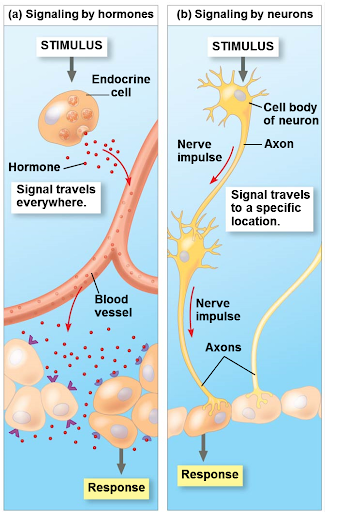
How do the endocrine and nervous systems differ in signaling pathways, transmission speed, and target specificity?
Endocrine signaling releases hormones into blood vessels for systemic, slower, long-lasting action on target cells with specific receptors; nervous signaling sends fast electrical impulses along dedicated axons directly to targeted effector cells.
Contrast the spatial distribution of signals in endocrine control versus nervous control.
Endocrine hormones travel everywhere via blood vessels, affecting only cells with matching receptors; nervous signals travel along specific neural pathways directly to designated targets.
Target Cell (Endocrine System)
A specific cell that responds to a circulating hormone because it expresses matching protein receptors in its plasma membrane or nuclear membrane.
The nervous system receives sensory input from receptors, performs _____ in the central nervous system to make decisions, and sends motor output to effector cells.
integration
What is the key physiological distinction between a regulator and a conformer?
A regulator maintains internal body conditions at a constant level despite external fluctuations; a conformer allows its internal condition to match changes in the external environment.

Classify the thermal strategy of the river otter versus the largemouth bass.
The river otter is a temperature regulator (maintains body temperature around 38∘C); the largemouth bass is a temperature conformer (body temperature tracks water temperature).
How does a negative feedback loop function to maintain homeostasis around a physiological set point?
A stimulus pushes a variable away from the set point, sensors detect the change, and an integrator signals effectors to produce a response that counteracts the stimulus, returning the variable to the normal range.
Human thermoregulation operates on a negative feedback loop where a drop in core body temperature below 37∘C causes the hypothalamus to send signals to muscle effectors, inducing _____.
shivering
How does a positive feedback loop differ fundamentally from a negative feedback loop?
A positive feedback loop amplifies or reinforces the initial stimulus, driving the variable further away from normal until a specific completion event occurs (e.g., childbirth contractions, action potentials).
Why does catalytic activity drop sharply when an enzyme is exposed to temperatures significantly above its optimal temperature?
Excess thermal energy disrupts non-covalent bonds stabilizing the enzyme's tertiary structure, denaturing the protein and destroying its active site.
What happens to enzyme-catalyzed reaction rates at ambient temperatures significantly lower than an organism's optimal temperature?
Reaction rates decrease due to lower kinetic energy, which reduces the frequency of energetic collisions between enzyme active sites and substrates.
What does this enzyme activity curve demonstrate regarding optimal temperature adaptation between typical human enzymes and thermophilic bacteria?
Human enzymes function optimally near 37∘C and denature above 45∘C, whereas thermophilic bacterial enzymes are adapted to function optimally around 75∘C to 80∘C.

What four physical mechanisms govern heat exchange (gain or loss) between an animal's body and its environment?
Radiation, Conduction, Convection, and Evaporation.
Differentiate between an endotherm and an ectotherm based on their primary heat source.
Endotherms generate most of their body heat internally through metabolic activity; ectotherms absorb most of their body heat from external environmental sources.
Differentiate between a homeotherm and a heterotherm based on internal body temperature stability.
Homeotherms maintain a relatively constant internal body temperature regardless of external temperature; heterotherms have body temperatures that fluctuate with environmental conditions or over time.

Where do most birds and mammals fall compared to most freshwater fish and amphibians?
Most birds and mammals are Endothermic Homeotherms (top right); most freshwater fish, amphibians, and reptiles are Ectothermic Heterotherms (bottom left).
Why are naked mole rats considered unique among mammals regarding thermal strategy?
Despite being mammals, naked mole rats lack strong endothermic heat production and tightly regulated homeothermy, exhibiting heterothermic traits and relying on huddling or ambient temperature.
Why can polar marine fish maintain homeothermy despite being ectotherms?
The surrounding polar ocean water remains at a constant temperature year-round, allowing the fish to maintain stable internal temperatures without internal metabolic thermoregulation.
Integumentary System
The outer body covering of an animal—including skin, hair, fur, feathers, scales, cuticle, or shells—that acts as a physical barrier and helps regulate heat exchange.
How do down feathers and dense underfur reduce conductive heat loss to cold air or water?
They trap a layer of still air next to the skin, creating an insulating layer that significantly lowers heat transfer rates.
How does cutaneous vasodilation affect heat exchange between an animal's core and the environment?
Vasodilation expands blood vessels near the skin surface, increasing blood flow to the epidermis and maximizing heat loss to the surroundings.
How does cutaneous vasoconstriction assist endotherms in cold air or diving marine iguanas in cold water?
Vasoconstriction narrows surface blood vessels, restricting peripheral blood flow and keeping warm blood diverted to the core to minimize heat loss.
What vascular adjustments occur in skin capillaries during heat loss vs heat conservation?
Vasodilation widens surface vessels to increase blood flow and heat loss; vasoconstriction narrows surface vessels to restrict blood flow and conserve core heat.


What prevents warm core arterial blood from losing heat to freezing surroundings at the tip of the extremity?
Warm blood in arteries transfers heat to adjacent cool blood in veins returning to the core along a continuous thermal gradient, recapturing heat before it reaches the foot or flipper tip.
How does evaporative cooling (e.g., sweating, panting, or gaping) remove heat from an animal's body?
Water molecules absorbing latent heat of vaporization transition from liquid to gas, taking heat energy away from the moist skin or mucosal surface.
Torpor
A state of decreased physiological activity characterized by reduced body temperature, metabolic rate, respiration, and heart rate to conserve energy.
How do hibernation and estivation differ in environmental triggers and seasonal timing?
Hibernation is long-term torpor adapted to survive winter cold and food scarcity; estivation is long-term torpor adapted to survive summer heat and dry conditions.
What is the primary evolutionary benefit and trade-off of seasonal hibernation for small mammals?
Benefit: Dramatically reduces winter energy requirements and enhances seasonal survival.
Trade-off: Inability to forage, reproduce, or actively escape predators while torpid.
Acclimation
Reversible physiological, anatomical, or cellular adjustments made by an individual organism in response to temporary changes in environmental conditions.
How do animals modify their cell membrane phospholipid composition to preserve fluidity at low temperatures?
They increase the proportion of unsaturated fatty acids with double-bond kinks, preventing phospholipids from packing tightly together into a rigid gel state.
How does cell membrane lipid modification maintain membrane fluidity in cold environments?
Increasing unsaturated fatty acids with hydrocarbon kinks prevents phospholipid tails from packing tightly at low temperatures, preserving membrane fluidity.

What is the biological function of antifreeze proteins in Arctic and Antarctic organisms?
They bind to microscopic ice crystals in body fluids, preventing crystal growth and ice propagation that would otherwise rupture cellular membranes.