CCT2 Utility functions and Marshallian Demand
 Call Kai
 Learn
 Practice Test
 Spaced Repetition
 Match
 Flashcards
 Knowt Play
1/10

There's no tags or description
Looks like no tags are added yet.
11 Terms
What is ordinal utility?
“Ordinal” means only the ranking matters. If bundle A has utility 10 and B has utility 5, all we learn is that A is preferred. We don’t learn that A is “twice as good”. Any relabelling that keeps the order is equally valid.
What is Marshallian demand?
Marshallian demand shows how much of a good a consumer buys to maximise utility based on income and prices. This occurs when you maximise utility subject to the budget constraint m = px(X) + py(Y), the solutions x* and y* depend on prices and income: x*(px, py, m) and y*(px, py, m) (Langrangian method)
What does it mean that Marshallian demand is uncompensated?
When a price changes, your real purchasing power changes too, so you move to a different indifference curve. A price change therefore has two effects:
Substitution effect: the good is relatively cheaper, so you switch towards it.
Income effect: the price fall makes you effectively richer.
What is a monotonic transformation?
A monotonic transformation is a function that consistently increases or decreases, ensuring that the relative order of values is preserved. In economics, this means that if one bundle of goods is preferred over another, it remains preferred after applying the transformation. If one person earns £30,000 and another £50,000, taking the log gives approximately 10.31 and 10.82—while the numbers change, the ranking of who earns more stays the same
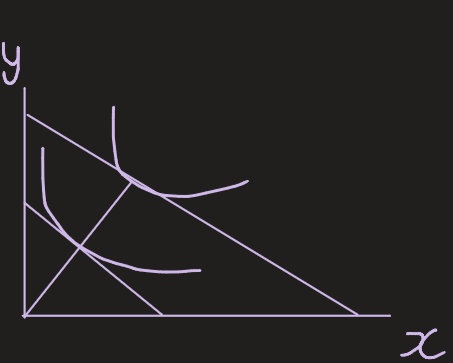
What is homotheticity?
Increasing income leads to goods being consumed in the same proportion but at a larger scale
What are the five types of utility function?
Cobb-Douglas, Perfect substitutes, Perfect complements, Quasi linear utility, Stone-Geary Utility
What is a Cobb-Douglas utility function?
U(x,y) = xaYb
What is a perfect substitutes utility function?
U(x,y) = ax + by

What is a perfect complements utility function?
U(x,y) = min{ax,by}

What is a quasi-linear utility function?
U(x,y) = ax + blny

What is a stone-Geary utility function?
U(x,y) = (x-a)a(y-b)b
There is a minimum threshold for x and y where utility isn't maximised.
E.G. x is food and y is housing. You need a minimum of each (α units of food, β units of housing) before you get any utility, and only consumption above the minimum is enjoyed.