Exam #2
 Call Kai
 Learn
Learn Practice Test
 Spaced Repetition
 Match
Match Flashcards
 Knowt Play
1/71

Earn XP
Description and Tags
Biology
Name | Mastery | Learn | Test | Matching | Spaced | Call with Kai | Chat |
|---|
No analytics yet
Send a link to your students to track their progress
72 Terms
Selective permeability
the membrane lets some molecules cross easily (small + nonpolar C-H) while others have a harder time (large + polar O-H) (ex. the phospholipid bilayer)
Passive transport
(big umbrella category) large and polar molecule move through this. solutes move from high —> low concentration
Simple diffusion
(type of passive transport) small and nonpolar molecules move through this. solutes move from high —> low concentration directly through the membrane with no ATP (energy required)
Dynamic equilibrium
Both sides of the concentration gradient are equal; the molecules still move, but there is no net movement because movement is equal in both directions.
Osmosis
Diffusion of water; water follows the side with more solute.
Hypertonic
(In osmosis) Outside has more solute - water follows the solute - cell shrinks
Hypotonic
(In osmosis) Outside has less solute - water follows the solute - cell bursts
Isotonic
(In osmosis) Equal solute concentration - water moves both ways equally - no net change in cell size
Facilitated diffusion
(type of passive transport) solute moves from high —> low concentration with the help from a transport protein, no ATP
Channel protein
(used in facilitated diffusion) a type of transport protein that is a tunnel through the membrane that allows specific substances through Ex. Aquaporin (water channel)
Gated ion channel
(used in facilitated diffusion) a type of transport protein that is a channel that can open and close to allow specific substances through ( a revolving door)
Active transport
moves solutes from low —> high concentration, which is against the concentration gradient, so it requires energy ATP
Pump
(used in active transport) ATP powered protein that changes shape and moves substances against their gradient
Cotransporter
(used in active transport) it is a secondary active transport; use’s the gradient made by another active transport process to help transport another solute
Prokaryote
circular chromosome, no membrane-bound organelles, generally smaller
Eukaryote
linear chromosomes, membrane-bound organelles, generally larger
Molecular zip codes
are amino acid sequences that. tells the cell where a protein belongs (protein tag/signal tells the cell its destination with its uber info)
Nuclear transport
how molecules move through the nuclear envelope; in and out of the nucleus . 2 situations - small molecules and large molecules.
Nuclear pore complex
(type of nuclear transport) small molecules diffuse through these
Nuclear localization signal (NLS)
(type of nuclear transport) large molecules need a signal, NLS means send me into the nucleus
Nuclear export signal (NES)
(type of nuclear transport) large molecules need a signal, NES means send me out of the nucleus
Importin
recognizes the NLS, binds to it and transports the protein into the nucleus
Exportin
recognizes the NES, binds to it and transports the protein out of the nucleus
Endomembrane pathway
(proteins move from) Ribosome - rough ER - vesicle - golgi - vesicle - destination
Possible destinations
lysosome, plasma membrane or outside the cell
ER function
synthesizes, modifies and continues making the protein
Golgi function
sorts, modifies, packages and sends proteins to their destination (specific sorting becomes important with their tags)
ER signal sequence
about 20 amino acids, tells the ribsosome/protein “take me to the ER”
Mannose-6-phosphate (M6P)
protein tag saying “send me to the lysosome”
Lysosome pathway
Ribosome - ER- transport vesicle - golgi - M6P tag - vesicle - lysosome
Exocytotsis
Vesicle fuses with plasma membrane and releases material outside of the cell. Material exits.
Endocytosis
Material enters the cell, the plasma membrane surrounds it and forms a vesicle. the material can eventually be delivered to the lysosome. (the route that brings material there)
Lysosome
cells recycling bin, contains acid hydrolases that break down materials.
Hydrolysis
chemical reaction where water breaks down the bonds in a compound
Microfilaments
AKA actin filaments. smallest of the three, involved in muscle contraction, cell crawling, cytoplasmic streaming and cytokinesis. made of actin which mostly works with the motor protein Myosin
Intermediate filaments
involved in internal structural supports, maintain shape, resist tension, anchors structures like nucleus
Microtubules
the roads/tracks, involved in transport, resist compression, move chromosome/organelle and cilia/flagella. Motor proteins can walk on them while carrying vesicles/organelles
Myosin
motor protein that walks on actin towards the plus end
Kinesin
motor protein that walks on microtubules towards the plus end (outside)
Dynein
motor protein that walks on microtubules towards the neg end (nucleus)
Intracellular transport
connects endomembrane system to cytoskeleton. motor proteins carry vesicles along cytoskeleton tracks.
Kinetic energy
chemical reactions have this, it is energy of motion (heat)
Potential energy
chemical reactions have this, it is also known as chemical energy and is stored energy. (more potential energy = more nonpolar covalent bonds)
Exergonic reaction
“spontaneous”, happens on its own without energy, it releases energy. products have less potential energy than reactants - DG<0
Endergonic reaction
“non-spontaneous”, needs energy to occur. Products have more potential energy than reactants. DG>0
Gibbs free energy (G)
energy available to do work. DG = DH -TDS (T = temperature) (DG = product energy - reactant energy)
Enthalpy (H)
total energy in a molecule
Entropy (S)
amount of disorder
Energetic coupling
pairing an energy releasing exergonic reaction with an endergonic energy needing reaction (if there is no energy to preform the endergonic reaction, the exergonic can drive the endergonic)
3 ways reactions can be energetically coupled
1- transfer of electrons, 2- transfer of electrons and an H+, 3- transfer of a phosphate group
ATP Hydrolysis
Ex. of energetic coupling is ATP undergoing hydrolysis. It goes from ATP to ADP +Pi which releases energy as an exergonic reaction, providing energy for an endergonic reaction
Redox reaction
movement/transfer of electrons “LEO the tiger says GER”
Oxidation
“Leo” loses electrons, always occurs with GER
Reduction
“Ger” gains electrons, always occurs with LEO
Redox example
NAD+ —> NADH When NAD+ gains and e- and an H+, it becomes NADH = reduction.
Activation energy (Ea)
minimum amount of kinetic energy needed to sufficiently strain chemical bonds so a reaction can occur (energy needed to start the reaction) (transition state energy - reactant energy)

Transition state
Unstable state at the top of the Ea barrier (curve) where bonds are strained ( the more unstable transition state the higher the Ea)

Enzyme
a protein catalyst that decreases activation energy and speeds up a reaction by stabilizing and reducing the transition state(does not change DG)
Substrate
the molecule the enzyme acts on
Active site
area/pocket on the enzyme the substrate binds to
Induced fit
when the subtrate binds into the enzymes active site, the enzyme slightly changes its shape to correctly positions the substrate ( after reactions enzyme goes back to normal and can be reused)
Low enzyme saturation
lots of free enzymes with no substrate, adding substrate increasing the reaction rate
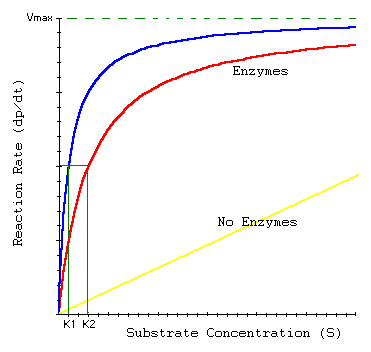
High substrate concentration
all enzymes active sites are occupied meaning, the enzyme is saturated (graph plateaus). adding substrate would not increace reactions rate because there are no more enzyme active sites to be filled, you would have to add more enzymes.
Optimal temperature
enzymes have an optimal temperature where activity is the highest. as temp rises toward the optimal temperature, reactions rate increases. but past the optimal temperature enzyme structure can change, changing its function.
Optimal pH
enzymes have optimal pH levels where activity is the highest. as pH rises towards optimal pH, reactions rate increases. but past or below the optimal pH enzyme shape can change, changing its function.
Cofactor
Inorganic molecule enzyme helper, interact near active site and help stabilize the transition state. Ex. Zn2+
Coenzyme
Organic molecule enzyme helper, interact near active site and help stabilize the transition state. Ex. vitamins, NADH
Competitive inhibition
(regulating enzyme’s activity) a regulatory molecule competes with the substrate for the active site (if inhibitor blocking the active site the substrate cant bind so less product is made)
Allosteric regulation
(regulating enzyme’s activity) a regulatory molecule binds somewhere other than the active site (allosteric site), changing the enzyme’s shape/activity
Phosphorylation
(regulating enzyme’s activity) a phosphate group is added to the enzyme acting like a molecular switch changing its shape/activity
Metabolic pathways
series of enzyme-controlled reactions, like an assembly line. Ex.

Feedback inhibition
one way to regulate an entire metabolic pathway. final product goes back and inhibits an earlier enzyme making the metabolic pathway stop. it does this to prevent the cell from wasting energy making a product it already has enough of
