Module 1: Why, What and How do/are we Feed Animals?
 Call Kai
 Learn
 Practice Test
 Spaced Repetition
 Match
 Flashcards
 Knowt Play
1/11

There's no tags or description
Looks like no tags are added yet.
12 Terms
Why do we feed animals?
moral and ethical reason
food security reasons
economic reasons
production quality reasons; composition, food safety, organoleptic, health benefits
human well-being and hedonistic reasons
Common measure of productive/economic efficiency
Weight gain
ADG in g or kg/day
FCR or feed efficiency
FCR = feed consumed/weight gain; lower the better
Feed Efficiency (FE) or Feed Efficiency Ratio (FER) = weight gain/feed intake; high the better
Feed and Feeding Cost
Feed cost: $/kg of feed
Feeding cost: $/kg of growth or L of milk or wool product, etc.
Food vs Feed
Food
Self-selected items
Often refer to items reserved for humans
Generally higher degree of sanitation (e.g. food grade)
Feed
Imposed items
Farm animals received an imposed ration = feed
Generally lower degree of sanitation (e.g. feed-grade)
Food, Feed vs. Diet
Foods / Feeds = individual items
Diet: A diet refers to the sum of food/feed consumed by an individual
Complete feed
A thoroughly blended mixture of different feed ingredients formulated to meet specific nutrient specifications
Ration
The 24-hour feed allowance for an individual animal.
Total animal feed consumption (without harvested forages)
Canada imports a lot of soy & corn from US

Forages
Bulky plant feeds, such as grass or hay for horses and ruminants; fodder
Crops, annual or biennial, which are grown to be utilized by grazing (pasture) or harvesting as a whole crop
Types of forages in livestock feeding
“Grass” in the pasture where animals graze the standing forage: > 70% moisture (water content)
Conserved forages
Hay: target so that it contains < 15% moisture. very high in moisture content when growing in the field. By making hay, we are producing a low moisture feedstuff that can be simply stored ideally under cover. Lowering pH.
Silage: 50 to 80% moisture (rely on microbial fermentation to produce a high moisture feedstuff)

Dairy feed Concentrate formulation

Types of feed for swine and poultry
Natural diet
Foraging/scavenging for different food items
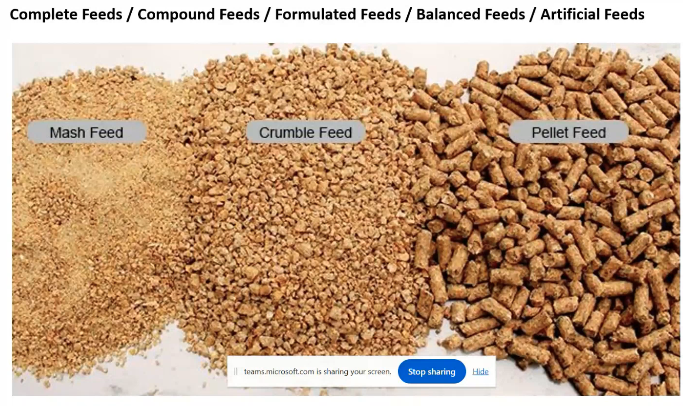
Mash
Homogenous mixture of more or less finely ground ingredients
Pelleted feeds
Homogenous mixture of feed ingredients compacted into pellets
*Pellet and crumble are most common for swine and poultry
Steam pellet mill
