CH 5: SENSATION AND PERCEPTION
 Call Kai
 Learn
Learn Practice Test
 Spaced Repetition
 Match
Match Flashcards
 Knowt Play
1/47

Earn XP
Description and Tags
Name | Mastery | Learn | Test | Matching | Spaced | Call with Kai | Chat |
|---|
No analytics yet
Send a link to your students to track their progress
48 Terms
Define:
Stimuli
Sensation
Sensory Receptors
Perception
Stimuli: anything in the world that we can detect with our senses We don’t experience stimuli directly!
Sensation: receiving stimulus energies (sound or light waves, tactile sensations, etc) from the environment, and transforming those energies into neural energy
Sensory receptors: sensory nerve endings that respond to stimuli
Sensations by themselves are meaningless!
Perception: organizing and interpreting sensory information so that it makes sense
Provides meaning to basic sensory information
Why are sensations considered meaningless on their own?
Sensations are just raw data collected from our surroundings without any context; they only become meaningful when interpreted and organized by our brain through the process of perception.
Can you provide an example of how perception alters our understanding of a sensation?
For instance, the sensation of loud noise can be perceived differently depending on context; a loud siren may indicate an emergency, while loud music at a concert is seen as enjoyable
In what ways do personal experiences influence perception?
Personal experiences shape how we interpret sensations; for example, someone who has had negative experiences with dogs might perceive a barking dog as threatening, while a dog lover may find it joyful.
What is the main difference between stimuli and sensation?
Stimuli are the external factors in the environment that we can detect using our senses
While sensation is the process of receiving and transforming these stimuli into neural energy for our brains to interpret
What is bottom up processing? Can you name an example?
Sensory receptors register information about the external environment and send it to the brain for interpretation
Ex. Stubbing your toe in a dark room -> pain registered by sensory neurons and brain infers that an object is present
Bottom-up info helps brain maintain arousal, keep track of the body’s position in space, regulate movement
What is top down processing? Can you name an example?
When our expectations, knowledge, or experience with the world influence what we sense; information processing guided by higher-level mental processes
Top-down processing helps the brain assign meaning to sensory messages, including information based on prior knowledge, learning, and goals
EX: Speech segmentation: the ability to tell where one word ends, and another begins Language doesn’t naturally come with gaps between words. We learn where the gaps are as we become more fluent with a language
How does top down processing affect perception?
Top-down expectations can influence what we sense
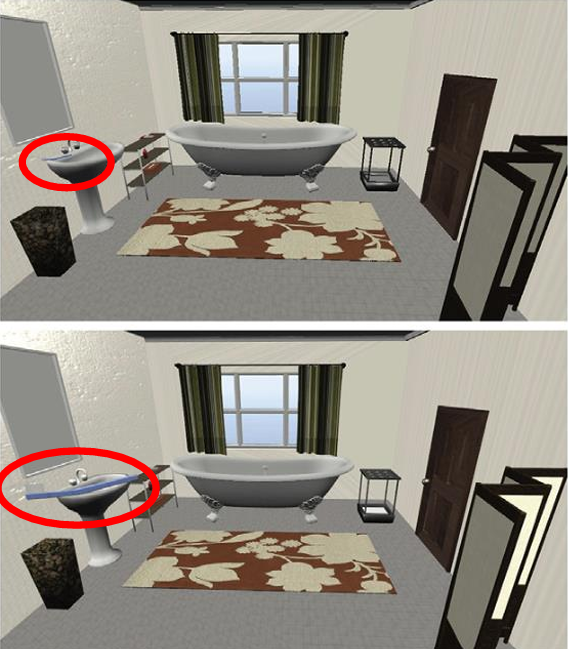
What is off about this picture? How does it show that top down processing affects perception?
Eckstein et al, 2017: view a scene and find the toothbrush
Toothbrush could be normal sized or giant
Participants missed giant objects 13% more often!
We look for objects based on expectations about what they should look like. This would explain why a lot of people missed the toothbrush. They expected it to be smaller but since it wasn’t, they missed it.
When applied to people, this can lead to stereotyping– expectations based on membership in a particular group
What is transduction?
Transduction: Changing one form of energy into another.
How does sensation get to the brain?
Environmental stimuli are taken in by sensory receptors
Stimuli are converted to electrochemical signals
Signals travel through the sensory neurons to the thalamus
Thalamus routes signals to appropriate areas of the cerebral cortex
What are sensory receptors? What are three examples and what do they detect?
Sensory receptors: specialized cells that detect stimulus info and transmit it to sensory/efferent nerves and the brain
Photoreceptors: detect light – sight
Mechanoreceptors: detect pressure, vibration, movements – tough, hearing, equilibrium/balance
Chemoreceptors: detect chemical stimuli – smell, taste
What is the all or nothing principle? Is the potential always the same strength?
All-or-Nothing Principle: once a stimulus reaches a certain level, the neuron WILL fire
Action potential is always the same strength
What is the thalamus?
Thalamus: forebrain structure; acts as relay station for sensory information
What are some areas in the sensory cortex that the thalamus signals to?
Visual info: occipital lobes
Hearing: temporal lobes Pain, touch,
temperature: parietal lobes
Perception is complex! Usually involves extensive coordination and integration between brain areas.
What are absolute thresholds? Name some examples in relation to senses.
The minimum amount of stimulus energy that a person can detect
Individual detects stimulus 50% of the time – arbitrarily decided!
EX:
Noise: irrelevant/competing stimuli – not just sounds!
Vision: candle flame at 30 miles on a dark, clear, night Hearing: ticking clock at 20 feet under quiet conditions
Smell: one drop of perfume throughout three rooms
Taste: a teaspoon of sugar in 2 gallons of water Touch: the wing of a fly falling on your neck from 1 cm
What are difference thresholds? What is difference between low levels of stimulation and high levels?
The degree of difference that must exist between two stimuli before the difference is detected
Difference is detected 50% of the time – again, arbitrary!
Difference thresholds increase as stimuli become stronger
Low levels of stimulation: small changes can be detected
High levels of stimulation: small changes are less noticeable
What is weber’s law?
Two stimuli must differ by a constant proportion to be perceived as different
What is subliminal pereption
Detection of information below the level of conscious awareness
What is priming and primes?
Priming: Activating, often unconsciously, associations in our mind, thus setting us up to perceive, remember, or respond to objects or events in certain ways.
Primes: stimuli that are presented before a target stimulus (sometimes outside of conscious awareness) and which influence later behavior
What is the effects of priming on gambling?
Payne et al, 2016: Participant is dealt two cards, then briefly shown either ‘bet’ or ‘pass’ as a prime word
More ‘betting’ after ‘bet’ prime– but only on moderate-value hands!
What are perceptual sets?
Perceptual Set: a predisposition or readiness to perceive something in a certain way
Act as psychological “filters” in processing information about the environment
Reflect top-down influences on perception – preconceived knowledge or experience!
People are more likely to notice stop signs before intersections than in the middle of a road (Shinoda et al., 2001)
What is sensory adaption? List some examples.
Sensory Adaptation: a change in the responsiveness of the sensory system based on the average level of surrounding stimulation
Turning out the lights, tuning out an air conditioner, getting used to cold water
Sense need time to adapt to changing circumstances
How does vision work in the brain?/ What are components of the eye that contribute to vision?
Vision involves the brain’s interpretation of the visual information sent from the eyes.
The pupil is the opening in the center.
The iris contains muscles that control the size of the pupil, regulating the light that enters.
The cornea and lens bring the image into focus.
At the back of the eye is the retina.
Optic nerve– carries visual information to the brain for further processing
Ganglion cells: connected to rods and cones; axons make up optic nerve
what is the difference between the retina, cones, fovea and rods?
Retina: the multilayered surface that records electromagnetic energy and converts it to neural impulses for processing in the brain.
Cones: the receptor cells that allow for color perception.
Rods: the receptor cells in the retina that are sensitive to light but not very useful for color vision.
Fovea: the tiny area in the center of the retina at which vision is at its best; it contains only cones.
What is the “blind spot” in the eye? How does the brain fill this blind spot?
One place on the retina that contains neither rods nor cones
Where the optic nerve leaves the eye on its way to the brain. Your brain fills in the gap with guesses about what must be in that spot.
How is stimuli registered in each visual field?
Stimuli in each visual field are registered by the retina on the opposite side
Left visual field registered by right side of retina in both eyes and vice versa
what is the Optic Chiasm? What processes and combines visual information?
Optic chiasm: optic nerve fibers
Information registered on right sides of retinas is processed by right side of brain
Information is processed and combined by visual cortex
how does color vision work?/ What are the two theory's for color vision?
Trichromatic theory: Color perception is produced by three types of cone receptors in the retina.
Particularly sensitive to different, but overlapping, ranges of wavelengths.
Three receptor systems involve cones sensitive to red, blue, and green.
Supported by dysfunctional color vision, or color blindness.
Opponent-process theory: cells in the visual system respond to complementary pairs of red-green and blue-yellow colors.
A given cell might be excited by red and inhibited by green, whereas another cell might be excited by yellow and inhibited by blue
Why are both color theories valid?
Both trichromatic theory and opponent process theory are valid!
Cone cells in the retina are trichromatic responsive to red/blue/green light (trichromatic theory)
Cone cells excite or inhibit ganglion cells according to opponent-process theory
How does gestalt perceive shape? / What are gestalts principles?
Gestalt psychology: a school of thought interested in how people naturally organize their perceptions according to certain patterns.
“the whole is different from the sum of its parts”
Gestalt Principles of Perceptual Organization: explain the way small elements are grouped to create larger objects
How does figure ground relationship work?
Figure-ground relationship: the principle by which we organize the perceptual field into stimuli that stand out (figure) and those that are left over (ground).
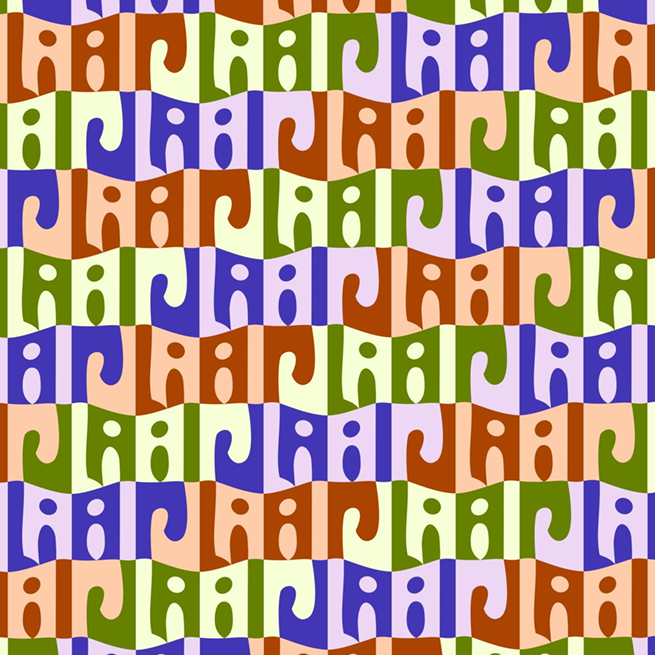
What are gestalts laws of perceptual organization?
Law of good continuation: Lines tend to be seen as following the smoothest path. EX: Think of a rope
Law of proximity: Proximal things are grouped together. EX: think stars in the sky etc.
Law of closure: We fill in gaps to create a complete, whole, object. EX: Good will face
What is depth perception?
Depth perception: Ability to see objects in three dimensions, although images that strike the retina are two-dimensional
Allows people to judge distance
What are the binocular cues of depth perception?
Binocular cues: depend on the use of two eyes.
Convergence: a binocular cue in which muscle movements in an individual’s two eyes provide information about how deep and/or far away something is.
Retinal disparity: The calculation of distance by the brain by comparing images from both eyes
Monocular cues: depth cues available to each eye s
eparately. Includes relative height, relative size, interposition, relative motion, linear perspective, and light and shadow
What is perceptual constancy? / What are the three different forms of consistency?
Perceptual constancy: the recognition that objects are constant and unchanging even though sensory input about them is changing.
Size constancy – object stays the same size despite different retinal images
Shape constancy – object retains shape despite changes in orientation
Color constancy – object is the same color despite different amounts of light
What is audation?
Audition: sense or act of hearing.
What is the relationship between a soundwaves frequency, wavelength, pitch and amplitude?
A sound wave’s frequency is determined by wavelength.
Pitch is the perceptual experience of the frequency.
A sound wave’s amplitude, measured in decibels (dB), is the amount of pressure produced.
Loudness is the perception of the amplitude.
Timbre is the tone saturation, or the perceptual quality, of a sound
How is the ear divided?
Outer Ear: the outermost part—the pinna and the external auditory canal.
Middle Ear: the part that channels and amplifies sound
Inner Ear: the oval window, cochlea, and basilar membrane
What are some other aspects of the ear that generates impulses that the brain interprets as sound?
Basilar membrane – lines inner wall of cochlea; vibrates when exposed to different sound frequencies
Hair cells – line basilar membrane
Cilia– fine bristles on hair cells
Tectorial membrane – cover hair cells
Movement of hair cells against tectorial membrane generates impulses that brain interprets as sound
how do we localize sounds? / Do the left and right ears receive different stimuli?
Left and right ears receive slightly different stimuli
Differences in timing of sound and intensity of sound
Sound travels less distance to ear that is closer to the sound source
The other ear is in the sound shadow of the listener’s head
How do we feel touch?
Touch = mechanical energy = pressure against the skin
feel pressure, temperature, pain
Other skin sensations are variations of the basic skin senses.
EX: wet = pressure + cold
How do we feel pain?
Pain: the sensation that warns you of damage to your body
Nociceptors: detect hurtful temperatures, pressure, or chemicals; brain neural networks process these sensation and produce perceptions of pain
What is the difference between the fast and slow neural pathways?
Fast neural pathway: warning system providing immediate info about an injury
Direct connection with thalamus and sensory/motor cortex areas
Slow neural pathway: reminds the brain that an injury has occurred Info travels through limbic system
How do the chemical senses work?
Taste:
Papillae: the taste buds, the receptors for taste.
Categories of tastes include sweet, bitter, salty, sour, and umami
Smell:
Olfactory epithelium: the lining of the roof of the nasal cavity
Only neural pathway that doesn’t pass through the thalamus – goes straight to limbic system.
How do the kinesthetic senses work/ What are kinesthetic senses, vestibular senses and semicircular canals?
Kinesthetic senses: provide information about movement, posture, and orientation.
Receptors embedded in muscle fibers and joints.
Vestibular sense: provides information about balance and movement.
The kinesthetic senses and the vestibular sense work together to coordinate our proprioceptive feedback
Supported by vision – if visual field is moving, we’re probably moving
Semicircular canals: three fluid-filled circular tubes in the inner ear containing the sensory receptors that detect head motion.
As you move your head, your perception of the movement and position is determined by how the fluid flows in different directions and different speeds.
How does sensory interaction work?
Sensory interaction is the principle that one sense may influence another.
What is the Mcgurk effect and what is it an example of?
McGurk Effect: when a person sees a speaker produce one sound but hears another sound, the brain perceives something in between
Sensation and perception are two points on a continuum
Example of sensory interaction.