psych midterm 2 - language
 Call Kai
 Learn
 Practice Test
 Spaced Repetition
 Match
 Flashcards
 Knowt Play
1/27

There's no tags or description
Looks like no tags are added yet.
28 Terms
language
a specific form of communication which can be done through spoken language, sign language, or written language
uses highly structures rules
three constructs of language properties
symbols, structure, and generativity
symbols
sounds, words, gestures (lexicon)
lexicon = a group of symbols
ex. chinese characters, the latin alphabet
structure
turning symbols into meaningful units
semantics (meaning) + syntax (grammatical rules)
ex. diff parts of a sentence being put tgt to make a proper sentence
generativity
combine symbols to form an infinite amount of novel messages
putting together a combination of words to make a really unique sentence
why is language not a foolproof method of communication?
receiving information: = surface structure → deep structure
expressing information = deep structure → surface structure
surface = receiving the info
deep = making sense of the info, turning sensation into perception
the meaning can be slightly modified at this stage
miscommunication can happen
interpersonal synchrony
helps w understanding and empathy
phys cues that communicate/synchronize meaning between multiple ppl
why miscommunication can happen online
physiological synchronization:
heart rate, breathing, tone of voice, gestures, etc.
motor mirroring:
imitation and reaction to facial expressions
neuronal coupling:
brainwave synchrony
phoneme
smallest unit unit of sound in a given language
the fuh i er tr u ck
morpheme
the smallest unit of meaning (combinations of phonemes)
the + fire + truck
s @ end of word = plural
word
a functional unit
how does language develop in infants?
observation
imitation
reinforcement
clapping when a baby says a word
natural readiness to learn language
natural language acquisition
experience-expectant plasticity
experience-dependent plasticity (for additional languages)
critical period of phonemes
1yo: you can’t reliably produce phonemes that you haven’t practiced in this critical period
7yo: you cannot reliably perceive differences in phonemes from other languages
monolinguals
native english (or wtv ur first language or main language is) speakers
non-immersion speakers
learned english as a second language without living in an english-speaking country
immersion learners
learned english as a second language while living in an english-speaking country
aphasia
an acquired language disorder
classified by fluency, comprehension, and repetition
symptoms - trouble..
speaking clearly
understanding speech
writing clearly
understanding written words
remembering words
remembering object names
how do u acquire aphasia
stroke
traumatic brain injury (tbi)
tumor in brain
brain infection/disease
three classifications of aphasia
fluency
is speech fluent?
comprehension
can they comprehend spoken messages?
can have limits, but mostly like can they answer in line with the questions asked
repetition
can the person repeat words or phrases?
“can you say ____ for me?”
broca’s area + aphasia
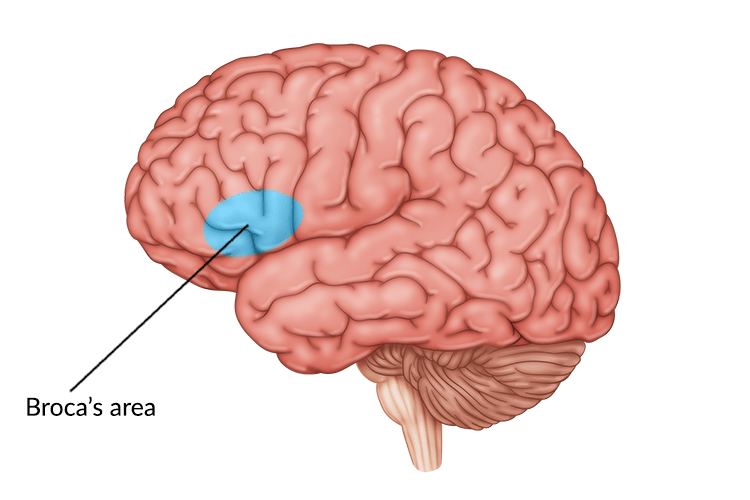
broca’s area:
responsible for speech production
identified by paul broca
in frontal lobe next to the primary motor cortex (for mouth/hands to move to produce language)
broca’s aphasia
characterized by non-fluent speech and good comprehension
wernicke’s area + aphasia
wernicke’s area:
responsible for speech comprehension
in temporal lobe
wernicke’s aphasia
characterized by fluent speech and comprehension challenges

lesion studies
the foundation of classical linguistics
after broca (and also wernicke) met patients who couldn’t speak properly, they would die shortly after and they would investigate their brain
found lesions in the broca’s area and above wernicke’s area
→ that must be where speech is produced / understood
arcuate fasciculus
suggested by geschwind
a white matter tract (a bunch of axons sending messages) in between the broca’s and wernicke’s area
if this is injured patients would have difficulty repeating back
broca’s and wernicke’s areas are not affected so ppl can still speak fluently and understand
conduction aphasia
characterized by fluent speech and comprehension, but a challenge with repetition
wouldn’t be able to count to ten, would skip numbers or say random words
understands qs and can speak
classical (broca-wernicke-lichtheim-geschwind) model
classical model of neurolinguistics
combination of all the areas
start in the primary language area
sent to wernicke’s area to get comprehended
→ broca’s area (thru the arcuate fasciculus) to produce the speech
→ to motor cortex to have ur mouth move to speak
language-related brain regions are left lateralized, or are all in the left hemisphere

new technologies that have allowed for complex modern understandings of neurolinguistics
mri/fmri
eCoG
eeg but on the surface/cortex of the brain
eeg
TMS
(don’t need to know)
can create a temporary lesion in the brain
turns off a brain region temporarily by using magnetic fields and then turned back on when finished
dual stream model (2000s)
dorsal stream:
smo speaks to u → auditory cortex → wernicke’s area & gets processed/made sense of → broca’s + motor cortex → produce speech
ventral stream:
along temporal lobes
semantic processing (meaning)
understanding the meaning of words
wernicke’s = take in the info and connect it to smt that it means
how do i make sense of this to turn it into speech
semantic = being able to understand what was actually said