Chemistry Lab Final
 Call Kai
 Learn
 Practice Test
 Spaced Repetition
 Match
 Flashcards
 Knowt Play
1/103

Earn XP
Description and Tags
Includes information on 1.0 Foundations Laboratory Skills: Measurement and Data Quality, 2.0 Principles of Spectroscopy and Solutions, 3.0 Other methods of Quantitative Analysis, 4.0 Chemical Synthesis, 5.0 Ideal Gas Law, 6.0 Molecular Geometry and Polarity, and 7.0 Predicting Chemical Reactions
104 Terms
the quality of any conclusion is directly dependent what?
the quality of the measurements taken,
Good scientific measurements are both what?
accurate and precise
Accuracy
How close a measurement is to the true or accepted value.
Precision
The consistency of repeated measurements (how close they are to each other).
Is a mistake and scientific error the same?
No, mistakes are avoidable and invalidates a result
Scientific error
inherent part of any measurement. Usually divided into 2 types
1st Type of Scientific Error
Systematic error
2nd Type of Scientific Error
Random error
Systematic error
Errors that result from definite causes, biasing the data in one direction.
How do systematic error occur?
From a flaw in equipment or experimental design
Are systematic errors reproducible?
Yes
Can systematic errors be corrected?
Yes, this causes better results
What is a example of systematic error?
Using a poorly calibrated pipet to prepare all the standard solutions for an experiment, causing every concentration to be consistently too low.
Random error
Errors that result from uncontrolled variables in the experiment. Usually small
Can random error be removed?
Not completely
What is a example of random error?
subjective judgment in determining the exact moment the pink-to-blue color change occurs at the endpoint of the EDTA titration.
Meniscus
curved surface of a liquid where it meets the walls of its container
Why does the meniscus form?
due to surface tension.
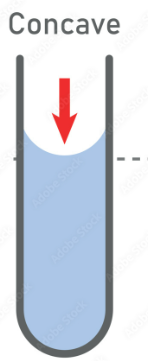
For water and most aqueous solutions, what kind of meniscus do they have?
A concave (it curves downward)
What position should your eyes be to properly read a meniscus?
Same level as the liquid
What happens if your eye positions is wrong?
It will cause a parallax error and an inaccurate reading.
How should you correctly record a measurement?
by estimating one digit beyond the smallest graduation mark on the instrument.
What does estimating a digit beyond smallest graduation mark show?
The uncertainty of the measurement
Correctly Reporting a Measurement Example
A buret has markings every 0.1 mL. You must estimate the readings to the nearest 0.01mL.
1st Category for Lab Glassware:
general-purpose containers for holding and mixing
2nd Category for Lab Glassware:
high-precision instruments designed for accurate measurement.
General-Purpose containers
Beaker & Erlenmeyer Flask
Beaker
cylindrical container made from sturdy borosilicate glass, which allows it to be heated.
Beakers Main Purpose
holding chemicals, mixing solutions, and carrying out reactions where precise volume is not a major concern.

Erlenmeyer Flask
flat bottom, conical body, and narrow neck. The sloped sides are designed to reduce evaporation and prevent splashing, making it ideal for swirling and mixing solutions.
TC (To Contain)
This marking indicates that the glassware is calibrated to hold the exact volume specified.
TD (To Deliver)
This marking indicates that the glassware is calibrated to deliver the exact volume specified when emptied correctly
1st Type of High-Precision Volumetric Glassware
Graduated Cylinder
2nd Type of High-Precision Volumetric Glassware
Volumetric Flask
3rd Type of High-Precision Volumetric Glassware
Volumetric Pipet
4th Type of High-Precision Volumetric Glassware
Buret

Graduated Cylinder Key Feature
tall, narrow laboratory container marked with numerous markings along its length to measure a wide range of volumes, typically ranging from 10 mL to 1000 mL.
Graduated Cylinder Purpose
Measuring and transferring a liquid volume with moderate precision.
Volumetric Flask Purpose
Preparing a solution to a specific, final volume (e.g., 100.00 mL)

Volumetric Flask Key Feature
Has only one mark on its narrow neck for a single, highly accurate volume.
Volumetric Pipet Purpose
Transferring a single, highly accurate fixed volume of liquid (e.g., 10.00 mL)

Volumetric Pipet Features
Has only one mark to deliver a specific, pre-calibrated volume.
Buret Purpose
Delivering variable, but precisely measured, volumes of liquid.
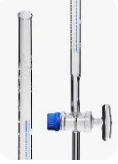
Buret Features
A long, graduated tube with a stopcock to control the flow of liquid, ideal for titrations.
Choice of glassware involves what?
a trade-off between convenience and the required level of precision for a given task
Beaker or Erlenmeyer Flasks are good for what goals?
Holding chemicals, mix solutions, or performing a reaction where precise volume isn't critical.
Why are Beakers or Erlenmeyer flasks only good for that specific goal?
They are general-purpose containers, but their markings are only approximate
Volumetric Flask is good for what goal?
Preparing a solution with a highly accurate final volume (e.g., 100.00 mL)
Why are Volumetric Flask only good for that one goal?
It is calibrated 'To Contain' (TC) a single, precise volume.
Volumetric Pipet is good for what goal?
Transfer a single, highly accurate volume of liquid (e.g., 10.00 mL) from one container to another.
Why is a Volumetric Pipet only good for that goal?
It is calibrated 'To Deliver' (TD) a specific, fixed volume with high precision
A Buret is good for what goal?
Deliver variable, precise amounts of a liquid, such as in a titration
Why is a Buret good for that only purpose?
It is designed 'To Deliver' (TD) and allows you to measure the exact volume dispensed to two decimal places.
Spectroscopy
powerful analytical tool that allows chemists to investigate matter by studying its interaction with light
How can Spectroscopy be used?
for both qualitative analysis and quantitative analysis (t).
qualitative analysis
identifying what a substance is
quantitative analysis
determining how much of a substance is present
solution
stable, homogeneous mixture of two or more substances
solute
substance present in the smaller amount that gets dissolved
solvent
substance present in the greater amount that does the dissolving
independent variable
the property that is changed in a controlled manner by the experimenter (e.g., concentration of a solution)
Which axis represents the independent variable?
The x-axis
dependent variable
the property that responds to this change (e.g., absorbance)
Which axis represents the dependent variable?
The y-axis
Transmittance (T)
ratio of light that passes through a solution to the total light that hits it
Absorbance (A)
measure of the quantity of light absorbed by the solution
What equations relates Transmittance and Absorbance?
A = 2-log%T
Lambda Max (λmax)
specific wavelength at which a substance absorbs the most light
How is the lambda max used?
in qualitative analysis to help identify a compound
On a graph, what the lambda max?
The highest point
Beer-Lambert Law
law states the direct, linear relationship between a solution's absorbance and its concentration.
What is the equation for Beer-Lambert Law?
A = alc
What is A in Beer-Lambert Law Equation?
Absorbance
What is a in Beer-Lambert Law Equation?
Molar absorptivity constant
What is l in Beer-Lambert Law Equation?
path length of the light through the solution
What is c in Beer-Lambert Law Equation?
concentration
Linear Range
The range of concentrations for which the Beer-Lambert Law holds true,
What does linear range mean for graphs?
the plot of Absorbance vs. Concentration yields a straight line
Regarding Linear Range, how do you get accurate results?
Quantitative analysis must be performed within this range
Standard Solution
A solution of a precisely known concentration
How do you prepare a standard solution?
By the careful dilution of a more concentrated stock solution
What Standard Solutions used for?
To create a calibration curve.
Dilution Factor
The ratio of the final volume of a diluted solution to the initial volume taken from the stock solution.
What is a example of a dilution factor?
A 10-fold dilution has a dilution factor of 10
he color a solution appears to the human eye is determined by what?
the wavelengths of light that are transmitted through it, not the ones that are absorbed.