salamanders of FL 4462C
 Call Kai
 Learn
 Practice Test
 Spaced Repetition
 Match
 Flashcards
 Knowt Play
1/82

There's no tags or description
Looks like no tags are added yet.
83 Terms
- gills have 3 frills
-possess true teeth
-paedomorphy (or paedogenesis) is common
-fully aquatic
name 4 larval synapomorphies
-no middle ear cavity (tympanum)
-forelimbs are always present
-most have opisthocoelous vertebrae (anterior is convex, posterior is concave)
-some have amphicoleous vertebrae (both sides are concave
name 4 salamander synapomorphies
concave on both sides and more common in frogs
amphicoleous vertebrate ( appearance and presence)
Head, trunk, tail
Segments of a sally body
Convex on one side, concave on the other
Opisthocoelous vertebrae
Skull, in-between vertebrae, and pelvic & pectoral girdles
What parts of the skeleton are cartliaginous?
entire species retains larval features thru sexual maturity
Paedomorphic
Individuals will retain larval body plan thru sexual maturity
Paedogenesis
true teeth
Larvae possess _____
Derived Lineages
Internal Fertilization
Basal Lineages
External fert
between limbs, assist with water movement
Costal Grooves
Lungless Salamanders (Family), most specious family of salamanders
Plethodontidae
Lack : lungs, ypsiloid cartilage, pterygoid (jaw) bone, lacrimal (tearduct) bones,
Vertebrae: Opisthocoelous
Plethodontidae synapomorphies (lacking, vertebrae type,
Present: Spinal Nerve Foramen,
-nasolabial groove,
-vomerine teeth,
-complex cloacal structure,
-mental glands
Plethodontidae synapomorphies (present)
-genus
-Some are neotenic
-Breeding males may have large cirri and mental glands
- many live in wet places
Eurycea traits
Eurycea cirrigera (Two-Lined Salamander)
name this pokemon!

14 costal grooves, yellow with black lines, rocky brooks & river swamps, Least concern
ID E. cirrigera traits (costal grooves, habitat, conservation)

Eurycea guttolineata (3 Lined Salamander)
name that pokemon!

13-14 costal grooves, yellow-tan-brown blotches, forested floodplains & ditches, Least concern
ID E. guttolineata traits

E. quadridigitata (Coastal Dwarf Salamander)
who's that pokemon!

16-18 costal grooves, 4 TOES, brown with scattered dark flecks, low swampy areas & bottomland forests, Least concern
E. quadridigitata traits
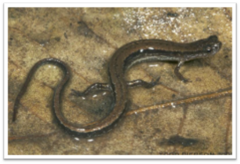
Eurycea sphagnicola (Bog Dwarf Salamander)
who's that pokemon! (no specimen)

12-14 costal grooves, gold-bronze, 4 toes, no keel on tail, pitcher plant bogs, G1 critically imperiled due to low range of habitat
E. sphagnicola traits

Eurycea wallacei (Georgia Blind Salamander)
name this pokemon! (no specimen)

red feathery gills, paedomorphs, subterranean cave dwelling,4 toes, threatened due to pollution of ground water, petitioned for ESA
E. wallacei traits

Pseudotriton montanus (Mud Salamander)
name that pokemon!

16-17 costa; grooves, brownish orange with spots, mucky seepage areas & backwater ponds, threatened in some ranges due to water quality sensitivity
P. montanus traits

Pseudotriton ruber (Red Salamander)
name that pokemon!

16-17 costal grooves, vermillion w/ black spots, clear rocky streams & springs, least concern although threatened by logging, costco pizza
P. ruber traits

Mole Salamanders
Ambystomatidae
-only found in North America
-nocturnal and solitary
-semi-fossorial
-most metamorph to terrestrial form
-males are larger
Ambystomatidae traits
-large head
-prominent costal grooves
-lack nasolabial grooves
-lungs & ypsiloid cartilage present
Ambystomatidae physical traits
Ambystoma cingulatum (Flatwoods Salamander)
name that pokemon!! no specimen

14 or less costal grooves, black with grey granite pattern, Vulnerable
A. cingulatum traits

A. bishopi (Reticulated Flatwoods Salamander)
name this pokemon! no specimen
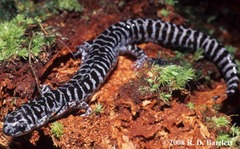
14 or more costal grooves, black w/ zebra-like grey striping, endangered due to habitat loss
A. bishopi traits

Ambystoma talpoideum (Mole Salamander)
name that pokemon

10-11 costal grooves, tubby body with brown-black color & blueish-white speckling, sometimes paedogenic, least concern
A. talpoideum traits

Ambystoma opacum (Marbled Salamander),
- individual is a male (bright white male, grey females)
name that pokemon! (what sex is this individual?)

11-12 costal grooves, black w/ white or grey marbling, males are larger, least concern
A. opacum traits

Ambystoma tigrinum (Eastern Tiger Salamander)
name that pokemon!

11-14 costal grooves, robust boy, black w/ yellow tiger stripes, sometimes paedogenic, least concern
A. tigrinum traits

true sallys and newts
Salamandridae
-NO COSTAL GROOVES
-rough, toxic skin (tetrodoxin & samandinine)
-opisthocoelous vertebrae
-septomaxillae & lacrimals absent
-lungs, ypsiloid cartilage, & spinal foramena present
-aquatic larval stage -> terrestrial efts -> sexually mature adults
Salamandridae physical traits
notophthalamus perstriatus (Striped Newt)
name that pokemon!

often neotenic, olive green w/ red black bordered stripe down back, eft form is bright orange with dots,
N. perstriatus traits

-Notophthalamus viridescens (Eastern Newt)
-spp. is N.v. piaropicola (Peninsula Newt)
name that pokemon! (species & subspecies)

-4 subspecies
-all have some form of unripe banana speckling w/ olive-brown bodies,
-breeding males develop certain physical characteristics.
N. viridescens traits

Dusky Salamander (genus)
Desmognathus
- many species, 4 you need to identify
-short & stout,
-necks wider than heads,
- hindlimbs bigger than forelimbs
-triangular, keeled tail
Desmognathus traits
Desmognathus apalachicolae (Apalachicola Dusky Salamander)
name this pokemon!

-light sandy brown w/ dorsal blotches (stripe down back),
-mucky floodplains & bottomland forests
-imperiled due to declining water quality
D. apalachicolae traits

Desmognathus auriculatis (Southern Dusky Salamander)
name this pokemon!
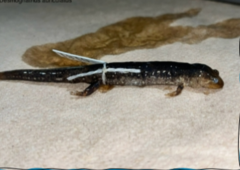
-dark brown or black
-mucky areas near coastal swamps, springs & more
-historic range covered campus (only 1% now), petitioned for protection
D. auriculatis traits

Desmognathus conanti (Spotted Dusky Salamander)
-notice that sawtooth tail
name that pokemon!
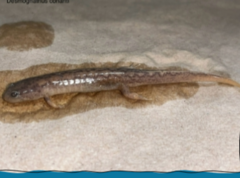
-light brown with dorsal saw-tooth pattern
-mucky floodplains
-endangered in parts of range (think "endangerment is spotty throughout range")
D. conanti traits

Desmognathus monticola (Seal Salamander)
name that pokemon!
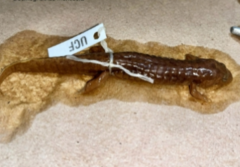
-purple-brown with spots (specimen is rubbery brown like a fake worm)
-mountain streams, muddy areas
-endangered in parts of range
D. monticola traits
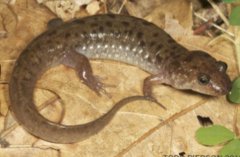
Monotypic genus
-4 toes on hindlimbs
-constriction of tail for autonomy (drop off)
Hemidactylium (+2 main physical traits)
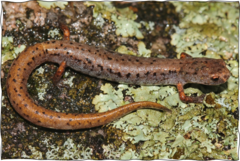
Hemidactylium scutatum (scutatum skidaddles without his tail)
name that pokemon!

monotypic genus
-skinny head
-3-5 longitudal lines on sides
- 1-2 years to metamorphose, larave are well-developed
Stereochilus (+3 main physical traits)

Stereochilus marginatus (Many-Lined Salamander)
-Marge Simpson
name that pokemon!

not monotypic, but need know 1 species
-direct developers
-almost entirely terrestrial/fossorial
-16-19 costal grooves
Plethodon (+3 main traits)

Plethodon grobmani (Slimy Sally)
name that pokemon!

-proteidae
-Amphiumidae
-Sirenidae
name 3 aquatic families of sallys
Congo Eel Family (aggressive & bitey) (1 genus)
Amphiumidae
-long and slender, dark
-incomplete metamorphosis (paedomorphic)
-lungs present
-absent: ypsiloid cartilage, lacrimals, septomaxillae
-4 tiny leggies
-alrgest blood cells of any vertebrate
Amphiumidae physical traits
Amphiuma means (two-toed amphiuma)
name that pokemon!
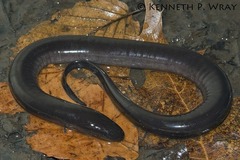
-two toed freak with 4 tiny limbs
-only amphiuma specimen (huge bro)
-largest salamander in United States
-dark brown-grey
-swamps and bayous
-least concern
A. means traits

basically identical to A. means except he has 1 pinky on each limb
-near threatened
-secretes a bitter white substance
Amphiuma pholeter (1-toed Amphiuma) traits (no specimen)

Necturus beyeri (Gulf Coast Waterdog)
name that pokemon! (no specimen)

-paedomorphic (fully aquatic, frilly gills, tail fin)
-dark brown, reticulated
-spring fed streams and sandy bottoms
-least concern
N. beyeri traits
Sirens
Sirenidae
4 specimens to learn
-eel-like body with frilled gills, tiny forelimbs w/ no hindlimbs
-Dwarves have 3 digits, sirens have 4 digits
-non-pedicellate teef
-lungs and keratinized beak present
-4 chambered heart!
-ability to aestivate (gets slimy and sleeps in mud when drought)
Sirenidae synapomorphies
Pseudobranchus striatus (Northern Dwarf Siren)
name that pokemon!

-brown with yellow stripes, 3 digits on each limb, 29-33 costal grooves
-cypress domes and prairie ponds
-48 chromosomes
-least concern
Pseudobranchus striatus traits

Pseudobranchus axanthus (Southern Dwarf Salamander)
name that pokemon!

-grey or brown with yellow stripes
-64 chromosomes
- cypress domes and prairie ponds
-least concern
P. axanthus traits

siren lacertina (Greater Siren)
name that pokemon!

largest and most commmon in Fl
-olive to light grey with yellow speckling
-36-40 costal grooves
-ditches and ponds
-least concern
S. lacertina traits

Siren intermedia (Lesser siren)
name that pokemon!

-31-35 costal grooves
-rare on campus
-somewhat herbivorous
-virtually no markings
-
S. intermedia traits
