General myology 1 and 2 - DONE
 Call Kai
 Learn
Learn Practice Test
 Spaced Repetition
 Match
Match Flashcards
 Knowt Play
1/57

Earn XP
Description and Tags
W2 Kani
Name | Mastery | Learn | Test | Matching | Spaced | Call with Kai | Chat |
|---|
No analytics yet
Send a link to your students to track their progress
58 Terms
What are the types of muscles?
1. smooth muscles
2. striated muscles (skeletal and cardiac)
What are the functions of the muscles?
contracts: active shortening
relaxes: passive lengthening
"muscles only pull, never push"
What is the muscle origin?
attachment closer to the center of the body (proximal attachment)
What is the muscle insertion?
attachment farther from the center of the body (distal attachment)

what are tendons?
connective tissue to attach the muscle to the bones
**typically, the tendon at the origin of the muscle is very short, it appears the muscle is attached directly to the bone. The tendon at the insertion of the muscle may be very long**
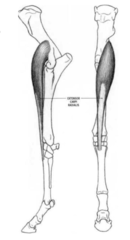
What is a broad, flat tendon called?
aponeurosis (in the case of flat muscles, the tendon of insertion is also flat).

true/false- the tendon of a muscle may attach to the tendon of another muscle
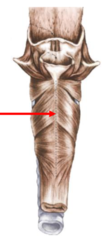
TRUE- a muscle pair may both originate from a single midline tendon
this is called a raphe
muscles attach to bones but act on _______________
joints
true/false- muscles MUST cross a joint to act on it
TRUE- muscles may cross and act on one, several joints, or a region
what are the muscle actions on joints?
1. flex/extend
2. adduct/abduct
3. pronate/supinate
4. rotate
5. stabilize
6. in the tail = raise/lower, left/right
What is the flexor surface?
the side of the joint where the act of flexion decreases the resting angle
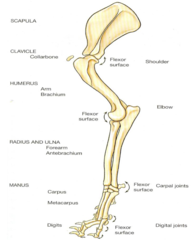
what is the extensor surface?
the side of the joint where the act of extension increases the resting angle

true/false- the proximal and distal digital joints "rest" in hyperextension
TRUE
What is adduction?
to draw toward the midline
"add to the body"

What is abduction?
to draw away from the midline
"take away from the body"

What is circumduction?
to move in a circle
what is medial rotation?
to rotate toward the midline (pronation)
What is lateral rotation?
to rotate away from the midline (supination)
true/false- large animals can pronate/supinate
FALSE- large animals have a fused radius/ulna so they cannot supinate/pronate (this affects the number of muscles present)
What is a sphincter?
A circular muscle that constricts or dilates to regulate the passage of materials through an opening

what is a circular muscle?
made up of concentric muscle fibers (ex. orbicularis oculi)

What is a two bellied muscle?
two muscular bellies joined together by an intermediate tendon

What is a two-headed muscle?
two bundles of muscle each with its own origin, but sharing a common insertion point

what is a single-headed muscle?
has one origin and one insertion

What is a multipennate muscle?
has multiple tendinous insertions and its fibers are oriented at multiple angles (AKA there is a tendon inside)
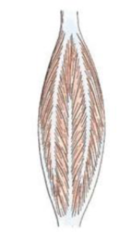
what is a unipennate muscle?
muscle fibers insert on only one side of the tendon

What is an intrinsic muscle?
muscles confined to a structure (ex. in the thoracic limb, the muscle has its origin and insertion in the thoracic limb)
AKA the origin and insertion are within the same structure
What is an extrinsic muscle?
muscles that connect the structure to the body (ex. the origin of a muscle is in the body, but the insertion is on the thoracic limb)
AKA the origin is outside the structure, insertion is inside (or vice versa)
what is a cutaneous muscle?
just deep to the skin (minimal or no skeletal attachment)
*often are twitch muscles*
How many muscles of facial expression are there?
38
How are head muscles classified?
By region:
1. mouth and cheek
2. muzzle and nose
3. eyelids
4. ears
What are some examples of mastication muscles?
1. temporalis m
2. masseter
3. digastricus
4. pterygoids

What is the function of the intrinsic muscles of the tongue?
complicated local movement of the tongue

What is the function of the extrinsic muscles of the tongue?
moving the tongue as a unit

What are the muscles of breathing and swallowing?
1. pharyngeal muscles
2. soft palate muscles
3. laryngeal muscles
4. hyoid muscles
What do the pharyngeal muscles do?
act to dilate or constrict (swallowing) the pharynx
What do the soft palate muscles do?
act to elevate (swallowing), depress, or shorten the soft palate
what do the laryngeal muscles do?
act to open or close the laryngeal opening and to control the pitch of vocalization
What do the hyoid muscles do?
act to move the hyoid relative to the larynx
What are the epaxial muscles?
those muscles of the vertebral column dorsal to the transverse processes (ex. transversospinalis, longissimus, iliocostalis)
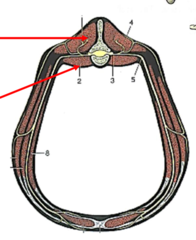
what are hypaxial muscles?
those muscles of the vertebral column ventral to the transverse processes
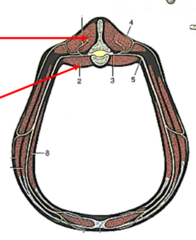
what are the muscles of the body wall?
layered muscles that not only contain and support the viscera within, but also help support the vertebral column and thus body as a whole (ex. muscles of respiration)

What is synsarcosis?
union between parts of the skeleton by muscles alone (no bony articulation)
ex. there is no bony attachment that attaches the thoracic limb to the axial skeleton

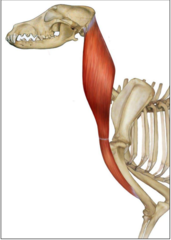
When the limb is weight-bearing, what happens during contraction of the extrinsic TL muscle?
contraction of the extrinsic TL muscle moves the body relative to the limb
ex. when the left brachiocephalicus m. contracts and the left forelimb is weight-bearing, the head and neck are moved to the left.

If the limb is non weight-bearing, what happens during the contraction of the extrinsic TL muscle?
contraction of the extrinsic TL muscle moves the limb relative to the body
ex. when the left brachiocephalicus m. contracts and the left forelimb is non weight-bearing, the left forelimb is advanced and the shoulder joint is extended.
What intrinsic muscles are present in the lateral and medial shoulder?
extensor of the shoulder j.
stabilizers of the shoulder j.

what intrinsic muscles are present in the caudal shoulder?
flexor of the shoulder joint

what intrinsic muscles are present in the cranial arm?
flexors of the elbow j.

what intrinsic muscles are present in the caudal arm?
extensor of the elbow j.
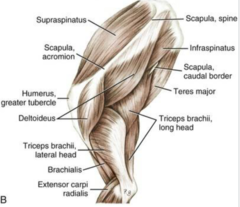
what intrinsic muscles are present in the cranio-lateral forearm?
extensors of the carpus and digits
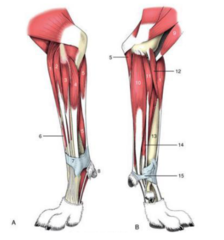
what intrinsic muscles are present in the caudo-medial forearm?
flexors of the carpus and digits

What muscles are present in the lateral pelvis?
flexors and extensor of the hip j.

what muscles are present in the medial pelvis?
rotator of the hip joint
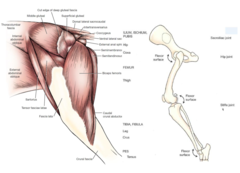
What muscles are present in the cranial thigh?
flexor of the hip
extensor of the stifle
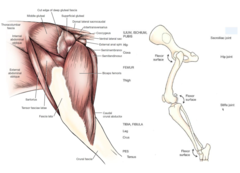
What muscles are present in the caudal thigh?
extensor of the hip
extensor and flexors of the stifle
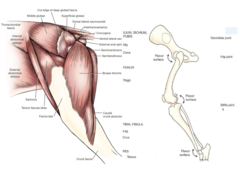
What muscles are present in the cranio-lateral leg?
flexors of the hock
extensor of the digits
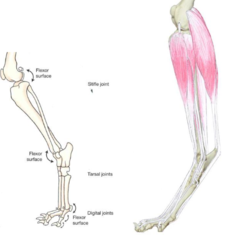
What muscles are present in the caudal leg?
extensor of the hock
flexors of the digits

What is in a muscle's name?
1. action: extensor carpi radialis m. (extends the carpus)
2. shape: trapezius m.
3. attachments: brachiocephalicus m. (attaches head to brachium)
4. location: external intercostal mm. (externally in the ribs)
5. number of heads: triceps/biceps brachii