ASCI 330 - Unit 2 Part 1
 Call Kai
 Learn
Learn Practice Test
 Spaced Repetition
 Match
Match Flashcards
 Knowt Play
1/98

Earn XP
Description and Tags
Starting September 30 -
Name | Mastery | Learn | Test | Matching | Spaced | Call with Kai | Chat |
|---|
No analytics yet
Send a link to your students to track their progress
99 Terms
What best describes heritability?
A measure ranging from 0 to 1 that measures how offspring resemble their parents (i.e., the proportion of variance in phenotypic values due to variance in breeding values)
Which of the following represents the equation for heritability?

What is true of variance in breeding values?
A population has a distribution of BV and therefore a variance = o2BV
What is the genetic model for a population?
o2p = o2BV + o2GCV + o2Ep + o2Et + o2Ecg
Which represents how heritability may be calculated when looking for the proportion of variance in phenotypic value due to variance in breeding value?

What is another way to define heritability?
The proportion of variation in a phenotype due to additive genetics (the BV)
How may heritability be calculated as a regression (i.e., the regression of breeding value on phenotypic value)?

Which equations represent a way to calculate heritability?

What does it mean for a trait to be highly heritable (h2 > 0.4)?
Animals with high performance tend to produce progeny with high performance, and an animal’s performance, on average, is a good indicator of his/her breeding value
What does it mean for a trait to be lowly heritable (h2 < 0.4)?
The performance of the parents reveals little about progeny performance
What is meant when we say a trait is heritable?
We mean the differences in performance for the trait are heritable
If a trait is highly heritable, does it mean breeding values are also high?
High heritability implies a strong relationship between phenotypic values and breeding values; breeding values vary regardless of heritability (as long as the heritability is not zero)
Is a heritability specific to an individual?
No! Heritability is a population parameter
Are heritabilities fixed?
It depends; they tend to be stable within a population … but vary between populations (e.g., breeds) and environments
Reminder: what is the overall design of breeding programs?
Define breeding objective → choose selection criteria → evaluate animals → select and mate → monitor progress → disseminate improvement
What is selection about?
Picking individuals with the best breeding values
What do we have to predict with polygenic traits?
Breeding values (EBV) from phenotypic values
What is true of heritability and selection?
As heritability increases, the accuracy of selection will increase
How do phenotypic values tell you about breeding values?
Via heritability
What is true of heritability and prediction?
Heritability provides an indication of how confident you can be with predictions
What is true of high heritability and management?
When traits are highly heritable, the differences in breeding value have a big impact on performance and the environment has a relatively small effect
Why do breeders often focus selection on highly heritable traits, such as growth traits?
They are easier to change
What do producers try to do for lowly heritable traits, such as fertility?
They often try to improve performance (P) through management (E)
What is true of producing ability (PA)?
It is a function of all factors that permanently affect an individual’s ability to perform

What is repeatability (r)?
A change in producing ability per unit change in phenotypic value

How may repeatability also be viewed?
The proportion of the differences in performance (P) that are attributable to differences in producing ability

What is true of repeatability?
It tells us if the animal’s performance is a good (or bad) indicator of subsequent performances, but it does NOT tell us about the animal’s value for breeding
What is true of repeatability in term of repeated measures?
Our prediction equation needs to account for one or multiple records; in other words, all the information you have on that animal
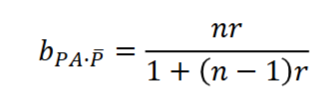
How may this equation (regression of PA on phenotypic mean) be broken down?
p bar = phenotypic mean, r = repeatability, and n = number of repeated records
What is repeatability necessary to predict?
Producing ability (PA) for multiple records
What is true of repeated records being correlated?
Each new record does not provide entirely independent information about an individual; repeatability is used to weight the marginal information an extra record provides
What is true when r is high?
Another record provides less extra information than when r is low
What happens as we get more records in terms of repeatability?
Each provides less information
What is true of a highly repeatable trait (r > 0.4)?
The first record of an animal is, on average, a good indicator of subsequent records
What is true of a lowly repeatable trait (r > 0.4)?
A given record is a poor indicator of any other records
What are the properties of repeatability?
Range in value from 0 to 1 (usually), is a population parameter (individual does not have), and is not a fixed value (value varies between populations an environments)
What is true of repeatability and culling?
For traits that are of high repeatability, poor performance at one record is often a good reason to cull an individual
What is the difference between high heritability and high repeatability?
Heritability means the phenotype is a good indicator of breeding value, and repeatability means one performance is a good indicator of the next (producing ability)
How may heritability and repeatability be improved?
Environmental uniformity, accurate and precise management, adjustment factors, and contemporary group effects
Why is a good (and high as possible) estimate good?
The higher the heritability, the better any one performance record is an indicator of breeding value, and the higher the repeatability, the better any one performance record is an indicator of producing ability
How may environmental uniformity be used to improve heritability and repeatability?
Manage animals in a manner such that their environment is as similar as possible (i.e., minimize o2E)
How may accurate and precise measurement be used to improve heritability and repeatability?
When measurements are recorded both accurately and precisely, the trait’s heritability will be higher
How may adjustment for known environmental and biology be used to improve heritability and repeatability?
There are some effects that have a consistent, measurable impact that can be adjusted for (e.g., age at weaning; individual’s sex; age of dam; birth-rearing type)
How may accounting for contemporary groups be used to improve heritability and repeatability?
As a group of animals that have experienced a similar environment with respect to the expression of a trait, contemporaries typically perform in the same location, are the same sex, are of similar age, and have been managed alike
Which represents the equation for predicting breeding value (BV)?

What is the key equation (aka Breeder’s equation)
ΔBVX / t → rBVX,BVXiXoBVX / Lx

What is accuracy of selection?
The strength of the relationship between true breeding values and their predictions
What occurs with more accurate predictions?
The better we can identify individuals with the best ‘true’ breeding values

What does accuracy of selection range from?
0 to 1

What factors affect accuracy of selection?
Heritability of the trait (higher = more accurate), and the amount and source of information used in prediction
What is the equation when selecting using a single record based on the animal’s own performance (phenotypic selection)?
Accuracy = h2 squared

What is selection intensity (iX)?
How choosy breeders are in deciding which individual are selected; high intensity means choose the only the very best individuals, and with intense selection, genetic change is quicker
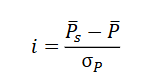
What is the mathematical definition of selection intensity (i)?
The difference between the mean phenotype for the individual’s selected and that of all candidates for selection, expressed in standard deviation units
What are the two approaches to calculating selection?
Use equations previously discussed and short cut with truncation selection
What is truncation selection?
Selection on a distinct division (point of truncation) above which individuals are kept for breeding, and below which they are culled
What does the selection intensity equation become when accounting for males and females separately?

What is generation internal (Lx)?
The amount of time required to replace one generation with the next; the average age of parents when their selected offspring are born
What is true of short generation intervals (L)?
Genetic change can be quick, such as 2 to 3 months in mice and 20 to 30 years in humans
What does our key equation become when accounting for males and females separately in regards to generation interval?

What is true of selection intensity and generation interval?
They are calculated separately for males and females
What is true of the key equation in terms of parents?
It represents the mean for each sex as each animal has a parent of each sex that contribute 50% to the progeny
What is true of variation in breeding value?
It is not something we really change as it tends to be fixed within a population, but with intensive selection, it can in theory be reduced
What trade offs should be considered in the key equation?
Intensity (i) vs generation interval (L), intensity (i) vs risk, accuracy vs selection, and accuracy vs generation interval (L)
Why should we consider trade offs in the key equation?
Due to us wanting to maximize the accuracy and intensity of selection and minimize the generation interval, which is not easy
What is replacement rate?
the rate at which newly selected individuals replace existing parents in a population (which is more relevant in females)
What is true of many systems in the intensity versus generation interval?
Females must be retained as replacements as we replace older unsound females with young females
What is the generation rule for the female generation interval?
If sires are genetically far superior than dams, save as many female replacements as possible, and If sires are only slightly better than dams, save fewer female replacements and be more selective in your choice
What is selection intensity?
The risk that the true breeding values of replacements will be significantly poorer than expected as seen more relevantly in males; you measured or guessed poorly
In terms of intensity versus risk, what is true of using one “exceptional” male (usually via AI)?
Putting all your eggs in one basket may not be as good as you thought (i.e. higher intensity and risk)
In terms of intensity versus risk, what is true of using multiple males?
There may be some poorer ones yet likely some better ones too in which average BV likely matches expectations (i.e. lower intensity and risk)
What is true of selection in most species and circumstances?
Male selection is more important than female selection
What is true of males producing more offspring?
Their impact on the next generation is larger, and their evaluation can be more accurate (magnified by AI)
What is true since we need fewer males in selection?
We can be pickier (intense) in selection
What is progeny testing?
Collecting evidence on the genetic value of an animal by gather data on his/her offspring
What is true of collecting data on sires?
There are often economic constraints associated with it
What is the goal of progeny testing?
Choose two best bulls best for feed efficiency
What is true of the economic constraints when testing sires in accuracy vs. intensity?
Test more males but fewer of offspring of each (less accurate but more intense), or test fewer males, each with more offspring (more accurate but less intense)
What best describes marker assisted selection (MAS)?
Specific genetic test for causative mutation or a handful of genes with known impact usually associated with genes with a major impact, and does not contribute significantly to quantitative traits
What best describes single nucleotide polymorphisms (SNP)?
A single variant in DNA (A or T, C or G, A or G, etc.), and tens of hundreds of thousands of SNPs evaluated at one time
What best describes genomic selection?
Variation of a quantitative trait is attributed to (many) markers across the genome that allows for the development of predictive equations
What are the assumptions of genomic selection?
• The trait is influenced by many markers
• Each contributes a minimal amount to the
phenotypic variance (<1%)
What is a key assumption of genomic selection?
A SNP is in close proximity to each locus contributing to the phenotype; “Tagging SNP” due to linkage disequilibrium
What are prediction equations built upon in genomic selection?
A reference population; Large groups of animals and accurately phenotyped for trait(s) of interest
What are SNP effects quantified in?
The reference population
How are genomic enhanced (GE) EBV calculated?
In the industry population using information from the reference population
Which of the following statements is true of genomic selection?
High density genotype of all animals is used to estimate the impact of each SNP on the phenotypic variance of the trait
In genomic selection, what traits have the highest impact?
Sex limited, expensive or hard to measure, only measurable after slaughter, and expressed later in life
What is true of linkage disequilibrium (LD)?
A nonrandom association of alleles at two loci
What is true if the LD is not consistent between the reference and test populations?
The estimated effects of the SNP may not hold true
What might make genomic selection more accurate?
• Genotyping all individuals in a population
• Using a high density of markers genotyped
• Identification of functional variation
What best describes the trade off associated with genome-wide information used to augment prediction of breeding values?
Increases selection accuracy
What best describes the trade off associated with the GE-EBV allowing for selection of animals with SNP information but without phenotypes?
Decrease generation interval
What happens to accuracy versus generation interval in using a sire for multiple years?
Lower selection accuracy to lower generation interval
What happens to accuracy versus generation interval in using a sire for one year?

True/False: If a trait has a high repeatability, one record from an animal (it's phenotype) is a good indication of its producing ability.
True
For a highly repeatable trait, an animal that performs poorly should not be used for breeding.
You cannot tell based upon this information.
Consider the following information for a population of racing snails. Given are the variances for the various portions of the genetic model. The trait - how far they move in 1 hour - is measured in cm. The population average is 20.9 cm.
Term | Variance (cm2) |
Gene Combination Value | 10.6 |
Breeding Value | 14.2 |
Permanent Environment | 20.3 |
Temporary Environment | 5.2 |
Contemporary Group (Environment) | 4.0 |
What is the repeatability of this trait?
0.831
Your classmate has her own population of racing snails (who knew?!). She calculated the repeatability in her population to be 0.52 with a and heritability of 0.40.
She wants to predict the producing ability of one of her snails based upon it's first race (it went 17.7 cm in 1 hour). What regression coefficient would you use in your calculation of that snail's estaimted producing ability? The average distance traveled in 1 hour in that population is 16.5 cm.
0.52
The snail from the prior question has now competed in 4 races. The distance it achieved in each was: 17.6, 17.3, 18.0, and 16.7 cm. If you recalculate its producing ability, what regression coefficient should now be used?
Reminder that the repeatability in her population is 0.52 and heritability 0.40. The average distance traveled in 1 hour in that population is 16.5 cm.
0.813