BIO2 Reading 8
 Call Kai
 Learn
 Practice Test
 Spaced Repetition
 Match
 Flashcards
 Knowt Play
1/25

There's no tags or description
Looks like no tags are added yet.
Name | Mastery | Learn | Test | Matching | Spaced | Call with Kai | Chat |
|---|
No analytics yet
Send a link to your students to track their progress
26 Terms
Selective Permeability
Allowing only substances meeting certain physical criteria to cross the membrane; controls the concentration of substances in the in the cell
Relative Permeability
Differences in membranes' mosaic compositions cause permeability rates to vary

Membrane Permeability Coefficient
Rate of movement of a substance across a biological membrane

Osmosis
Movement of water through a semipermeable membrane according to the concentration gradient of water across the membrane
Tonicity
The ability of an extracellular solution to change the volume of a cell by affecting osmosis; correlates directly with osmolarity

Osmolarity
Total solute concentration of the solution; water moves from low osmolarity to high osmolarity
Low -> Greater # of water molecules relative to # of solute particles
High -> Lower # of water molecules relative to # of solute particles

Hypotonic Solution
Extracellular fluid has lower osmolarity that intracellular fluid -> water enters the cell

Hypertonic Solution
Extracellular fluid has higher osmolarity than intracellular fluid -> water exits the cell

Isotonic Solution
Osmolarity of extracellular fluid equals that of intracellular fluid; no net movement of water

Osmoregulation
Method to control the effects of osmosis, such as plasmolysis in plant cells (cell does not shrink in hypertonic solution due to the cell wall) and contractile vacuoles in protists (collect excess water and pump it out)

Passive Transport
Exergonic movement of substances across the membrane from a high concentration to a low concentration; energetically favorable

Types of Passive Transport (2)
Simple diffusion and facilitated transport/diffusion

Simple Diffusion
Substance moves across a concentration gradient until the concentration with the cell equals that outside the cell

What factors can impact simple diffusion? (6)
Extent of the concentration difference inside and outside the cell
Shape/size/mass of substance
Temperature
Solvent density
Surface area/thickness of the membrane
Distance travelled by the substance

Facilitate Transport/Diffusion
Substances diffuse across the membrane with the help of transmembrane proteins
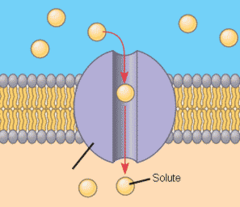
Channel Protein
Provide a "passageway"/"tunnel" for either a specific substance or multiple substances sharing characteristic(s); can be open at all times or gated (controlled by binding of small molecules/ions or by environmental conditions)
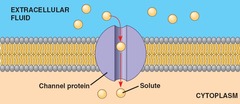
Aquaporins
Protein channels that facilitate the movement of water into and out of a cell

Carrier Proteins
Bind to a substance, triggering a change in its shape that moves the substance to the other side of the membrane depending on the concentration gradient; usually serve a particular substance

Active Transport
Endergonic movement of substances across the membrane from a low concentration to a high concentration coupled with an exergonic reaction; energetically unfavorable

Pump
Active transport mechanism

Electrogenic Pump
Pump creating a charge imbalance across a membrane

Primary Active Transport
Moves ions across a membrane, creating a difference in charge on either side (uses ATP/energy)

Secondary Active Transport
Moves substances using the electrochemical gradient established by primary active transport (indirectly uses ATP/energy)

Uniporter
Carrier protein that moves one ion/molecule across the membrane

Symporter
Carrier protein that moves two ions/molecules across the membrane in the same direction

Antiporter
Carrier protein that moves two ions/molecules across the membrane in the opposite direction
