POB Chapter Questions (Chapters 25, 5, 23, 24, 27)
 Call Kai
 Learn
 Practice Test
 Spaced Repetition
 Match
 Flashcards
 Knowt Play
1/143

Earn XP
Description and Tags
Chapters 25, 5, 23, 24, 27
144 Terms
DNA does NOT have which of the following characteristics?
A. has a double helix
B. bases held together by hydrogen bonds
C. has a deoxyribose sugar
D. contains adenine, guanine, cytosine, and uracil
D. contains adenine, guanine, cytosine, and uracil
Which base is unique to DNA?
A. guanine
B. adenine
C. thymine
D. uracil
C. thymine
The individual(s) credited with the discovery of the structure of DNA is (are)
A. James Watson and Francis Crick.
B. Erwin Chargaff.
C. Rosalind Franklin and Maurice Wilkins.
D. Charles Darwin and Gregor Mendel.
A. James Watson and Francis Crick.
In semiconservative DNA replication, each new double helix formed will have
A. two new strands and two old strands.
B. one new and one old strand in each helix.
C. two new and one old strand in one helix and two old and one new strand in second helix.
D. two new strands in one helix and two old strands in the other helix.
B. one new and one old strand in each helix.
Because one original strand of the double-stranded helix is found in each daughter molecule, the replication process is called
A. proofreading.
B. semi-conservative.
C. freeing of DNA.
D. mutation positive.
B. semi-conservative.
The enzyme that reads the template strand and makes a complementary strand of DNA is
A. DNA polymerase.
B. RNA polymerase.
C. helicase.
D. ribozyme.
A. DNA polymerase.
The _____ enzyme is responsible for unwinding the double-helix structure of DNA during replication.
A. helicase
B. polymerase
C. extendase
D. windase
A. helicase
Which does NOT describe a function of the DNA polymerase molecule?
A. recognize the free nucleotide that pairs with the base on the old strand of DNA
B. read the strand of old DNA and recognize the base there
C. proofread to ensure that the proper base has been incorporated
D. synthesize the proper nucleotide to match with the base read on the old strand
D. synthesize the proper nucleotide to match with the base read on the old strand
Which of the classes of RNA molecules carries the genetic information from the nucleus as it is needed for the construction of a protein?
A. ribosomal RNA
B. transfer RNA
C. messenger RNA
D. nuclear RNA
C. messenger RNA
The function of transfer RNA is to
A. carry amino acids to ribosomes.
B. transmit coded information to the cytoplasm.
C. turn DNA on and off.
D. act as the site for protein synthesis.
A. carry amino acids to ribosomes.
Which of the classes of RNA molecules carries the amino acids that are added to the growing polypeptide chain?
A. ribosomal RNA
B. transfer RNA
C. messenger RNA
D. ribozyme
B. transfer RNA
The ______ contain(s) the information for the structure of the protein.
A. introns
B. exons
C. promoter
D. ribosomes
B. exons
An intervening sequence of DNA that is NOT expressed is called a(n)
A. exon.
B. intron.
C. replicon.
D. gene.
B. intron.
During the process of transcription, the information in
A. a protein is converted into RNA information.
B. RNA is converted into protein information.
C. RNA is converted into DNA information.
D. DNA is converted into RNA information.
E. DNA is converted into protein information.
D. DNA is converted into RNA information.
Which is the process that synthesizes mRNA?
A. translation
B. transcription
C. transformation
D. translocation
B. transcription
The correct sequence of events in the production of a polypeptide is
A. initiation - termination - elongation
B. elongation - termination - initiation
C. elongation - initiation - termination
D. initiation - elongation - termination
D. initiation - elongation - termination
Which is the process by which a protein is constructed in the cytoplasm of eukaryotic cells?
A. translation
B. transcription
C. transformation
D. translocation
A. translation
If the normal nucleotide sequence was TACGGCATG, what type of gene mutation is present if the resulting sequence becomes TAGGCATG?
A. germinal mutation
B. addition mutation
C. deletion mutation
D. substitution mutation
C. deletion mutation
Which of the follow is NOT a frameshift mutation of the nucleotide sequence CATUAUCCC?
A. ATUAUCCC
B. CTUAUCCC
C. CATUAUCGC
D. CCATUAUCCC
C. CATUAUCGC

In the diagram of DNA, notice the three chemical bond in the center image labeled “A'“, “B”, and “C”. The bond represented by a dotted line below the letter “A” is a
A. ionic bond
B. covalent bond
C. hydrogen bond
C. hydrogen bond
The anticodon
A. is found on the DNA coding strand
B. can be found on the chart of the genetic code
C. is found on the transfer RNA
D. is found on the ribosomal RNA
C. is found on the transfer RNA
The part of a transfer RNA molecule that binds to the codon is the
A. active site
B. anticodon
C. codon
D. rRNA
E. amino acid
B. anticodon
Mutations in DNA
A. occurs at random sites
B. are placed in DNA as needed by the cells
C. arise due to natural selection
D. never have an effect on mRNA sequences
A. occurs at random sites
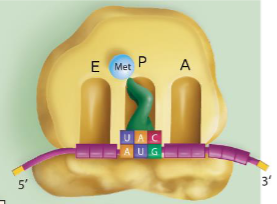
In the image, the site that is ready for a new transfer RNA to complementary base pair its anticodon to the codon is labeled
A. A
B. P
C. E
A. A

Consider the type of mutation represented by the sequence labeled A. Which of the following could be true for that mutation type? (Multiple choice)
A. It is a substitution mutation
B. In some cases that type of mutation will be silent
C. It is an insertion
D. it is a deletion
E. it is a frameshift mutation
F. It is a point mutation
G. It is the same type of mutation that causes sickle-cell anemia
A. It is a substitution mutation
B. In some cases that type of mutation will be silent
F. It is a point mutation
G. It is the same type of mutation that causes sickle-cell anemia

Consider the diagram representing DNA replication. Match the letter label to the thing being labeled
1). A
2). B
3). C
4). D
5). E
6). F
A. template DNA from parent molecule
B. DNA ligase
C. Original double-stranded DNA
D. DNA helicase
E. newly synthesized DNA
F. DNA polymerase
[F] 1). A
[D] 2). B
[C] 3). C
[A] 4). D
[E] 5). E
[B] 6). F
What is NOT a correct association?
A. S stage-DNA synthesis
B. M stage-mitosis and cytokinesis
C. interphase-shortest stage of the cell cycle
D. G2 stage-metabolic preparation for mitosis
C. interphase-shortest stage of the cell cycle
Which of the following is the correct sequence for the cell cycle?
A. S-M-G1-G2
B. S-M-G2-G1
C. S-G1-G1-M
D. S-G2-M-G1
D.S-G2-M-G1
During which stage of the cell cycle do the chromosomes duplicate?
A. prophase
B. interphase
C. telophase
D. mitosis
B. interphase
Upon examination, a cell is found to have twice as much DNA as the normal diploid state but is no longer in the process of replicating the DNA. All of the DNA is found within a single nucleus. Which stage of the cell cycle is this cell in?
A. M phase
B. S phase
C. G1 phase
D. G2 phase
D. G2 phase
Which of the following proteins would you expect to be a coded for by a proto-oncogene?
A. a growth factor receptor
B. a DNA repair protein
C. a protein involved with the G1 checkpoint
D. a caspase
A. a growth factor receptor
Which type of genes, when abnormally activated so that protein is always present and active, can result in cancer?
A. tumor suppressor genes
B. proto-oncogenes
C. DNA repair protein genes
D. executioner caspase genes
B. proto-oncogenes
If a cell stops at the G1 checkpoint, this is most likely due to what problem?
A. The DNA has not finished replicating.
B. There is DNA damage.
C. The cell is cancerous.
D. There is no problem. The cell normally stops at the G1 checkpoint.
B. There is DNA damage.
Which of the following is not involved in the regulation of the cell cycle?
A. cyclins
B. internal and external signals
C. growth factors
D. caspases
D. caspases
Which of the following is NOT true concerning the checkpoints in the cell cycle?
A. Mitosis stops if chromosomes are not properly aligned.
B. Mitosis will not occur if DNA is damaged or not replicated.
C. If DNA is damaged, apoptosis may occur.
D. The p53 protein causes the cell to divide even if the DNA is damaged.
D. The p53 protein causes the cell to divide even if the DNA is damaged.
Which sequence of stages in mitosis is correct?
A. prophase, metaphase, interphase, telophase
B. anaphase, interphase, telophase, prophase
C. prophase, metaphase, anaphase, telophase
D. interphase, metaphase, prophase, anaphase
C. prophase, metaphase, anaphase, telophase
During what stage of mitosis does the nuclear envelope disappear and the chromosomes become distinct?
A. prophase
B. metaphase
C. anaphase
D. telophase
A. prophase
The nuclear membrane reappears in mitosis during
A. interphase.
B. prophase.
C. metaphase.
D. anaphase.
E. telophase.
E. telophase
In which stage of mitosis do the chromosomes line up in the center of the cell?
A. interphase.
B. prophase.
C. metaphase.
D. anaphase.
E. telophase.
C. metaphase
If the diploid chromosome number is 16, the chromosome number of each gamete will be
A. 4.
B. 8.
C. 16.
D. 32.
B. 8
Meiosis results in a change in chromosome number indicated by
A. 2n to 2n.
B. 2n to n.
C. n to 2n.
D. 2n to 2n in diploid organisms, n to n in haploid.
B. 2n to n.
During what stage do homologous chromosomes separate from each other?
A. prophase
B. anaphase I
C. anaphase II
D. metaphase I
E. metaphase II
B. anaphase I
Synapsis occurs during what stage of meiosis?
A. anaphase I
B. telophase II
C. metaphase II
D. prophase I
E. anaphase II
D. prophase I
During what stage of meiosis do sister chromatids separate from each other?
A. anaphase I
B. anaphase II
C. metaphase I
D. metaphase II
B. anaphase II
During which phase will homologous chromosomes separate?
A. anaphase I
B. anaphase II
C. anaphase
D. metaphase I
A. anaphase I
What lines up at the metaphase plate during metaphase II of meiosis and metaphase of mitosis?
A. each chromosome composed of two sister chromatids at both
B. homologous chromosomes at both
C. each chromosome composed of two sister chromatids for meiosis, each chromosome composed of one sister chromatid for mitosis
D. homologous chromosomes for meiosis, each chromosome composed of two sister chromatids for mitosis
E. each chromosome composed of two sister chromatids for meiosis, homologous chromosomes for mitosis
A. each chromosome composed of two sister chromatids at both
What lines up at the metaphase plate during both metaphase I of meiosis and metaphase of mitosis?
A. each chromosome is composed of two sister chromatids at both
B. homologous chromosomes at both
C. each chromosome composed of two sister chromatids for meiosis, each chromosome is composed of one sister chromatid for mitosis
D. homologous chromosomes for meiosis, each chromosome is composed of two sister chromatids for mitosis
E. each chromosome is composed of two sister chromatids for meiosis, homologous chromosomes for mitosis
D. homologous chromosomes for meiosis, each chromosome is composed of two sister chromatids for mitosis
Which of the following statements is NOT true about oogenesis in humans?
A. It occurs in the ovary.
B. The egg will contain 23 chromosomes.
C. Four equal size daughter cells will form.
D. At least two nonfunctional polar bodies will form.
C. Four equal size daughter cells will form.
In the human life cycle, fertilization results in
A. a zygote.
B. a gamete.
C. oogenesis.
D. a haploid cell.
A. a zygote
In the human female life cycle, meiosis begins
A. in the fetus.
B. at birth.
C. at the onset of puberty.
D. at the onset of menopause.
A. in the fetus
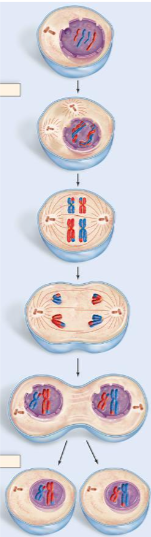
In the diagram, what cell divisions is represented?
A. Mitosis
B. Meiosis 1
C. Meiosis 2
B. Meiosis 1

In the diagram, which of the Ras proteins, A or B, is mutated and why?
A. The one labeled B because it there is no growth factor present and it is still sending a signal for cell division.
B. The one labeled A because it there is no growth factor present and it is still sending a signal for cell division.
C. The one labeled A because it there is a growth factor present and it is sending a signal for cell division.
D. The one labeled B because it there is a growth factor present and it is sending a signal for cell division.
A. The one labeled B because it there is no growth factor present and it is still sending a signal for cell division.
Alternative forms of a gene that influence the same trait and are found at the same location in homologous chromosomes are called
A. alleles.
B. phenotypes.
C. genotypes.
D. incomplete dominance.
A. alleles
Which of the following represents the physical characteristics of the individual?
A. phenotype
B. genotype
C. alleles
D. dominance
A. phenotype
What are alleles?
A. genes for different traits, such as hair color and eye color
B. alternative forms of a gene for a single trait, such as blue eyes or brown eyes
C. the locations of genes on a chromosome
D. recessive forms of a kind of characteristic carried by genes
B. alternative forms of a gene for a single trait, such as blue eyes or brown eyes
The _____ indicates the gene combination of an individual.
A. phenotype
B. loci
C. genotype
D. homozygous
C, genotype
Which of the following is NOT correct concerning the law of independent assortment?
A. It is based upon the process of meiosis.
B. Each pair of factors separates independently.
C. All possible combinations of factors can occur in the gametes.
D. It follows the observation that all maternal chromosomes end up in the egg.
D. It follows the observation that all maternal chromosomes end up in the egg.
Which is NOT true according to Mendel's law of segregation?
A. Each individual contains two alleles for each trait.
B. An individual can have either both dominant alleles, both recessive alleles, or a dominant and recessive allele.
C. Alleles separate from each other during gamete formation.
D. Each gamete contains one copy of each allele.
E. Fertilization restores the presence of two alleles.
B. An individual can have either both dominant alleles, both recessive alleles, or a dominant and recessive allele.
Mendel's law of segregation implies that the two members of an allele pair
A. are distributed to separate gametes.
B. are distributed to the same gamete.
C. are assorted dependently.
D. are segregated pairwise.
A. are distributed to separate gametes.
In a Mendelian monohybrid cross involving two homozygous genotypes, the ____ generation is always completely heterozygous.
A. F1
B. F2
C. P
D. P2
A. F1
What will the genotypic ratio be of a monohybrid cross of two individuals who are both heterozygous for a trait? Use the link in the instructions to an online Punnett square
frame.
A. 100% homozygous dominant
B. 50% homozygous dominant, 50% homozygous recessive
C. 25% homozygous dominant, 50% heterozygous, 25% homozygous recessive
D. 50% homozygous dominant, 50% heterozygous
C. 25% homozygous dominant, 50% heterozygous, 25% homozygous recessive
A pheasant breeder starts with two birds in the P generation, one of which is AA and the other is aa. If he takes two of the birds from the F1 generation and breeds them together, what can he expect in his F2 offspring?
A. AA and Aa.
B. Aa and aa.
C. AA, Aa, and aa.
D. Aa only.
C. AA, Aa, and aa.
A woman who can roll her tongue (presumably dominant) is married to a man who cannot. Two of their four children can roll their tongues and two cannot. If A = roll tongue
and a = cannot roll tongue, then what is the genotype of the parents?
A. woman Aa; man Aa
B. woman AA; man aa
C. woman Aa; man AA
D. woman Aa; man aa
D. woman Aa; man aa
Some plants fail to produce chlorophyll, due to a recessive trait. If we locate a pea plant that is heterozygous for this trait, self-pollinate it, and harvest the seeds, what are the likely phenotypes of the resulting offspring?
A. All will be green with chlorophyll since that is the dominant trait.
B. About one-half will be green and one-half white since that is the distribution of the genes in the parents.
C. About one-fourth will be white and three-fourths green since it is similar to a monohybrid cross.
D. About one-fourth will be green and three-fourths white since it is similar to a monohybrid cross.
C. About one-fourth will be white and three-fourths green since it is similar to a monohybrid cross.
A cross is made between two parents with genotypes AaBB and aabb. If there are 32 offspring, how many of them would be expected to exhibit both dominant
characteristics?
A. 32
B. 24
C. 16
D. 8
E. 0
C. 16
In guinea pigs, B = black, b = brown, S = short hair, s = long hair. A heterozygous black, short-haired animal reproduces with a brown, long-haired animal. What is the
expected phenotypic ratio of the offspring?
A. 1 black short hair, 1 black long hair, 1 brown short hair, 1 brown long hair
B. 9 black short hair, 3 black long hair, 3 brown long hair, 1 brown short hair
C. 9 black short hair, 3 black long hair, 3 brown short hair, 1 brown long hair
D. 9 black short hair, 6 black long hair, 3 brown long hair, 1 brown short hair
A. 1 black short hair, 1 black long hair, 1 brown short hair, 1 brown long hair
In humans, aniridia, a type of blindness, is due to dominant allele A. Migraine headaches are due to another dominant allele M. If a man who suffers from both
conditions (AaMm) marries a woman who suffers from both (AaMm), what are the chances of an offspring expressing both traits?
A. 9/16
B. 3/16
C. 1/2
D. 1/16
A. 9/16
In which kind of cross could you expect to find ratios of 1:1:1:1 among the offspring?
A. monohybrid cross
B. dihybrid cross
C. one-trait test cross
D. two-trait test cross
D. two-trait test cross
In guinea pigs, B = black, b = brown, S = short hair, s = long hair. Two heterozygous individuals reproduce. The expected results are
A. 9 black long hair, 3 black short hair, 3 brown long hair, 1 brown short hair.
B. 9 black short hair, 6 black long hair, 3 brown long hair, 1 black short hair.
C. 9 black short hair, 3 black long hair, 3 brown short hair, 1 brown long hair.
D. 9 brown short hair, 3 black long hair, 3 brown long hair, 1 black short hair.
C. 9 black short hair, 3 black long hair, 3 brown short hair, 1 brown long hair.
What genetic disorder is associated with the lack of an enzyme necessary for the normal metabolism of the amino acid phenylalanine?
A. phenylketonuria (PKU)
B. Huntington disease
C. sickle cell disease
D. cystic fibrosis (CF)
A. phenylketonuria (PKU)
Which genetic disorder is associated with an irregular shape of the red blood cells?
A. sickle cell disease
B. Marfan syndrome
C. Huntington disease
D. cystic fibrosis (CF)
A. sickle cell disease
What are the chances that two individuals with wavy hair (an incomplete trait) will have a curly-haired child? Curly hair and straight hair exhibit incomplete dominance.
A. none
B. 25%
C. 50%
D. 75%
B. 25%
The four o'clock flower is an example of incomplete dominance: R = red, r = white, and Rr = pink. If two hybrids are crossed, what are the chances that an offspring will have pink flowers?
A. 0%
B. 25%
C. 50%
D. 75%
E. 100%
C. 50%
Traits that are controlled by several sets or pairs of alleles, such as skin color and height in humans, are the result of what form of inheritance?
A. polygenic
B. incomplete dominance
C. simple Mendelian inheritance
D. codominance
A. polygenic
Which of the following is an example of the blending of phenotypes?
A. codominance
B. polygenic inheritance
C. simple Mendelian inheritance
D. incomplete dominance
D. incomplete dominance
You have two true-breeding rose bushes, one with red flowers and one with white flowers. A cross between these two roses yields a bush with pink flowers. What condition does this demonstrate?
A. codominance
B. incomplete dominance
C. environmental effects
D. polygenetic inheritance
B. incomplete dominance
When two or more genes with multiple alleles affect the same trait in an additive fashion, it is termed
A. a double-trait cross.
B. codominant.
C. incomplete dominance.
D. polygenic inheritance
D. polygenic inheritance
You have two true-breeding rose bushes, one with red flowers and one with white flowers. A cross between these two roses yields a bush with white flowers that have red splotches. What condition does this demonstrate?
A. codominance
B. incomplete dominance
C. environmental effects
D. polygenetic inheritance
E. monohybrid inheritance
A. codominance
Cold weather can change the ______ of a Himalayan rabbit.
A. genotype
B. phenotype
C. alleles
D. sex
B. phenotype
Hydrangeas are a flowering plant with large showy blooms. When a plant is grown in aluminum-rich soil it has blue flowers. If the same plant is transplanted into soil that is lacking aluminum, the flowers produced will be pink. This is an example of
A. codominance.
B. incomplete dominance.
C. environmental effects.
D. polygenetic inheritance.
C. environmental effects.
In peas, yellow is dominant over green in seeds. With which of these is it best to cross a yellow-seeded pea plant to determine whether it is homozygous or heterozygous?
A. a green-seeded plant
B. a heterozygous, yellow-seeded plant
C. a pure, yellow-seeded plant
D. a heterozygous, yellow-seeded plant or a pure, yellow-seeded plant
A. a green-seeded plant
In a testcross, an organism with a dominant phenotype, but unknown genotype is crossed with which of the following to establish its genotype?
A. homozygous dominant
B. heterozygous
C. homozygous recessive
D. heterozygous dominant
C. homozygous recessive

Common fruit flies, Drosophila melanogaster, have been used as model organisms to study inheritance in animals for many years. Flies with the yellow body phenotype make no melanin. Look at the image above to see diagrams representing the "wild-type" and "yellow body" flies. In an experiment, Karen crossed a true-breeding line of wild-type flies with yellow body flies. All the offspring of those crosses were wild-type. Then Karen crossed the offspring with each other. She got 328 yellow body flies and 1014 wild-type flies. What is the probably inheritance pattern for the yellow body allele?
A. Yellow body is recessive to wild-type.
B. Wild-type is recessive to yellow body.
C. Wild-type and yellow body are incompletely dominant.
D. Wild-type and yellow body are codominant
A. Yellow body is recessive to wild-type.

This pedigree documents an autosomal recessive trait. Remember, affected individuals are represented by filled in shapes. What is the genotype of individual 6 at generation II?
A. Homozygous Dominant
B. Homozygous Recessive
C. Heterozygous
D. There is not enough information given to tell.
C. Heterozygous

What type of inheritance is represented by the above pedigree? Remember, affected individuals are represented by filled in shapes.
A. Autosomal Dominant
B. Autosomal Recessive
A. Autosomal Dominant
A man with AB blood type can have a child with type O.
A. True
B. False
B. False
The location of a gene on a chromosome is called
A. a locus
B. a linkage map
C. a linkage group
D. an allele
A. a locus
Considering that males can have Klinefelter (XXY) syndrome, XYY, and normal XY chromosomal combinations, and females can have Turner (XO) syndrome, poly-X (XXX, XXXX), and normal XX combinations, it is obvious that
A. maleness results from the presence of only one X chromosome.
B. maleness results from the absence of two or more X chromosomes.
C. maleness results from the minimal presence of one Y chromosome.
D. femaleness results from the presence of two or more X chromosomes.
C. maleness results from the minimal presence of one Y chromosome.
Genes on the ___ chromosome determine if the sex of a child will be male or female
A. X
B. Y
C. 21st
D. 5th
B. Y
A normal male marries a color-blind woman. What percent of their female children will be color-blind?
A. 0%
B. 25%
C. 50%
D. 75%
E. 100%
A. 0%
Color-blindness is inherited as an X-Linked recessive trait. A male who is color-blind marries a heterozygous woman. What percent of their total children will be color blind?
A. 0%
B. 25%
C. 50%
D. 75%
E. 100%
C. 50%
A color-blind (recessive trait) woman will pass the allele to
A. her sons only
B. all her children
C. her daughters only
D. none of her children
E. her husband
B. all her children
If a woman is a carrier for the color-blind recessive allele and her husband vision, what are their chances that a son will be color-blind?
A. none, because the father is normal
B. 50%, since the mother is only a carrier
C. 100% because the mother has the gene
D. 25% because the mother is a hybrid
E. none since the son will also just be a carrier
B. 50%, since the mother is only a carrier
Which of the following sex-linked diseases is characterized by the absence of a clotting factor?
A. hemophilia
B. color-blindness
C. Duchenne muscular dystrophy
D. none of the answer choices are true
A. hemophilia
Which refers to the loss of a complete chromosome?
A, inversion
B. translocation
C. deletion
D. monosomy
D. monosomy
A person who has an extra copy of a chromosome is said to have
A. monosomy
B. trisomy
C. nondisjunction
D. duplication
B. trisomy
Generally, it is not possible to determine whether nondisjunction failed to occur in oogenesis or spermatogenesis. However, it is possible to assert that _____ resulted in nondisjunction in ____.
A. XXY; oogenesis
B. XYY; spermatogenesis
C. XXX; oogenesis
D. XXY; spermatogenesis
B. XYY; spermatogenesis
When homologous chromosomes fail to separate during meiosis, this is termed
A. linked genes
B. nondisjunction
C. crossover
D. monosomy
B. nondisjunction
An individual who has an XXY combination of sex chromosomes is said to have ____ syndrome
A. Klinefelter
B. Turner
C. Down
D. Cri Du Chat
A. Klinefelter
A person with an XO genotype is classified as having
A. Down syndrome
B. Turner Syndrome
C. Klinefelter syndrome
D. a poly-X state
B. Turner Syndrome