Disabilities and Giftedness Exam 2
 Call Kai
 Learn
 Practice Test
 Spaced Repetition
 Match
 Flashcards
 Knowt Play
1/34

There's no tags or description
Looks like no tags are added yet.
35 Terms
What are the pros and cons of the Ashley Medical Intervention? What APA Ethics would we want to consider?
Pros- prevents rape, easier to move and transport, protects her from bed sores and other health complications, better quality of life, eliminates puberty complications
Cons: disrupts her endocrine system, violation of body integrity, unknown medical complications, perpetual infantilization
APA ethics to consider
Beneficence: do the benefits outweigh the risks?
Respect for People’s rights and dignity
Autonomy
Differentiate between the genetic types of DS– why such variance among those with DS?
Nondisjunction (extra or missing chromosome)
Robertsonian Translocation (the 14th and 21st chromosomes are substituted)
Mosaicism (some cell lines don’t have triplication of the 21st chromosome)
Describe characteristics of DS and relevant psychological issues
Physical Characteristics
Muscle hypotonia
flat facial profile
upward slant to the eyes
abnormal shape of ear
single crease across the center of the palm
Hyperflexibility
little finger is curved inward
epicanthal folds
excessive space between large and 2nd toe
enlargement of tongue relative to mouth size
Relevant Psychological Issues
Increased aggression
Social reasoning
Communication
Diminished cognitive reversal ability
Spatial memory deficits
Depression is common
Offer tips on educational strategies for working with students with DS
Integrated setting at home and at school
Special attention to hearing and speech difficulties
High expectations and follow individual’s ability and needs
Seating away from windows and doors to minimize distractions
Small group instruction & some 1 on 1
Model the task and give many opportunities to perform it. Break down tasks into smaller sequenced steps.
Ask the student to repeat or rephrase instructions.
Set aside time for frequent review and practice of tasks.
Allow the student adequate response time
Provide consistent positive reinforcement immediately after the student produces a correct response.
If the student makes a mistake, do not say "that's wrong." Ask the student to try again, or provide the correct response and require the student to repeat the correct response immediately. Immediate corrective feedback is more effective than delayed.
Give clear signals about the end of one activity and the beginning of the next.
Present only a few stimuli or objects at a time
Use concrete objects/manipulatives along with verbal explanations.
Be flexible with attaining educational goals.
Describe the diagnostic and developmental characteristics of FASDs
Wide-spaced appearance between the eyes
Smaller than normal head size
Partial or missing corpus callous
Low birth weight
Abnormal facial features
Executive Functioning Deficits
Motor functioning
Attention and hyperactivity
Social skills
Not understanding cause and effect
Cognitive deficits
Low IQ
Learning Disabilities (math in particular)
Poor grades in school
Why is it hard to diagnose and underdiagnose?
Even if they have a high IQ, they struggle with short-term memory/recall
Features can be subtle in newborns
Different features depending on race and ethnicity
Describe the “moral chameleon” characteristic and an example of it.
A phenomenon where a youth or young adult tends to quickly and completely assume the norms, morals, values, and behaviors of the specific people or peer group they are currently with
How does alcohol damage the developing brain?
Excessive cell death
Reduced cell proliferation
Migration errors in brain development
Inhibition of nerve growth factors
What are some of the behavioral and cognitive interventions for those with FAS/FAE?
Cognitive behavioral therapy (usually for impulse control)
Child friendship training (how to be a good sport, handle teasing, manage conflict, listening skills)
Parental coaching
Language literacy learning (interactive tasks, multisensory stimulation exercises, word cards, short stories)
Be able to define the DSM-V characteristics of autism and 3 levels of severity
DSM Characteristics
(Impairment in Social Communication and Social Interaction) Deficits in Social-emotional reciprocity
ranging from abnormal social approach
failure of normal back-and-forth conversation through reduced sharing of interests, emotions, and affect and response
Total lack of initiation of social interaction
(Impairment in Social Communication and Social Interaction) Deficits in nonverbals used for social interaction
Poorly integrated verbal and nonverbal communication
Abnormalities in eye contact and body language
Deficits in understanding and use of nonverbal communication
Total lack of facial expression or gestures.
(Impairment in Social Communication and Social Interaction) Deficits in developing and maintaining relationships, appropriate to developmental level (beyond those with caregivers)
They struggle to keep friends
Ranging from difficulties adjusting behavior to suit different social contexts
Not sharing in imaginative play and in making friends
An apparent absence of interest in people
(Restricted, Repetitive Patterns of Behavior) Stereotyped or repetitive speech, motor movements, or use of objects
simple motor stereotypies, echolalia, repetitive use of objects, or idiosyncratic phrases
(Restricted, Repetitive Patterns of Behavior) Excessive adherence to routines, ritualized patterns of verbal or nonverbal behavior, or excessive resistance to change;
motoric rituals, insistence on same route or food, repetitive questioning or extreme distress at small changes
(Restricted, Repetitive Patterns of Behavior) Highly restricted, fixated interests that are abnormal in intensity
such as strong attachment to or preoccupation with unusual objects, excessively circumscribed or perseverative interests
(Restricted, Repetitive Patterns of Behavior) Hyper-or hypo-reactivity to sensory input or unusual interest in sensory aspects of the environment;
such as apparent indifference to pain/heat/cold, adverse response to specific sounds or textures, excessive smelling or touching of objects, fascination with lights or spinning objects.
IDEA definition of Autism
A developmental disability significantly affecting verbal and nonverbal communication and social interaction, generally evident before age 3, that adversely affects a child's educational performance. Other characteristics often associated with autism are engagement in repetitive activities and stereotyped movements, resistance to environmental change or change in daily routines, and unusual responses to sensory experiences.
Three Levels of Severity of Autism
Level 1: Requiring support
Level 2: Requiring substantial support
Level 3: Requiring very substantial support
How is one diagnosed with ASD? What are early detection strategies (Dr. Klin’s research)
Eye gaze!
A decline in eye gaze
Lacks Attachment to Parents; more secure on their own
How do they relate to people? For instrumental reasons or expressive reasons?
Instrumental refers to relating to someone for something (Autistic tendencies)
Expressive is for relational reasons
Associated features of autism
Commonly associated diagnosis of MR
Behavioral: hyperactivity, short attention span, impulsivity, aggressiveness, self-injurious behaviors, temper tantrums, high threshold for pain, etc.
Seizures may develop in 46% of cases
Why do those with Fragile X have a higher number of ASDs?
The genetic mutation that causes FXS directly disrupts normal brain and neural development that aligns with the characteristics of ASDs
Fragile X on its own is the most common cause of intellectual disabilities
In Fragile X, there is a protein (FMRP) that plays a critical role in neural development (synaptic plasticity- how easily the brain can rewire)
More common in males than females
How many kids are identified with autism
1/36
What role may pollution have to do with development of ASDs? How do we know?
Particulate matter- like air pollution and mercury exposure increase the risk of ASDs
What is the role of methylation in Autism?
DNA methylation is an epigenetic modification, i.e., a heritable change in DNA without any modifications to the sequence of DNA. It alters the expression of a gene during cell differentiation and causes a change that is heritable.
44 sperm samples in high autism sample - looking for any paternal sperm DNA methylation • Found a significant association between DNA hypermethylation with the severity of Autism - specifically the deletion and hypermethylation of promotor region in ASD - this leads to reduced expression of the OXTR gene (oxytocin) important to filial bonding and attachment
What correlates reduce or increase the risk of Autism?
Paternal age being less than 25 or greater than 51
Interpregnancy intervals
Low omega fatty acids in mother’s diet increases the risk
Assisted fertility techniques have shown a possible increase in risk
Maternal diabetes increases the risk
Taking folic acid 4 weeks prior to conception and after conception decreases the risk
Increased risk with antidepressants, anti-asthmatic and anti-epileptic meds
C-reactive protein during pregnancy lowers risk
Increased risk for mothers who use SSRIs
What are three pieces of brain structural evidence of differences in neurology between those with ASDs and those without?
1. Caudate Nucleus
2. Fusiform Gyrus
3. “Social Brain Network”
Inferior Frontal Gyrus
Posterior superior temporal sulcus
Superior frontal gyrus
Amygdala
Fusiform gyrus
What happens in early childhood regarding brain development that may contribute to a child developing autism at age 2 or 3 years of age when they had been developing normally?
There is a lack of synaptic pruning
What role may neurohormones or mirror neurons play in the characteristics of ASDs? What do animal models reveal?
Difficulty in demonstrating an empathic reaction and fully appreciating the thoughts and feelings of others - basic human social ability to attribute thoughts and feelings to oneself or others
In monogamous prairie voles, blocking oxytocin or vasopressin receptors impairs pair-bonding and social preference, confirming these neuropeptides are critical for social attachment.
Rodent studies isolating fronto-insular and anterior cingulate circuits show that "mirror-like" activity mediates observational fear and emotional contagion (e.g., a rat showing distress upon observing a companion in pain). Manipulating these circuits alters social-emotional transfer, offering a model for how neural mirror mechanisms influence affective empathy.
Inactive firing of mirror neurons results in a lack of empathy
Where do you begin with social skill interventions? How do you know where to begin to intervene?
First assess: is the behavior an acquisition deficit, performance deficit, or fluency skill?
Individual Social Skills Interventions
Point-of-view video modeling
Comic strip conversations-color
Social autopsies
Hidden curriculum
Describe characteristics of various LD’s
Visual perception (figure-ground discrimination and visual discrimination)
Language/Spoken and Written
Reading, Spelling and Math
Handwriting
Attributions
Don’t feel like they have the self-efficacy to complete a task
Low sense of self-worth
Work and Study Habits
Difficulty expressing what one feels or thinks, difficulty understanding body language or humor of others
Deficits in working memory and long-term memory
Struggle with using metacognitive strategies - plan on how to solve the problem and regularly self-assess one’s progress and how to complete a task efficiently
Compare and contrast models for identifying LD
MN is split between the models; each district gets to choose which they use
Achievement Discrepancy Model
Kids have to fall behind 1.75 standard deviations, be failing their classes, and show a noticeable brain processing difference
Compares aptitude vs. achievement
Takes a long time to diagnose, essentially waiting for kids to fail
RTI (Response to Instruction)
Tier 1 (universal)
Tier 2 (small groups)
Tier 3 (specialized interventions for individuals)
An attempt to capture kids with learning disabilities sooner
What are the neurobiological findings for dyslexia and specific reading comprehension deficits?
Dyslexia
Underactivation in the left occipitotemporal and temporoparietal regions and overactivation in the homologous right hemisphere regions as compared to TD (typically developing) readers
The lexical quality hypothesis says that you need all these things to read well
Phonological awareness
Orthography (being able to write out a word/ match letters with a sound)
Semantics (attaching meaning to things)/ reading comprehension
Reading Comprehension
Adequate word reading abilities but struggle with comprehension of written text
Adequate phonological and orthographic representations, weak semantic representations – weakness in declarative memory systems – problems in linkages between IFG and hippocampal regions related to semantic retrieval have been shown
What are evidence-based practices/interventions for LDs and how do they address the characteristics and neurobiological differences? Select one or two and describe why it is effective.
Break large tasks into subtasks
Direct instruction- use of straightforward, explicit teaching techniques, usually to teach a specific skill such as phonemic awareness
Curriculum based assessment
progress monitoring of progress through brief curriculum probes or short assessments in reading, math, writing through RTI (Response to Intervention) framework
Cognitive training
Token reinforcement systems
Metacognitive strategies (self monitoring)
Class-wide peer tutoring with self monitoring
PALS (Peer Assisted Learning Strategies)
Step 1: Pair Reading: Stronger partner reads 1st for 5 min; then weaker student reads for 5 min.
Step 2: Gist: Stronger partner asks, “What did you learn first?” “What did you learn next?”
Step 3: Shrinking Paragraph
Name the “who” or “what” (para. Refers to)
State the most important thing about “Who” or “what”
State the main idea in 10 words or less
Step 4: Prediction Relay
Predict what will happen next.
Read less than half a page.
Check: Did your prediction come true?
Summarize in 10 words or less.
Collaborative Strategic Reading (CSR)
Compare and contrast Barkley and Brown’s Models of ADHD
Brown’s Theoretical Framework of EF Impairment
Executive functions (work together in combinations)
Activation
Focus
Effort
Emotion
Memory
Action
Barkley’s Unifying Model: Executive Functions
Believes that ADHD is a lack of self-regulation
Disrupts goal-directed, future-oriented actions; challenges sustaining actions over time to achieve one’s goals
Problem solving as part of goal-directed actions
Struggles with working memory, internalized speech, emotional control, and problem solving
(Similarity) Both focus on executive function and emotional control. Attention can impair action and focus. (Differences) Barkley’s addresses internalized speech. Barkley’s is more neurobiological, or will connect characteristics back to the brain.
What three factors (neuroimaging and structural evidence) lead to underarousal in the brain?
Decreased glucose metabolism
Sluggish firing within frontal cortex
Slow blood flow in frontal cortex and premotor cortex
What are the four main regions of the brain implicated in ADHD and what tasks/skills do they interfere with? What does this practically look like?
Basal Ganglia
Can’t interrupt behavior when warned
Often misjudge the consequences of their actions
IT- Control unwanted response tendencies and to monitor whether current actions are moving toward the expected goal
Prefrontal cortex
Failure to see the bigger picture
Can’t retain simple instructions
Extreme impulsivity
Cerebellum
Lack of coordination and clumsiness
Failure to learn from mistakes
Corpus Callosum
Connects the right and left sides of the brain
Smaller in individuals with ADHD
What do NE and DA do (and are implicated in the symptoms of ADHD)? Neurotransmitters
Norepinephrine- helps maintain and increase overall arousal, applies to how we control and display our emotions, contributes to memory storage and retrieval
Dopamine- a precursor to NE, involved in the reward system, and long-sustaining attention (needed for long hard tasks), helps us pay attention to the small details
What are evidence-based treatments for ADHD?
Medications
Token reinforcement
Computer Assisted instruction
Self-evaluation
Response cost
Are there differences in stimulant medication effects (e.g., methylphenidate (the stimulant) vs. atomoxetine (non-stimulant))?
Both can help with blocking dopamine (in ADHD there are inappropriate amounts of dopamine in the brain, poor regulation)
Both medications raised the activation of the prefrontal cortex
Only methylphenidate helps with the behaviors
Differentiate between the traditional behavior- and relationship-based developmental approaches
Traditional behavior (ABA): reward positive behaviors; historically focused on adapting behavior to match neurotypical standards.
Relationship-Based Developmental Approach (RDI): intrinsic motivation, join the child where they are at, use play-based tactics (floor time); Focuses on understanding sensory profiles and supporting natural communicative intent without forcing masking.
Treatment Programs with both philosophies of ABA and RDI
SCERTS- Social Communication, Emotional Regulation and Transactional Support
TEACCH- the treatment and education of autistic and related communication handicapped children
TEACCH operates on the premise that autistic individuals process information differently, often excelling at visual-spatial processing while struggling with auditory language, abstract concepts, executive functioning, and unpredictable environments.
Instead of forcing the individual to fit standard learning environments, TEACCH adapts the physical environment, instruction style, and routines to align with their cognitive profile.
Describe the support definitional model of IDs (Intermittent, Limited, Extensive, Pervasive)
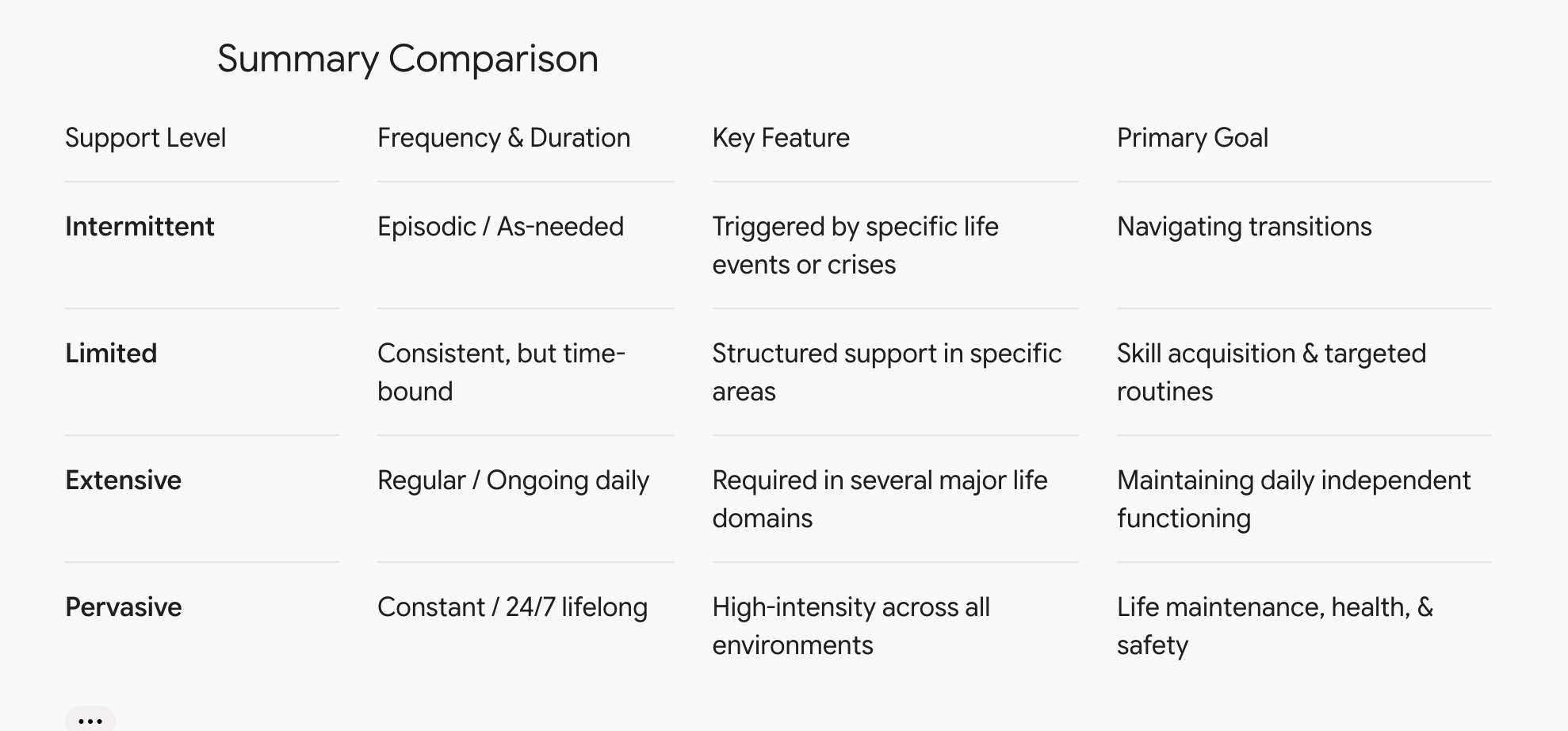
Intermittent Support: Support provided on an "as-needed" basis. It is episodic, short-term, or triggered by specific events rather than ongoing daily necessity.
Limited Support: Support that is consistent over time, but time-limited and restricted to specific settings or tasks. It is predictable rather than episodic.
Extensive Support: Regular, ongoing support needed in at least some everyday environments (e.g., home, work, or community settings) without a planned short-term endpoint.
Pervasive Support: High-intensity, constant support required across all environments to sustain life, health, or basic daily functioning.