GEOG 200 U5
 Call Kai
 Learn
 Practice Test
 Spaced Repetition
 Match
 Flashcards
 Knowt Play
1/16

There's no tags or description
Looks like no tags are added yet.
17 Terms
Absolutist states
a state in which monarchs held all the power and the people had few if any rights, would not last. The French Revolution is considered to have ended the era of absolutist states.
Asylum
Legally protected residency status; usually granted by a host country to immigrants fleeing political oppression in their former homeland. The country in Europe with the most refugees is Germany, followed by France, Sweden, the U.K., and Italy. Most refugees come from Syria, then Afganistan, then Iraq.
Balkanization
The recurrent division and fragmentation of a region. The term is rooted in the Balkans of Europe, derived from east-west trending Balkan mountains that stretches across Bulgaria. This area was harshly impacted by the violent dismantling of Yugoslavia and is a very fragmented zone. None of these countries are in Europe’s core.
Brexit
The referendum of the UK in 2016 to leave the EU. Won a 52% majority. Those favouring leave argued that the EU rules constrained British economy, and that the UK contributed too much to the funds that were distributed to other member states. They mostly opposed an “ever closer union,” believing it to be a threat to the UK’s sovereignty. They also wanted to be in control of immigration. Those in favour believed that it helped them economically. More than half their exports are to EU countries. London is central to the world economy. They believed that leaving would not fix the refugee crisis.
Celtic Tiger
What Ireland became known as when it reached economic prosperity apart from Britain in the last decades of the 20th century. The term likens it to the Hong Kong style of economic development.
Centrifugal forces
A term used by political geographers to identify and measure the strength of division in a region, which may result from religious, racial, linguistic, political, economic, or other regional factors. Causes devolution. One way to deal with them is to give certain historic regions certain rights and privileges formerly held exclusively by the national government. They are measured against centripetal forces.
Devolution
The process whereby regions within a state demand and gain political strength and growing autonomy at the expense of the central government.
Euro crisis
The challenge of having one currency in Europe which includes the euro itself and the unwillingness of the EU members to comply with fiscal standards and apply them as solutions to their economies. It began in 2010 when Greece accumulated massive a government deficit that an emergency bailout from Brussels was essential to avoid immediate bankruptcy and economic chaos. It also happened in Ireland, Portugal, and Greece again in 2012.
Industrial Revolution
The term applied to the social and economic changes in agriculture, commerce, and especially manufacturing and urbanization that resulted from technological innovations and greater specialization in late-eighteenth-century Europe. The beginning was the invention of the steam engine by James Watt in 1780. Britain was its epicenter and had an advantage because of its control on materials and held a monopoly on many products.
Irredentism
A policy of cultural extension and potential political expansion by a state aimed at a community of its nationals living in a neighboring state. Hungary has an issue with this because many Ethnic Magyars (Hungarians) are found in large numbers in neigbouring countries like Romania, Slovakia, and Serbia.
Marshall Plan
A plan integrated in 1948 by the U.S. in support of Western Europe integration and keep communist influences at bay. $130 billion in today’s money was poured out into 16 western European countries including the western half of Germany.
NATO
Established in 1950 at the height of the Cold War as a U.S.-led supranational defense pact to shield postwar Europe against the Soviet military threat. NATO is now in transition, expanding its membership while modifying its objectives in the post-Soviet era. Its 28 member-states (as of late 2019) are: Albania, Belgium, Bulgaria, Canada, Croatia, Czech Republic, Denmark, Estonia, France, Germany, Greece, Hungary, Iceland, Italy, Latvia, Lithuania, Luxembourg, the Netherlands, Norway, Poland, Portugal, Romania, Slovakia, Slovenia, Spain, Turkey, the United Kingdom, and the United States
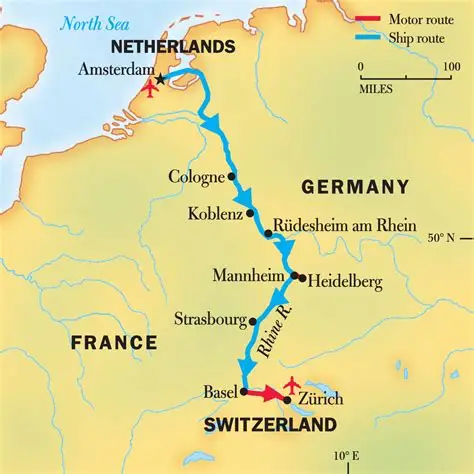
Rhine River. Western Europe’s leading river. Serves as a means of transportation, a barrier, and natural boundary. Climate change causes droughts and the river dries up, leading to poor economics in the countries who rely in it to transport materials
Saami People
A reindeer herding Indigenous population from Finland who have started a devolutionary movement. They live across Norway, Sweden, and Finland. Climate change is threatening their way of life. Saami land defenders claim that increasing temperatures change the amount of snow which negatively affects the reindeer population. These changes negatively affect all sorts of Saami in different ways.
Supranationalism
A venture involving three or more states—political, economic, and/or cultural cooperation to promote shared objectives. European integration is an example of this.
Transition zone
An area of spatial change where the peripheries of two adjacent realms or regions join; marked by a gradual shift (rather than a sharp break) in the characteristics that distinguish these neighboring geographic entities from one another. It can be argued that Eastern Europe marks a transition zone between the European and Russian dominated realms. Rome lies in Italy’s narrow transition zone. The transition zone in Ukraine is marked by the Dnieper river
Euro zone
The 19 countries (as of late 2019) whose official currency is the euro.