Chem 1A03 - Atomic Structure and Theory (Term 1)
 Call Kai
 Learn
Learn Practice Test
 Spaced Repetition
 Match
Match Flashcards
 Knowt Play
1/37

There's no tags or description
Looks like no tags are added yet.
Name | Mastery | Learn | Test | Matching | Spaced | Call with Kai | Chat |
|---|
No analytics yet
Send a link to your students to track their progress
38 Terms
Electromagnetic spectrum
Light is is a form of energy; referred to as electromagnetic radiation
C = 𝝀𝝂
speed of light is constant (c)

1nm conversion rate
= 10^-9 m
Wavelength
distance from peak to peak (m)
Frequency
how many peaks in a given time (s^-1 or Hz)
How is wavelength and frequency related
High frequency = shorter wavelength
Low frequency = longer wavelenght
Blackbody radiation
Blackbody Radiation – all objects emit electromagnetic radiation due to thermal energy (except
at 0 K). As a blackbody is heated, it will eventually glow, producing visible light, a phenomenon
known as incandescence.
Stefan-Boltzman law
States that the total intensity emitted radiation of a blackbody is σT4.
Wilhelm Wien
Wilhelm Wien found the wavelength emitted with maximum intensity, λmax is proportional
to 1/T (Wien’s Law) The higher the temperature, the shorter the λmax.
Ultraviolet Catastrophe
Using classical wave theory, Rayleigh and Jeans derived that I(λ) would be proportional to 1/λ4.
So, hot bodies should emit intense UV and X-Ray radiation.
Even the human body would produce light and glow in the dark.
Classical wave theory could not predict observed spectra – the ultraviolet catastrophe.
Quantum Theory
Energy is Quantized (discontinuous)
Photon
a discrete packet (quantum) of energy
Voltmeter
measures how fast the e- are going (KE)
Ammeter
measures how many e- are ejected and travelling (current)
Red light - 700nm
red light does not eject electrons and no current flow
e red light < e threshold
Ammeter and Voltmeter show no reading
increasing the intnesity of the red light does not chnage the readings
Green light - 500nm
green light ejects photons and current flows
E green light > e threshold
Ammeter: reading increases
Voltmeter: Reading increases
Purple light
ejects electrons and currents flows
e purple light>e threshold
ammeter: reading (no change compared to green light)
Voltmeter: reading increases compared to green
Doubling the intensity of the purple light
Doubling the intensity of the purple light means you double the number of ejected electrons and current
E purple light > E threshold
Ammeter: Reading (2x the previous reading
voltmeter: Reading (no chnage from less intense light)
The wavelength of light needed to eject electrons from a metal is 85.8 nm.
Are electrons ejected if light of 90.0 nm shines on the metal sample?
A. Yes
B. No
Now. The energy has to be the same or higher to generate a photoelectron
Longer wavelength = less energy
Each packet of light interacts with 1 electron, if you have a sufficent packet of light to overcome the attraction of the elcton to the nucleus of the atom and bulk of the material, then it gets ejected
To ionize you have to meet that energy threshold
The development of an atom: Daltons theory
single indivisible entities unique to each element
cannot be altered destroyed
combinations form more complex atoms
however; there were negatively charged particles called electrons that were not accounted for
Plum Pudding Model
negatively charged particles , corpuscles, electrons, were embedded in a sea of positive charges
However, when we fire alpha particles at gold foil, they get depleted.
The nuclear model
highly concentrated postive charges in a very small volume contained most of the atoms mass and electrons orbiting around it.
Problem with the nuclear model
any charged particle that is moving in a circular obrbit continuously will eventually loe energy and will spiral into the nucleas
Bohrs idea: To combine the model of an atom with Planck’s ideas of quantized energies
Electronic transition in hydrogen: Absorption

Electronic transition in hydrogen: emission
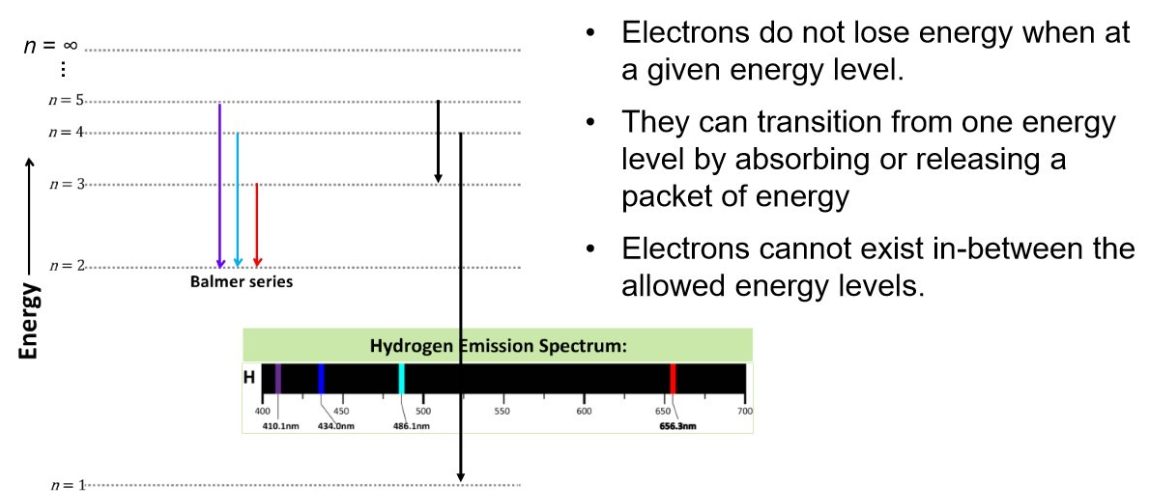
Quantifying the electronic transitions in hydrogen
DELTA E> 0 : Absorption
DELTA E < 0: Emission
Thompsons electron diffraction experiemnt
diffraction occurs when radiation and object spacing are similar. (e.g. X-
rays, = 100 pm, array of Al atoms 200 pm spacing)
Wave-particle duality
waves, like light, display particle like properties
Partciles, like lectrons, display wave like properties
Small particles like electrons have long wavelength
Heseinberg Uncertainty principle
there is a uncertainty of the position of an electron in an atom
one can olny speak of the probailty of finding the electron in a volume within the atom.
Principal quantum number
n
Describes orbital energy and distance from the nucleus
the larger the n vale, the further it is from the nucleus
E in the orbital is at a higher energy level
n describes a principal shell
Obrital angular quantum number, l
describes orbital shape
l - 0, 1, 2, 3, n-1
S=0
p=1
d=2
f=3
Number of l values is the number of subshells in a given n shell
cannot be negative
Magentic quantum number, ml
describes orbital orientation
ml = -l….+l
ml has (2l + 1) values
Electron spin quantum numeber, ms
Electrons have spin, generating a magnetic field
values are + or - ½
pair of electron with opposite spins has no magnetic field
Diamagnetic vs paramagnetic
Atoms or ions with all spins paired are diamagentic
most atoms are like this, the effect is so weak that it goes unoticed
1or more unpaired electrons is paramagnetic
stronger than dimagnetic so it ovverides it.
Orbital shapes; s and f

Orbital shapes: d

Aufbau Principles
Occupy orbitals so that the atoms energy is minimized; occupy orbitals of lower energy
Paule-exclusion principle
ever e- has a unique set of quantum numbers
Hunds rule
orbitals of the same energy level are occupied singly before they are paired