MODULE - I Electrode Systems
 Call Kai
 Learn
Learn Practice Test
 Spaced Repetition
 Match
Match Flashcards
 Knowt Play
1/62

There's no tags or description
Looks like no tags are added yet.
Name | Mastery | Learn | Test | Matching | Spaced | Call with Kai | Chat |
|---|
No analytics yet
Send a link to your students to track their progress
63 Terms
Electrochemistry
it’s a branch of chemistry that deals with the inter conversion of chemical and electrical energies
Electrochemical cells
The device which converts chemical energy to electrical energy or vice versa
Electrode
An electrode is an electrical conductor used to make contact with a non- metallic part of circuit
anode : It is the electrode at which oxidation occurs.
cathode: Cathode: It is the electrode at which reduction occurs.
Conductors

Electrode Potential
The potential developed at the interface between the metal and the solution when it is in contact with a solution is called electrode potential
When a metal undergoes oxidation, it loses positive ions in to solution leaving behind a layer of negative charges on its surface.
This layer attracts positive charges and form electrical double layer, also called as Helmholtz electrical double layer.
The resultant potential difference between the electrode (metal) and the solution is termed as electrode potential.

Standard electrode potential
The potential developed at the interface between the metal and the solution when it is in contact with a solution of unit concentration at 298 K at 1 atm pressure is called standard electrode potential.
Emf
or Cell potential (Ecell)
The potential difference between the two electrodes of a galvanic cell which causes the flow of electrons (current) from one electrode to the other is called electromotive force (EMF).
− Ecell depends on the nature of electrode, temperature and concentration of the electrolyte solution.
− Standard emf of a cell is defined as “the emf of a galvanic cell when the reactants and products of the cell reaction are at unit concentration at 298 K and at 1 atm pressure”. l
E⁰cell = E⁰cathode - E⁰anode (right - left)
Types of Electrochemical cells:
Electrolytic cell : electrochemical cells which are used to convert electrical energy to chemical energy
eg. electroplating, electrorefining
Galvanic Cell: converts chemical energy to electrical energy (voltaic cell)
Primary cell: serves as an energy source as long as the active species are present in the cell, the cell reactions are irreversible, only for single use; once discharged cannot be charged again
eg Dry cell, Zn-HgO cell, Zn Ag2O cell
Secondary cells: can be charged and reused, reversible,
Discharging - cells act as voltaic cells
Charging - cells act as electrolytic
eg Ni-MH cell, Lithium ion cells

Concentration Cell
Its a type of galvanic cell in which electrode and electrolyte present in both half cells are same but only the concentration of metal (electrode) or electrolyte is different
Construction of concentration cell
made up of two half cells having identical electodes except that the concentration of ions at the electrodes are different
may be joined by salt bridge
no net cell reaction
Reason for emf rising - change in concentration of either electrolyte or electrode but in galvanic it rises due to change in free energy of the chemical reaction
eg Copper, Zinc concentration cell etc.

How is a concentration cell represented?

What reaction occurs at the cathode in a concentration cell?

What is the overall reaction in a concentration cell?

Why is the standard EMF of a concentration cell zero?
Because both half-cells use the same electrode and same electrolyte system.
Ecell=0
What is the Nernst equation for an electrolyte concentration cell?

What are the standard electrode potentials of the anode and cathode in a concentration cell?
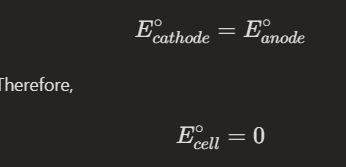
What is the simplified EMF equation of a concentration cell?

What is the concentration-cell EMF equation at 298 K?

Types of electrodes:
"My Mother Gives Red Apples Instantly"

Metal-Metal Ion Electrode
A metal dipped in a solution containing its own ions.
General Representation:
M/M^n+
Examples:
Zn/Zn²⁺ (Zinc rod in ZnSO₄ solution)
Cu/Cu²⁺ (Copper rod in CuSO₄ solution)
Key Point: Both oxidation and reduction occur reversibly through the metal cation of the electrode.
Metal-insoluble salt electrode
An electrode where a metal is in contact with its insoluble salt and immersed in a solution containing a common ion.
Key Point: Used as a secondary reference electrode. [calomel] (compared to SHE, its better cuz u gotta supply hydrogen continously and u need pt, setups bulky)
How does a Metal-Insoluble Salt Electrode develop potential?
Due to:
Oxidation of metal to its insoluble salt, or
Reduction of the insoluble salt to metal.
What is the representation of the Calomel Electrode?
Hg / Hg2Cl2 / Cl−
Name: Standard Calomel Electrode (SCE)
What is the representation of the Silver-Silver Chloride Electrode?
Ag/AgCl/Cl−
What is the representation of the Lead-Lead Sulphate Electrode?
Pb/PbSO4/SO42−
Gas Electrode
An electrode in which a gas is continuously bubbled through a solution containing its ions using an inert metal like Pt.
Function of Pt: Provides electrical contact.
Give examples of Gas Electrodes.

What is an Oxidation-Reduction (Redox) Electrode?
An electrode whose potential arises from the presence of oxidised and reduced forms of the same substance in solution.
Pt/Fe²⁺, Fe³⁺
Pt/Ce³⁺, Ce⁴⁺
Pt/Sn²⁺, Sn⁴⁺
Fe²⁺ tends to convert to the more stable Fe³⁺ state, producing a potential difference.
Amalgam Electrode
An electrode in which a metal amalgam (alloy with mercury) is in contact with a solution containing its own metal ions.

What is an Ion-Selective Electrode (Membrane Electrode)?
An electrode containing a membrane that selectively exchanges a particular ion with the solution.
eg Glass Ph H+
What is a reference electrode?
electrodes with reference to those; the electro potential of any other electrode can be measured.
criteria:
i. Its electrode potential should be known under the conditions of utility.
ii. The potential of such electrode should show minimum variation with respect to temperature
Types of reference electrode:
I. Primary reference electrode
II. Secondary reference electrode
Primary reference electrode
− Standard hydrogen electrode (SHE) is the only primary reference electrode (gas electrode).
− Represented as Pt/H2(g)(1 atm)/HCl(1M)
− The potential of SHE is taken as zero by convention. Therefore, potential values of all other electrodes are expressed w.r.t. this electrode.
Limitations of SHE:
a) Construction and maintenance is difficult since it’s a gas electrode.
b) Pt metal used in the electrode is easily poisoned by any impurity present in the system.
c) Cannot be used in the presence of oxidizing agents like nitrates, H2S, chlorides, etc. as they poison Pt.
d) Difficulty in maintaining pressure at 1 atm.
Secondary reference electrode
electrodes whose potential is measured w.r.t. SHE and then can be used as reference electrode for measuring potentials of other electrodes.
Eg: Calomel electrode, silver-silver chloride electrode
Advantages:
a) Easy to set up and operate.
b) Potential values do not vary much with variation in temperature.
c) Not poisoned by oxidizing impurities.
Construction of Calomel Electrode
A Calomel Electrode is a secondary reference electrode belonging to the metal-insoluble salt electrode category.
It consists of:
Mercury (Hg)
Mercurous chloride (Hg₂Cl₂, calomel)
KCl solution
It consists of a glass tube in which pure mercury (Hg) is placed at the bottom.
It is covered by a paste of Hg and mercurous chloride (Hg2Cl2) which is further in contact with KCl solution.
Hg2Cl2 is commonly called as calomel and it is sparingly soluble in water.
A platinum wire is dipped in the mercury layer, which is used to make electrical contact with other electrode and to measure potential at the electrode.
KCl solution used in calomel electrode is of known concentration.
Electrode potential of the cell depends upon the concentration of KCl used.

Write the cell representation of a calomel electrode.

Working of calomel
Calomel electrode can be used as cathode or anode depending upon the nature of the other electrode of the cell.
Step 1: Electrode Reaction
The calomel electrode contains:
Mercury (Hg)
Mercurous chloride (Hg₂Cl₂)
KCl solution
The reversible reaction is:
Hg2Cl2 + 2e−⇌ 2Hg + 2Cl−
Since Cl⁻ ions participate directly, the electrode is reversible with respect to Cl⁻ ions.
Step 2: If Calomel Acts as Cathode (Reduction)
The electrode gains electrons:
Hg2Cl2 + 2e− → 2Hg+ 2Cl−
Hg₂Cl₂ converts to Hg.
Reduction occurs.
Step 3: If Calomel Acts as Anode (Oxidation)
The electrode loses electrons:
2Hg + 2Cl− → Hg2Cl2 + 2e−
Hg converts to Hg₂Cl₂.
Oxidation occurs.
Step 4: Potential Depends on Cl⁻ Concentration
From Nernst equation:
Ecalomel=Ecalomel∘−0.0591log[Cl−]2
Therefore:
↑ Cl⁻ concentration ⇒ ↓ Electrode potential
↓ Cl⁻ concentration ⇒ ↑ Electrode potential
Why does KCl concentration matter?
Cl dissociates as:
KCl→K++Cl−
More KCl means more Cl⁻ ions.
Since Cl⁻ appears in the Nernst equation, changing KCl concentration changes the electrode potential.
Advantages of Calomel electrode
a) Simple to construct
b) Stable
c) Electrode potential value is reproducible
Applications of Calomel electrode
a) It is used as secondary reference electrode in the measurement of single electrode potential.
b) It is the most commonly used reference electrode in all potentiometric determinations.
ION SELECTIVE ELECTRODE (ISE)
An electrode that selectively responds to a particular ion in a mixture while ignoring other ions.
ISEs are membrane based electrodes and hence are also called as membrane electrodes.
What is the main function of an Ion Selective Electrode?
to determine the concentration of a specific cation or anion in a mixture
On what does the potential of an Ion Selective Electrode depend?
the electrode potential depends on the concentration of the specific ion being measured.
How does the membrane of an ISE work?
The membrane selectively exchanges only a particular ion with the solution, producing a potential difference proportional to its concentration
Why are Ion Selective Electrodes considered highly useful in analysis?
They are:
Highly sensitive
Highly selective
Rapid
Accurate
Low-cost
What is the most common example of an Ion Selective Electrode?
Glass pH electrode.
Which ion is detected by the glass pH electrode?
H+
(Hydrogen ion)
How does a glass pH electrode determine pH?
It measures the concentration of H⁺ ions in the solution.
What is the application of ISE in water analysis?
Determination of the hardness of water.
How are Ion Selective Electrodes used in the dairy industry?
For determining calcium concentration in milk.
How are Ion Selective Electrodes used in environmental monitoring?
For monitoring nitrate concentration in wastewater.
How are Ion Selective Electrodes used in oceanography?
For estimating the salinity of seawater.
What is a Glass pH Electrode?
A Glass pH Electrode is an ion-selective electrode (ISE) that selectively responds to H⁺ ions and is used to measure the pH of a solution.
What is the principle of a Glass pH Electrode?
When two solutions of different H⁺ ion concentrations (different pH values) are separated by a thin glass membrane, a potential difference develops across the membrane.
Describe the construction of a Glass pH Electrode.
It consists of:
A long glass tube
Thin glass membrane bulb at the bottom
Internal 0.1 M HCl solution
Ag/AgCl internal reference electrode
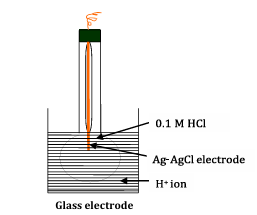
What is the composition and thickness of the glass membrane?
SiO₂ = 72%
Na₂O = 22%
CaO = 6%
0.03−0.1 mm
What is the function of the glass membrane?
It selectively exchanges H⁺ ions with the solution, producing a boundary potential.
Which electrode is used as the internal reference electrode in a glass pH electrode?
Silver-Silver Chloride electrode.
Ag/AgCl
Working of glass electrode
When the glass bulb separates two solutions having different H⁺ ion concentrations, a boundary potential develops across the membrane.
This potential depends on the difference in H⁺ concentration inside and outside the bulb.
The total electrode potential is:
EG = Eb + EAg/AgCl + Easym
which simplifies to
EG = 0.0591log[H+] + E0
[Asymmetry potential is a small potential that exist due to the unevenness in the membrane and strain on the surface of the membrane]
Since the potential depends on H⁺ concentration, the glass electrode is used for pH measurement.
![<p>When the glass bulb separates two solutions having different H⁺ ion concentrations, a <strong>boundary potential</strong> develops across the membrane. </p><p>This potential depends on the difference in H⁺ concentration inside and outside the bulb. </p><p>The total electrode potential is:</p><p><span>EG </span>= <span>Eb </span>+ <span>EAg/AgCl </span>+ <span>Easym</span></p><p>which simplifies to</p><p><span>EG </span>= 0.0591lo<span>g</span>[<span>H+</span>] + <span>E0</span></p><p>[Asymmetry potential is a small potential that exist due to the unevenness in the membrane and strain on the surface of the membrane]</p><p>Since the potential depends on H⁺ concentration, the glass electrode is used for <strong>pH measurement</strong>.</p>](https://assets.knowt.com/user-attachments/19fbef2e-b744-476d-9f88-4671cc4985af.png)
Determination of pH of a solution using Glass electrode
The pH of any given solution is measured by a galvanic cell, constructed by combining glass electrode with standard saturated calomel electrode as reference electrode.
EMF of the above cell i.e.
Ecell when immersed in a solution of unknown pH is,
ECell = ECathode - EAnode
ECell = EG - ESCE
Where
EG = potential of glass electrode
ESCE = potential of saturated calomel electrode
ECell = E⁰G - 0.0591 pH - ESCE
From
Ecell=EG0−0.0591(pH)−ESCE
0.0591(pH)=EG0−ESCE−Ecell
Therefore,
pH = (EG° − ESCE − Ecell)/0.0591

Advantages of Glass electrode:
1. This electrode can be used to determine pH in the range 0-9, with special type of glass even up to 12 can be calculated.
2. It can be used even in the case of strong oxidizing agents and biological fluids.
3. The equilibrium is reached quickly.
4. It is simple to operate, gives accurate values of pH.
Limitations of Glass electrode:
1. The glass membrane though it is very thin, it offers high resistance. Therefore ordinary potentiometers cannot be used; hence it is necessary to use electronic potentiometers.
2. This electrode cannot be used to determine the pH above 9 accurately due to alkaline error.
3. This cannot be used in case of fluoride ions