BICH 440
 Call Kai
 Learn
Learn Practice Test
 Spaced Repetition
 Match
Match Flashcards
 Knowt Play
1/68

There's no tags or description
Looks like no tags are added yet.
Name | Mastery | Learn | Test | Matching | Spaced | Call with Kai | Chat |
|---|
No analytics yet
Send a link to your students to track their progress
69 Terms
D- glyceraldehyde

L-Glyceraldehyde

D-Ribose

D-Glucose

D-Mannose

D-Galactose

Dihydroxyacetone

D-Ribulose
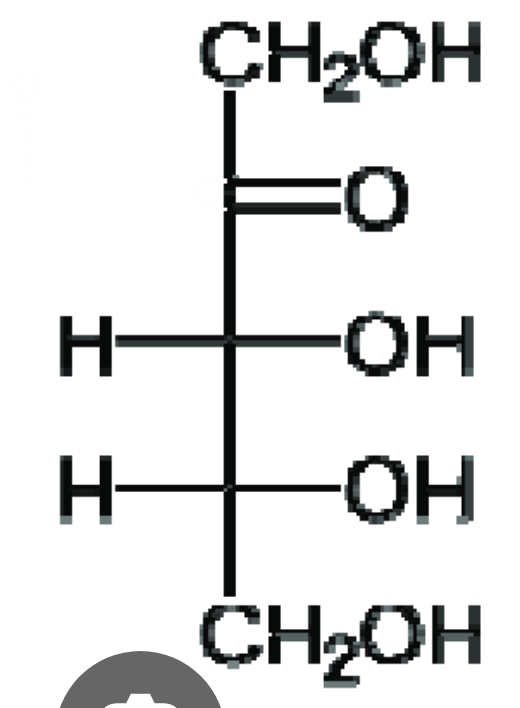
D-Fructose

Enantiomers
Stereoisomers that are mirror images of each other
Diasteromers
stereoisomers that are not mirror images of each other
Epimers
diastereomers that differ around one carbon
Glucose can cyclize to form a cyclic hemiacetal

Fructose can cyclize to form a cyclic hemiketal

The dominant cyclic form of glucose is a
pyranose (six membered ring)
The dominant cyclic form of fructose is a
furanose (five membered ring)
Cyclization results in a new stereocenter called the
anomeric carbon
Monosaccharides that differ in configuration only at their anomeric carbons
Anomers
Anomers can interconvert
mutarotation
a-D-glucopyranose Haworth Projection

B-D-Glucopyranose

is it the boat or the chair conformation where hexoses exit in?
chair conformation
carbohydrates with a free anomeric carbon
Reducing sugars
What can convert a reducing sugar into a sugar acid
Oxidants such as peroxide, ferricyanide and some metals
Reduced form of monosaccharides where all carbons have a hydroxyl group
Sugar alcohols
Fundamental constituents of DNA, and RNA
Deoxy sugars
Phosphate esters like ATP
Sugar esters
One or more amino groups substituted for a hydroxyl
Amino sugars
Basis for polysaccharides
Acetals, ketals, and glycosides
Monosaccharides can be linked via the
anomeric carbon and an alcohol substituent
Derived from furanoses
furanosides
those from pyranoses
pyranosides
Formed between the anomeric carbon to the OR group of the attached monosaccharide
glycosidic bond
Lactose

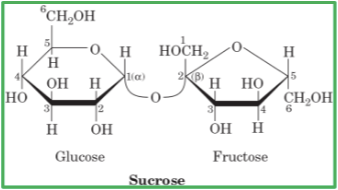
Sucrose
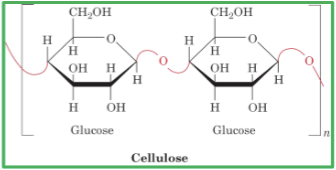
Cellulose
Chitin

a-Amylose

Formation of a Glycosidic linkage is fundementally a
condensation, or removal of an H2O
Very slow under physiologcial conditions and catalyzed by enzymes
Hydrolysis
Lactose is hydrolyzed to the component monosaccharides by an enzyme called
B-D-galactosidase or lactase
Sucrose is the main product of
photosynthesis
What is sucrose used to produce?
cellulose and starch
Main storage polysaccharide for glucose, the primary fuel for generating metabolic energy
Glycogen
— The principle energy source in plants and comes in two types
Starch, a-amylose & amylopectin
Amylose is a linear polymer with an helical strucutre
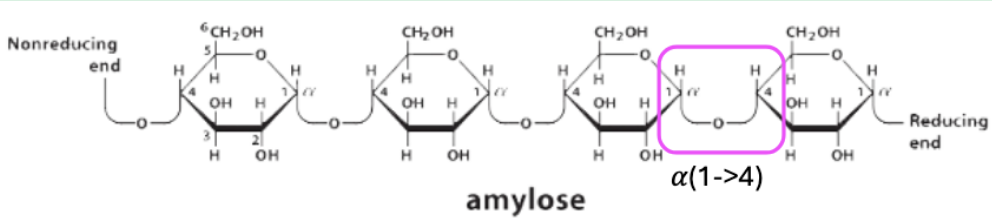
Amylopectin is a branched polymer formed from amylose connected via a1-6 linkages

Glycogen vs amylopectin, which has more frequent branching?
Glycogen
Homopolymer of glucose with B(1→4) linkages
cellulose
What is cellulose a primary component of?
Plant cell walls
What polymers are parallel
homopolymers
Hydrogen bonding that generates sheets of cellulose polymers
Interpolymer
Principle structural component of exoskeletons of invertebrates and present in most fungi and algae
Chitin
Homopolymer of B(1→4) linked N-acetyl-D-glucosamine residues
Chitin
Almost all membrane and extracellular proteins of eukaryotes are
glycosylated
Oligosaccharides are covalently attached by either
N- or O-glycosidic bonds
N-linked glycosylation occurs cotranslationally
while exiting the ribosome
N-linked glycosylation occurs on Asn via a
b-linkage
O-linked glycosylation occurs primarly in the
Golgi
O-linked glycosylation occurs on
Ser or Thr
Carbohydrates
CnH2nOn
oligo- also means
few
poly- also means
many
What is essential to metabolism
Monosaccharides
For adoses, the carbon with the aldehyde group CHO is designated as
carbon one
For ketoses, the carbon with the ketone group (C=O) is assigned the
lowest possible number
Reducing sugars
carbohydrates with a free anomeric carbon
Sugar alcohols
Reduced form of monosaccharides where all carbons have a hydroxyl group
What does lactase do?
Hydrolyzes lactose