BSC 2011 Exam 2
 Call Kai
 Learn
Learn Practice Test
 Spaced Repetition
 Match
Match Flashcards
 Knowt Play
1/122

There's no tags or description
Looks like no tags are added yet.
Name | Mastery | Learn | Test | Matching | Spaced | Call with Kai | Chat |
|---|
No analytics yet
Send a link to your students to track their progress
123 Terms
what are some general characteristics of animals
-multicellularity, heterotrophic metabolism, internal digestion. movement and nervous system
common ancestor of animals
-probably a colonial flagellated protist, similar to choanoflagellates and sponges
-formation of colonies possibly occured because colonies are more efficient at pre capture than single cells
-cells in colonies began to specialize
why are choanoflagellate protist colonies and sponge choanocytes similar?
-evolutionary link between the two
-a sponge moves food containing water through its body by beating the flagella of its choanocytes
-water enters the sponge through small pores, passes into water canals, where the choanocytes capture food particles from the water
what is cleavage
-early cell divisions of an embryo
-patters of cleavage characterize major animal groups
what is radial cleavage
-yolk (provides energy) is evenly distributed throughout the egg cytoplasm,zygote and descendant cells divide completely and evenly (symmetrical)
what is spiral cleavage
-complex permutation of radial cleavage (new cells at angles to existing ones)
germ layers (diploblastic animals)
-have two cell layers, ectoderm (outer) and endoderm (inner)
germ layers (tripoblastic animals)
-have three cell layers, ectoderm, endoderm, and mesoderm (middle)
-form a clade
when do the germ layers form
-during gastrulation in the embryo (invagination)
what is gastrulation
-embryo is a hollow ball of cells that indents to form a cavity, the blastopore
bilaterians
-bilateral symmetry during embryonic development
-all triploblasts are bilaterians (have bilateral symmetry)
protostomes
-blastopore develops into the mouth; anus forms later
-ex. insects, snails
deuterostomes
-blastopore develops into the anus; mouth develops later
-ex. vertebrates and starfish
body plan
-general structure, arrangement of organ systems, and integrates functioning of body parts
-five features
symmmetry, body cavity structure, segmentation, external appendages, nervous system
what is symmetry and the two types
-overall shape
-symmetrical- can be divided along at least one plane into similar halves
radial-body parts arranged around a central axis
bilateral- can be divided into mirror image halves on only one plane
-asymmetrical- no plane of symmetry (placozoans and sponges)
what is bilateral symmetry correlated with
-cephalization (has a head)
-concentration of sensory organs and nerve tissues at the anterior end or head
-seen as a more advanced trait
-evolutionary favored, anterior end encounters the environment first
acoelomate
-no fluid filled body cavity
-space between gut and body wall is filled with cells called mesenchyme; move by beating cilia
-ex. flatworm
pseudodocoelomate
-body cavity is a pseudocoel (fluid filled space)
-internal organs are suspended, no mesoderm surrounding interal organs
-ex. roundworm
coelomate
-body cavity is a coelom
-Develops within the mesoderm
-lined with a layer of muscular tissue, called the peritoneum
-enclosed on both the inside and the outside by mesoderm
-when muscles contract, can put pressure on fluid
ex. earthworm
how can body cavities function as hydrostatic skeletons
-when muscles contract, fluid is pushed to another part of the cavity, which causes that region to expand
segmentation
-facilitates specialization of body regions, allows animal to alter body shape and control movements precisely
ex. our spine is segmented
radiation of the arthopods was based on changes in a segmented body plan
appendages
-enhance an animal’s ability to move around; also include antennae, claws, mouthparts, and reproductive organs
nervous nets
-diffuse nervous systems in animals such as ctenophores and cnidarians
what kind of nervous systems do bilaterians have
-have well coordinated central nervous systems
muscle action is coordinated to allow movement of appendages and body oarts
sensory info is gathered and processed
which animal groups are not bilaterians
-sponges, ctenophores, placozoans, cnidarians
-most biologists agree that the sponges and ctenophores split first from the remaining animals
-large multicellular animals appear to have evolved several times in different lineages
characteristics of sponges
-have no distinct embryonic cell layers and no true organs
-have hard skeletal elements called spicules
glass sponges and demosponges- spicules made of silicon dioxide
calcareous sponges- spicules made of calcium carbonate
what are ctenophores
-comb jellies
-radial symmetry
-diploblasitc
-move by beating cilia arranged on eight comblike plates called ctenes
what are placozoans
-very simple, only 4 cell types
-diploblastic
-two life stages- pelagic (free) swimming stage and stage that adheres to surfaces
what are cnidarians
-jellyfishes, sea anemones, corals, hydrozoans
-diploblastic (more complex development)
-gastrovascular cavity- functions in digestion circulation, gas exchange, and as a hydrostatic skeleton
-life cycle with sessile polyp and motile medusa stages
-nematocysts- specialized harpoon like structures with toxins, used to capture large prey
cnidarian life cycle
1) Adult medusa produces gametes
2) Fertilization of the egg and sperm
3) The zygote develops into a planula larva (free-swimming)
4) The planula settles and develops into a polyp (stationary)
5) The polyp reproduces asexually, producing multiple young medusa
6) Young medusa grow into an adult

heterotrophs
-require preformed organic molecules as sources of energy and chemical building blocks
-obtain energy by breaking the chemical bonds of organic compunds obtained from other organisms
-build their tisssues from matter present in preexisitng organic compounds
-animals need chemical building blocks for growth and to replace cells throughout life
why organization is so important
-organization is the most essential attrubute of life
-2nd law of thermodynamics tells us that any organized system, left to itself, tends to lose organization and become more random
-animals need to obtain energy so they can do work to maintain their organization by combating the effects of the 2nd law of thermodynamics
-it takes energy to create and maintain organization
what are the 3 types of feeding
-predation
-suspension feeding- a method where an animal captures and eats tiny food particles floating in the water
-symbiosis
what is nutrition + its importance
-study of how animals meet their needs for both chemical substances and energy
-animals can interconvert some molecules
ex. lipid molecules can be converted to carbs, but some molecules must be obtained, fully formed, from their food
essential nutrients
-required but cannot be synthesized by the animal
standard amino acids
-the 20 amino acids animals need to build proteins; animals can synthesize some of these (non-essential)
essential amino acids
-the ones that cannot be synthesized and must come from food
essential fatty acids
-including omega-3 and omega-6 fatty acids
essential vitamins
-vitamin a (vision), vitamin k (blood clotting) etc
essential minerals
-chemical elements that animals require in addition to C, O, H, and N
-ex. calcium and phosphorus are needing for bone, iodine is required for synthesizing thyroid hormones, iron is required to synthesize hemoglobin
how is the energy content of food measured
-can be measured by the amount of heat the food produces when completely burned in the presence of O2 producing CO2 and H20
-calorie- amount of heat needing to raise 1 gram of water by 1 degree celsius
metabolic rate
-amount of chemical bond energy consumed and coverted to heat per day
-animals with high metabolic rates need to eat more food per unit of time to replace the energy being consumed
-can be measured by determining rate of O2 consumption
-when organic matter is oxidized during aerobic metabolism, O2 is used while heat is produced
what are the 3 types of food molecules
-lipids, carbs, proteins
metabolic rate (humans, fish, birds)
-physical activity increases metabolic rate
-humans- metabolic rate increases linearly as running speed increases
-fish- metabolic rate increases exponentially because resistance posed by water increases exponentially
-bird- at low speed, metabolic rate is high just to stay airborne
basal metabolic rate (BMR) and its scaling relationships
-measured when the animal is in a comfortable thermal environment and has not eaten recently
-scaling relationships- animal characteristics as functions of body size
BMR per gram of body weight decreases as animal size increases
small mammals need more food per gram of body weight than large mammals do
regulation
-cells in an animal’s body are bathed with body fluids called tissue fluids (interstitial fluids) - the internal environment
-regulation occurs when the internal environment stays constant even as the external environment changes
animas that do this are regulators
regulation provides stability, but is energetically expensive, tend to increase metabolic rates
-in conformers, the internal environment varies so that is always matches the external environment
energetically cheap
animal’s cells must be able to cope with changes in their environment
intracellular and extracellular fluid
-intracellular fluid- fluid inside cells
-extracellular fluid- includes blood plasma and interstitial fluid
-fluid compartments are seperated by epithelia and cell membranes
what is the epithelium and simple epithelium
-sheet of epithelial cells that covers a body surface or organ or lines a body cavity
-simple epithelium: a single layer of cells on a non-living basement membrane; lines all blood vessels, intestines, and other tubules
function of the epithelium
-pumps ions between fluid on either side of the epithelium
-secretes substances such as horomones, mucus, digestive enzymes, milk, sweat
-absorbs nutrients from the gut
-serves sensory functions, including smell and taste
cell membrane and its functions
-thin layers separating the extra and intracellular fluids
-pumps ions between the intra and extracellular fluid
-play key roles in producing and receiving physiological signals
-controls diffusion of ions/molecules
levels of organization (tissue, organ, multi-organ system)
tissue- assemblage of cells of similar type
organ- two or more types of tissue with a defined strucutral relationship to each other
-multi-organ system- multiple organs working together
what is homeostasis
-refers to stability of the internal environment and the mechanisms that maintain it
-a parallel concept to regulation and has the same pros and cons; it is energetically expensive
homeotherms
-animals that maintain a constant internal body temperature (thermoregulation)
ex. mammals and birds
thermoneutral zone (TNZ)
-a range of external temperatures in which metabolic rate is minimal and does not change with external temperature
-outside the TNZ, the metabolic rate rises
what are poikilotherms or ectotherms
-body temperatures are variable and are determined by the external temperature
-Poikilotherms vary widely in their body temperature limits
-They can control body temperature through behavior, such as by positioning themselves in the sun or shade (behavioral thermoregulation)
-ex. alligator
the relationship between metabolic rate and external temperature
-Metabolic rates of homeotherms are higher than poikilotherms, especially when external temperatures are low
-Lower temp = higher metabolic rate
-super high temp = panting, sweating

homeotherm mechanisms
-can increase metabolic rate in cold environments
-shivering- skeletal muscles contract, and energy is converted from ATP to heat
-nonshivering thermogenesis- most mammals have brown adipose tissue in which oxidative phosphorylation is uncoupled from ATP production; energy goes to heat production instead
smaller animals have more of this tissue
occurs in specific locations in the body (in the places that are the most important)
-insulation- important for maintaining body temp, ex. fur and feathers
-blood flow patterns- can conserve heat
-evaporative cooling- water absorbs a lot of heat energy to change from liquid to gas state; sweating and panting allow water to evaporate from the body
negative feedback system
-control mechanism that activates effectors to bring a variable back into the normal (homeostatic) range
1) controlled variable- characteristic being controlled such as body temperature
2) sensors- detect current level or state, such as temperture receptors in the skin and brain
3) control mechanism- uses information from sensors to determine which effectors to activate. nerve cells of the hypthalamus in the brain are are temperature control mechanism
4) effectors- tissues or organs that can change the level of the controlled variable (ex. shivering muscles)
positive feedback
-deviations of a controlled variable from its existing level are increased or amplified (pushes father away from homeostasis)
-destabilizes a system, moving away from homeostasis, but can be useful if it is ultimately brought under control
-ex. childbirth
stretching of the cervix —> pituitary releases oxytocin —> oxytocin causes stronger uterine contractions —> stretches the cervix more —> causes more oxytocin release —> stronger uterine contractions… ends with childbirth
types of environments
-specific environments- where they live and have evolved
-microhabitats (place/location)
-microenvironments (parameters of the location)
places within a habitat that potentially differ from the habitat at large
-microclimate- climate conditons prevailing in a microenvironment
smaller animals and protective microenvironments
-small animals can enter small protective environments
-ex. lemming living under the snow
-easier for smaller animals to do this
small bodied animals behavioral and physiological defenses
-often deal with the stresses of an extreme environment by using behavior
larger surface area to volume ratio
higher metabolic rate- more energetically expensive to maintain body temperature
easier to enter microenvironments
large bodied animals behavioral and physiological defenses
-often have fewer behavioral options; they depend more on physiological defenses to survive
phenotypic plasticity
-The ability of an organism to change its physical traits, behavior, or functions in response to its environment, without changing its underlying DNA
-ex. reindeer
Reindeer have a much lower metabolic rate in winter compared to a human
reindeer add insulation in winter, and regional hypothermia allows tissues in appendages to be cooler than the core tissues
regional hypothermia and countercurrent heat exhange system
-regional hypothermia- tissues in appendages doesn’t freeze, even when environmental temperatures are very low
-countercurrent heat exchange system- between arteries and veins in the limbs conserves heat
keeps most of the heat in the body core, but prevents the paws from freezing
ex. artic fox- heat is metered to foot pads so that the tissues cool to near the freezing point but never colder than freezing. feet are kept dry because they are too cold to melt snow or ice
hot dessert/ high temps behaviroal and psychological defenses
-mostly nocturnal- to avoid high temps
ex. kangaroo rats
-countercurrent system
keeps the brain cool
-large animals can tolerate a rise in core body temp
gazelle
-burrows and small patches of shade, stay close to ground
lizards
-live in colonies underground, forage during day for recently dead insects (to get water)
desert ants
hibernation
-state of low body temperature and thermal conformity that persists for a long period of time in winter
-the animal allows its core body temp to match external temp
-animal lives on body fat or stored food
metabolic depression
-biochemically induced reduction of metabolic rate
supercooled state
-many insects can stabilize a supercooled state in which their body fluids do not freeze (fluids contain antifreeze)
-other insects species simply freeze soild and recover unharmed (cells contain antifreeze)
-many polar fish species are adapted to frigid waters and die if warmed to 5 degees celsius
-other species are adapted to warm tropical waters. different forms of key enzymes in the metabolic pathways function best at specific temperatures
internal respiration
-in mitochondria, oxygen (O2) is used as the final electron acceptor in aerobic respiration
external respiration
-animals obtain O2 from the environment, which then follows a pathway to the mitochondria
partial pressure
-the individual pressure exerted by a specific gas in a mixture of gases
-total atmospheric pressure = 760mmHg
79% N2
21% O2
-partial pressure of a gas equilibrates between air and liquid
-even though the partial pressues inside the gas and liquid are equal at equilibrium, the actual concentration is much lower in liquid than in air
the pathway for oxygen (steps)
1) air fills the lungs
2) oxygen diffuses across the alveolar epithelium and capitally epithelium
3) O2 diffuses down partial pressure (PP) gradient
higher in lungs, lower in blood
4) O2 binds to hemoglobin (respiratory pigment) on red blood cells
5) O2 diffuses from blood into body cells
bulk flow definition
-passive flow of matter (material being carried within media) from one place to another
bulk flow and O2
-O2 and CO2 are transported by diffusion and bulk flow (no active transport)
-O2 is carried in the bulk flow of air into the lungs and alveoli
-O2 is also carried by the bulk flow of blood from capillaries to interstitial fluid
gas exchange membranes
-thin layers of tissue where respiratory gases move between the environment and the internal tissues
breathing (external respiration)
-process by which O2 and CO2 are transported between environment and gas exchange membrane
are lungs invaginated or evaginated
-invaginated (folded inwards) into the body and contain the environmental medium
are gills invaginated or evaginated
-evaginated (folded outward) from the body and are surrounded by the enviromental medium
ventilation
-bulk flow of air or water between the gas exchange membrane and the outside world
tidal ventilation
-air moves in and then out of the same passageways
some fresh (O2-rich) and O2 depleted air mix
unidirectional (flow-through) ventilation
-in animals with gills water moves in a one-way stream across the gills (air and water comes in one opening and comes out another)
no mixing of fresh and O2 depleted air
more efficient at gas exchange
perfusion
-blood flow through capillaries or other small blood vessels of a tisse
diffusion in air vs water
-diffusion is much faster through air than water
sea turtles lay eggs in the sand. eggs get plenty of O2, if the sand is moist not wet
-O2 solubility in water is low and descreases with increasing temperature
how do fish breathe
-fish gills have a large SA
-each gill has two rows of gill filaments, each with numerous secondary lamellae on its upper and lower surfaces
-a fish pumps water unidirectionally through mouth cavity and gill splits, over the gills and out from under the opercular flaps. blood flows through each lamella in the opposite direction, a countercurrent system
Countercurrent flow- water moves across on way and oxygen moves across the opposite way
Concurrent flow- same direction

surfactant
-inner surfaces of vertebrate lungs are coated with a lung surfactant that reduces surface tension and prevents the gas exchange tissue from sticking together
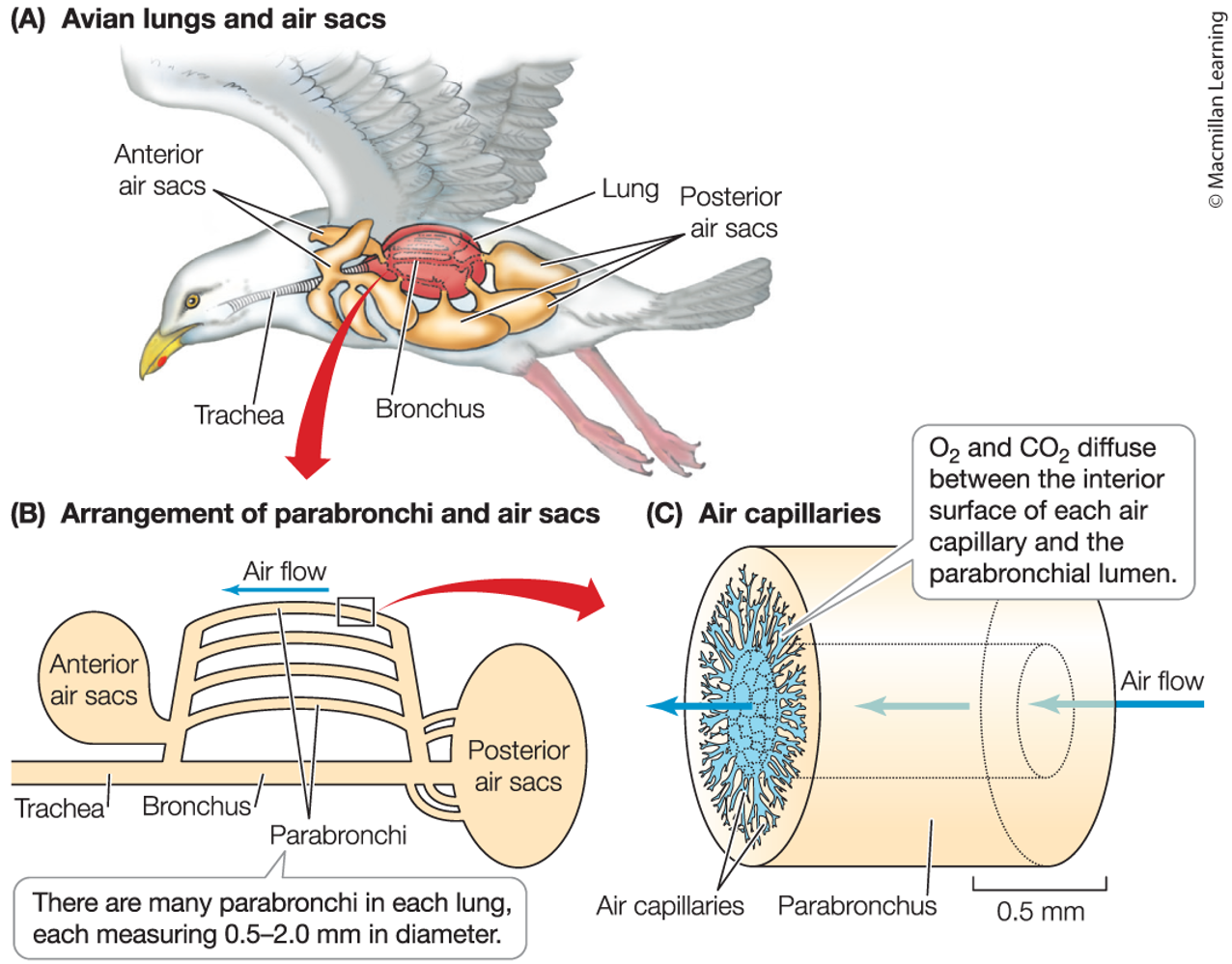
how do birds breathe
-unidirectional air flow to suppy O2 to tissues at high rates
air sacs expand and contract acting like bellows to push air past gas exchange surfaces in the lungs
tracheal breathing system (insects and spiders)
-spiracles (openings) in the abdomen open into tubules called tracheae. the tubules branch in such a way that a gas-filled tubule comes close to every cell
-gases are exchanged directly with the atmosphere, so the circulatory systems plays litte role in O2 and CO2 transport
mammalian breathing system
-lung passages are highly branched
-the trachea branches into two primary bronchi, then into secondary bronchi, whcih end in alveolar sacs of epithelial tissue
-the wall of each alveolar sac consists of pocket like structures called alveoli, where gas exchange occurs

tidal volume
-the amount of air that moves in and out of the lungs per breath
respiratory minute volume
-total volume of air inhaled and exhaled per minute
residual volume
-lungs and airways are never completely empty some “stale” air is left behind
-prevents walls of lungs from sticking together (lung collapse)
inhalation
-contraction of the diaphragm expands the thoracic cavity, which pulls on the lungs and expands them, air is sucked in
exhalation
-the diaphragm and intercostal muscles relax, allowing elastic recoil of the lungs and thoracic cavity to push air out
PCO2 levels
-breathing is under negative feedback control by blood levels of CO2 (which lowers blood pH) and O2
if PCO2 increases, H+ increases and pH falls, this is detected in the medulla oblongata and breathing is stimulated to increase respiratory minute volume
If PO2 falls, chemoreceptors in the aorta and carotid arteries send nerve impulses to the medulla oblongata to stimulate increased breathing
what is in the circulatory system
-the heart, blood, blood vessels
circulatory system in vertebrates
-closed- blood remains within blood vessels
-the heart pumps blood into arteries, which branch into smaller arterioles, and evenually into capillaries of microscopic size
-as blood leaves tissues and organs, it flows into larger and larger vessels, the veins, back to the heart
-microcirculation (arterioles, capillaries, venules)

capillary walls and capillaries
-capillary walls
consist of vascular endothelium (<1 micron thick)
small blood cells must pass through one at a time
-capillaries
found near every tissue cell and are the primary sites where O2, CO2, and other materials are exchanged between blood and cells
open circulatory system
-blood exits vessels as it flows through the body
-occurs in most arthropods and most mollusks
-no distinction between blood and interstitial fluids
hemolymph (term sometimes used instead of blood)
blood plasma
-water and solutes such as glucose, ions, wastes, horomones, clotting proteins, and O2