Wuchereria bancrofti and Brugia malayi
 Call Kai
 Learn
Learn Practice Test
 Spaced Repetition
 Match
Match Flashcards
 Knowt Play
1/42

There's no tags or description
Looks like no tags are added yet.
Name | Mastery | Learn | Test | Matching | Spaced | Call with Kai | Chat |
|---|
No analytics yet
Send a link to your students to track their progress
43 Terms
Arthropod-borne/vector borne Nematodes
What kind of nematodes are FILARIAL WORMS?
Definitive Host: Man
Intermediate Host: Vector
FILARIAL WORMS
HOSTS:
Definitive Host:
Intermediate Host:
Infective Stage to Man: Filiform
Larva/Third stage larva
Infective Stage to Vector: Microfilaria
Diagnostic stage: Microfilaria
FILARIAL WORMS
INFECTIVE STAGE AND DIAGNOSTIC STAGE
Infective Stage to Man:
Infective Stage to Vector:
Diagnostic stage:
Skin penetration
FILARIAL WORM
MOT:
Wuchereria bancrofti
Brugia malayi
Loa-loa
Onchocerca volvolus
FILARIAL WORMS
Wuchereria bancrofti: Aedes/ Anopheles mosquito/ Culex
Brugia malayi: Mansonia sp. mosquito
VECTOR (specific)
Wuchereria bancrofti:
Brugia malayi:
Wuchereria bancrofti: Lymphatics (lower)
Brugia malayi: Lymphatics (upper)
HABITAT
Wuchereria bancrofti:
Brugia malayi:
Blood (BOTH)
SPECIMEN
Wuchereria bancrofti:
Brugia malayi:
Wuchereria bancrofti: Elephantiasis (lower
Brugia malayi: Elephantiasis (upper)
DISEASE
Wuchereria bancrofti:
Brugia malayi:
Bancrofti's filarial worm
Wuchereria bancrofti
COMMON NAME:
☺Long, creamy white, filiform in shape
MORPHOLOGY of Wuchereria bancrofti
length:
color:
shape:
☺Minute, snakelike organisms
☺270-290 microns by 6-7 microns
☺Enclosed in a hyaline sheath
Wuchereria bancrofti - LARVA OR MICROFILARIA
appearance:
size:
enclosed by:
☺Sheathed microfilaria
Wuchereria bancrofti
sheathed or not?
☺The tail is pointed and FREE of nuclei
☺NOCTURNAL PERIODICITY
unique feature of Wuchereria bancrofti
tail:
periodicity:
Wuchereria bancrofti
Has several curvature and graceful
appearance.
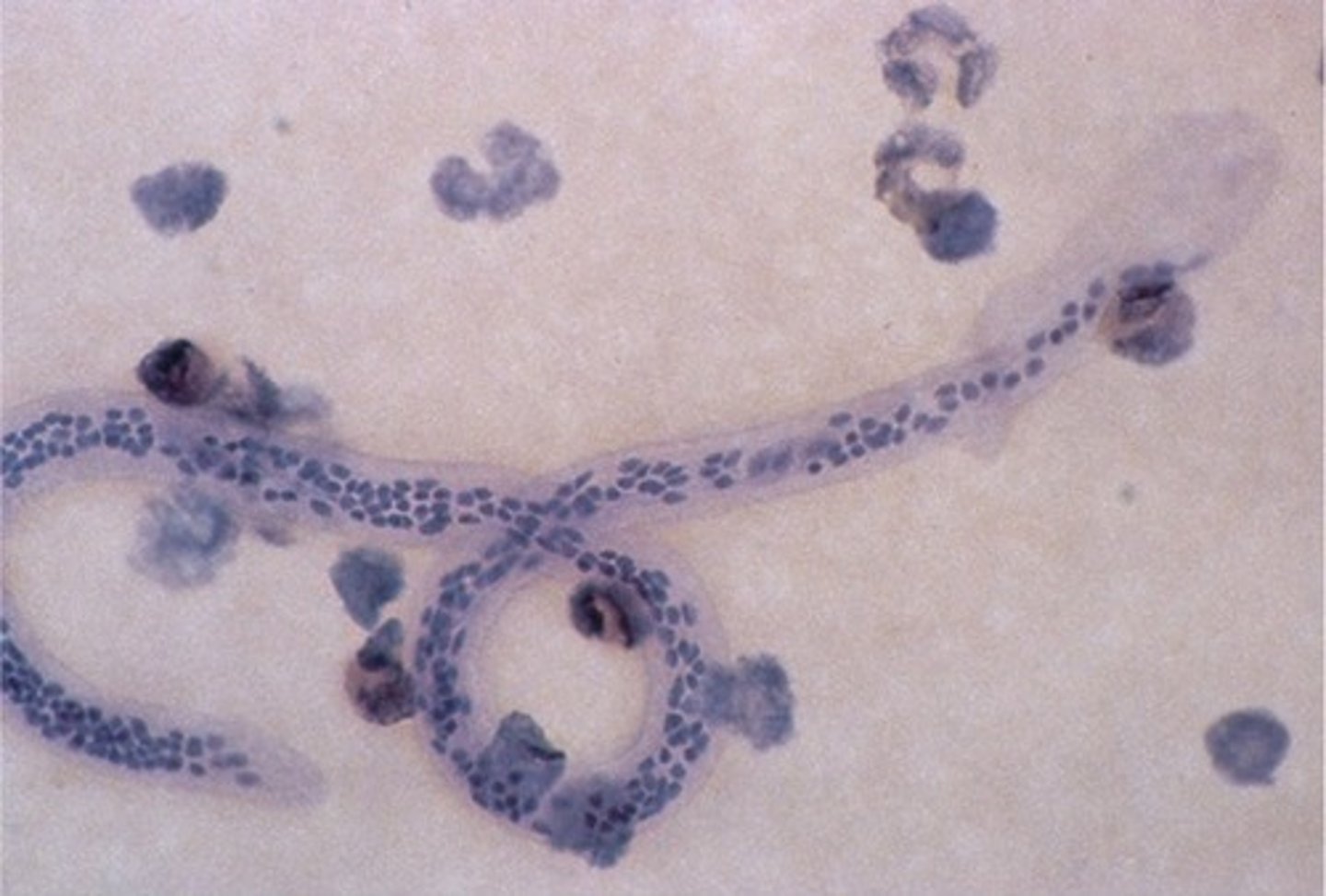
Giemsa
When stained with this, the sheath of
Wuchereria bancrofti does not stain well.
Malayan filarial worm
Brugia malayi
COMMON NAME:
111-230 MICRONS
MICROFILARIA of Brugia malayi
size:
☺Sheathed microfilaria
Brugia malayi
sheathed or not>
tail: PRESENCE OF TWO (2) DISTINCT NUCLEI IN
THE TIP OF THE TAIL.
periodicity: SUBPERIODIC NOCTURNAL PERIODICITY
unique feature of Brugia malayi
tail:
periodicity:
In Giemsa-stained blood films, they appear PINK in color and have angular curvatures with secondary kinks.
Unlike with Wuchereria bancrofti, Giemsa does stain Brugia malayi well.
W. bancrofti is larger
Brugia malayi is smaller
W. bancrofti vs Brugia malayi
what is larger in size ?
W. bancrofti: Curves of body are natural, smooth (GRACEFUL)
Brugia malayi: Curves of body are rigid, the small in larger curve
SHAPE OF THE BODY
W. bancrofti:
Brugia malayi:
W. bancrofti: Shorter
Brugia malayi: Longer
CEPHALIC SPACE
W. bancrofti:
Brugia malayi:
W. bancrofti: Equal sized, clearly defined, countable
Brugia malayi: Unequal sized, coalescing, uncountable
BODY NUCLEI
W. bancrofti:
Brugia malayi:
☺Inflammation, edema, fibrosis
☺Acute fever, lymphadenitis, funiculitis, swelling, redness
☺ELEPHANTIASIS
☺Expatriate syndrome
☺Hives, rashes and blood eosinophilia
☺HYDROCOELE
☺Genital and pedal enlargements are common
☺CHYLURIA
PATHOLOGY -
W. bancrofti:
Exposure to Wolbachia-
PATHOLOGY - W. bancrofti:
inducer of inflammation
(BANCROFTIAN FILARIASIS)
PATHOGENESIS - W. bancrofti
Stage 1 (Chronic lymphedema) - Swelling increases during the day but reversible once the patient lies flat in bed
Stage 2 - swelling is no longer reversible at night
Stage 3 - presence of shallow skin folds, and base of the lesion are seen when leg or foot moves
Stage 4 - knobs are present in affected areas
Stage 5 - with deep skin folds
Stage 6 - bulky lesions are present and leakage of fluid
Stage 7 - patient is unable to perform daily activities
(BANCROFTIAN FILARIASIS)
Stage 1 -
Stage 2 -
Stage 3 -
Stage 4 -
Stage 5 -
Stage 6 -
Stage 7 -
∞Deformity produced in infected cases is not as severe as in bancroftian filariasis
∞There may be enlargement of the epitrochlear, inguinal and axillary lymph nodes
∞Rarely in scrotum
PATHOLOGY - B. malayi
a. Thick blood smear: 2~3 drops of free flowing blood by finger prick method
b. Membrane filtration method: 1~2 ml intravenous blood filtered through 3µm pore size membrane filter
c. DEC provocative test (2mg/Kg): after consuming DEC, mf enters into the peripheral blood in day time within 30~45 minutes
d. Adult: biopsy of the nodes or lymphatic vessels
e. Immunological tests: antibody or circulating filarial antigen (CFA)
f. KNOTT'S TECHNIQUE
DIAGNOSIS
Wuchereria bancrofti and Brugia malayi
Thick blood smear: capillary blood from skin puncture
NOTT'S TECHNIQUE: Venous blood (Venipuncture)
DIAGNOSIS - specime
Thick blood smear:
KNOTT'S TECHNIQUE:
KNOTT'S TECHNIQUE
DIAGNOSIS
This technique involves ISOLATION of microfilariae
GIEMSA
ideal stain for BLOOD parasite.
• Reagent: 1 part of blood + 9 parts of formalin + Acetic Acid
NOTE: RBC will be hemolyzed; what will be left are WBC's and MICROFILARIA
KNOTT'S TECHNIQUE
• Reagent:
1. urban type-
2. rural type-
2 types of Bancroftian filariasis
1. urban type- Aedes poecilus
2. rural type- Anopheles minimus flavirostris
2 types of Bancroftian filariasis
1. urban type-
2. rural type-
> most prevalent in ABACA raising areas - urban type; Aedes poecilus
> towards the mountains and hills - rural type; Anopheles minimus flavirostris
2 types of Bancroftian filariasis
> most prevalent in ABACA raising areas -
> towards the mountains and hills -
45 endemic provinces (e.g. REGION IV)
83 endemic countries
Epidemiology
Wuchureria bancrofti and Brugia malayi
# endemic provinces (PH) -
# endemic countries -
- Most mosquitoes are NIGHT BITERS and usually starts biting as early as 5:00 pm to around 11:00 pm
- With (B. malayi), CAT is an important reservoir host.
TAKE NOTE!
M. bonneae- breed in freshwater swamps
M. uniformis- breed in rice field
EPIDEMIOLOGY: (B. malayi)
M. bonneae-
M. uniformis-
With (B. malayi), cat is an important reservoir host.
TAKE NOTE!
- Diethylcarbamazine citrate, Ivermectin with albendazole
- Relieving the pain (cooling the area, , washing the affected area,
- surgery (for hydrocoele )
- All abaca workers must wear long sleeved shirts and use mosquito repellents on the exposed skin ☺
-Use mosquito nets especially for endemic provinces/ use of insecticides
- Keep the surroundings clean and throw away possible habitat for the vectors.
TREATMENT, PREVENTION AND CONTROL