Mind As a Work of Art (MAWA)
 Call Kai
 Learn
 Practice Test
 Spaced Repetition
 Match
 Flashcards
 Knowt Play
1/251

There's no tags or description
Looks like no tags are added yet.
252 Terms
in psych, what direction to people usually associate the mind and the arts?
theories of how the mind words → theories of the arts
so, the standard model claims
the arts reflect cognition capacities

how does MAWA flip this?
theories of art → how the mind works
we can look at how the arts can shed light on the nature of human cognition/psychology
so, the MAWA model says
the arts shaped cognition capacities
this is an interactive relationship
they both intertwine

generic processes of the course
creativity → how we think
aesthetics → what we desire
intermediate processes of the course - the narrative arts
visual art → the design of objects
theatre/lit → the drama of social life
4 ways to achieve MAWA
Artful Cognition
Novel Art Functions in Humans
Joint Evolutionary Precursors
Applied-Arts Effects in Cognition/Behaviour
artful cognition
social behaviour as theatre
we are protagonists, we have friends, foe, etc.
novel arts functions in humans
evolutionary add-ons
such as musical scales → these are uniquely found among humans
joint-evolutionary precursors
art and non-art have co-evolved together
such as the co-evolution of music and language
applied-arts effects in cognition/behaviour
such as melodic intonation therapy (MIT)
using musical intervals/rhythmic patterns to help those with aphasia (those who cannot speak)
standard model of art thinking
ordinary thinking → art thinking
“think outside of the box”
art thinking seen as separate from ordinary thinking (which comes first)
how MAWA sees art thinking
argues that ordinary thinking already has an art-like nature to it

6 Forms of Artful Cognition
display thinking
graphical cognition
narrative thinking
theatrical thinking
proto-dancing
proto-music
display thinking
displays of self in public (behavioural and static)
such as dressing a certain way as a professional being
we are always displaying ourselves in a certain way in public
graphical cognition
our graphic design sense
designing outfits, picking out decorations, etc.
narrative thinking
the storied nature of human cognition
theatrical thinking
role playing during everyday social interactions
such roles switch often — can be submissive or dominant, etc.
proto-dancing
coordinated body movement during conversation
somewhat unconscious - Chameleon effect
studied by MoCap
proto-music
the musicality of speech
speech =/= music, but lots of aligned features
how to classify the arts
Narrative arts
Coordinative arts
branches from Narrative Arts
Static → painting, sculpture, photography, literature, written poetry
Performance →
branches from Narrative Arts → Performance
Narrated → oral storytelling, oral poetry, songs with words, pantomime
3rd person
Acted Out → theatre/opera, film, narrative dance, mime theatre
taking on the 1st person
branch from Coordinative Arts
Performance → dance, music
where does Performance Arts fit into here?
in the “Performance” boxes, from both Narrative Arts and Coordinated Arts
classifying the arts - all

4 major artforms that can break into 2 triangles

The Narrative Triad
we have evolved 3 different modalities for telling stories, each of which aligns with the 3 major branches of Narrative arts
visual art → image
dance → gesture
theatre/story-telling → language

the Performance Triad within Performing Arts
we have evolved 3 modalities (based on phrases) that align with the major branches of performing arts
music → melodies
dance → dance phrases
theatre/storytelling → utterances

all together, this creates the 4 Systems of Arts
Narrative Arts → Static Narrativity & Dynamic Narrativity
Coordinated Arts → Coordination of Bodies & Coordination of Voices

consider how we think about others on either side
narrative arts → others are Characters
exist in a separate world, we can feel for them but not with them, very asymmetrical
coordinative arts → others are Partners
exist in our world, we can feel with them
10 Systems of Core Knowledge
OBJECTS:
Objects and their Categorization
Language → symbols/representations of an object, usually abstract but sometimes iconic
Numerical Cognition → individual, can be precise counting or approx
Logic and Deductive Reasoning → start w generic rule/premise, and apply it to a specific case to reach a specific conclusion
Spatial Cognition and Orientation
EVENTS
Causal Inference Through Inductive Reasoning → using a specific observation to make broad, probable generalizations
Mental Time Travel → distinction between past, present, and future
AGENTS
Mentalizing (theory-of-mind) → making inferences about other’s mental states
Social Intelligence; categorizing people
Self-awareness; self-regulation
example of logic and deductive reasoning
if we discover a new mammal species, and we know that most mammals have hair (general rule), we will deduct that the new species likely has hair (specific conclusion)
iconic means
it resembles the representation
ex, mimicking drinking water
ex, the word “shush”
domain-general
applies toa wide variety of tasks and functions, rather than one specific function
attention
forming associations (can cross between modalities)
working memory (in general)
domain specific
is targeted to one specific task/function
think of novel arts functions that are add-ons in humans:
Unique Art Capacities in Humans - example of Domain-Specific
iconic gestures
figurative drawing
acting (impersonation)
rhythmic synchronization of movement to people through group dancing
the most diverse musical scale systems of any species
most elaborate group rituals to any species
iconic gestures
resembles the thing it is representing, can stand alone and be recognized
like presenting to throw a ball
figurative drawing
drawing real thongs that are flat (2D) but iconic
acting (impersonation)
not considered to be deception, as it would be in animal behaviour (like a sneaker fish)
theatre is a non-deceptive way we pretend to be someone else
the most diverse musical scale system of any species
birds do have musical scales, but way less diverse
we have complex chorusing, unison, harmonizing, etc.
in general, humans are mostly social species
altruism → helping others to no gain of our own
food sharing
collaborative actions → hunting, dancing, etc.
the shortest people in the world in Africa can hunt elephants, bc they do it together!
very efficient
we should be selfish …
individual organisms are self-serving; we are supposed to be individualists trying to maximize reproductions
In groups, even "cheaters" can reap the benefits of cooperation without paying the cost
Groups are unstable, defection is common!
the biological paradox of group living
evolutionarily, we shouldn’t be as cooperative as we are
we shouldn’t want groups/shouldn’t evolve altruism, due to chances of cheaters
but, we are!
we are _____ purely selfish or purely selfless
neither!
we are in between:
within-group
between group
within-group; ex of study group
competition → me vs you
I want to do better than my study buddies
cooperation → us
we want to work together to collectively do well
between group
competition → us vs them
Canadians vs Americans
cooperation → us + them
people vs AI
dominant theory about why the human brain is 3X larger than a primate our size
the social brain hypothesis
the Social Brain Hypothesis
Positive correlation between group size and brain volume
In primates, group size predicts brain size
Maybe it expanded to deal with our larger social capabilities
↑ group size = ↑ # social interactions = ↑ brain size
so, the human brain expansion was driven by the need for
social intelligence
6 elements of Social Intelligence
Keeping track of relationships in social networks → friends vs foe
Categorizing the self and others into groups → us vs them, etc.
Theory of mind - making inferences about people’s mental states → compared to empathy, more of an acknowledgement
Folk psychology - explaining people’s behaviour with regard to their mental states → “she tripped bc she was distracted thinking about her kids”: people do things for a reason, similar to mentalizing
Empathy - sharing in people’s emotional states → you are also emotionally involved; often have mentalized that they have the emotion, THEN you start to share
Altruism - helping behaviour → with no obvious benefit
considering the biological paradox of group living, how can we show that the group is stable/won’t have cheaters?
behavioural coordination!
behavioural coordination
performance rituals → individuals synchronizing with one another, are very important means of group functionality
proves that we are willing to cooperate, we feel more connected, more committed, etc.
also reinforces such feelings (seeing this from others), makes us more willing too
not just about entertainment
people who sync together, think together
what do we have proof of in controlled experiments?
“People who sync together, think together”
typical idea from evolutionary psych as to why we cooperate
reciprocity
reciprocity
"I'll help you and eventually you'll help me"
really only works well in dyads, but falls apart in massive groups
think; soldiers going to war aren’t keeping track of every person they help to expect reciprocity
so, how do we get cooperation of an entire group? a community?
coordination instills a sense of cooperation in the entire group
group rituals that stimulate coordination → behavioural coordination → cooperation of the group
functions of group rituals
demonstrate commitment to the group
consider any form of sacrifice; circumcision, avoiding sin, learning new language, etc.
increasing group cohesion
transforming from Me to We
ceremonies as arts - MAWA
religious ceremonies are (nothing more than) collections of arts behaviours and objects
If we strip arts from the ceremonies, there's nothing really left!
Stravinsky - Rite of Spring
had a huge jump from his performance 6 years prior to the unique, incredible Rite of Spring
what happened within those years that led him to create the revolutionary work?
creativity - ideas or products that are
novel (most important)
surprising (people say it should be)
useful (most optional, this one can never stand alone)
non-creative, based on the above
reproduction
imitation
re-use
creativity is contrasted with
routines
habits
rituals
traditions
all involve reproduction the same fixed movements
is creativity art-specific?
no - it is generic and applied to many domains
for ex, Mark Carney could be described as a creative leader for his consistent new ideas for policy
so, is creativity domain-specific or domain-general?
likely more domain-general
even though some people have extenuated/exaggerated domain-specific creativity
Domain-Specific Approach - in fMRI studies
A) - music improvisation or language improvisation
B) - playing known piece or reciting known poem
we take A - B, and assume the difference is the Domain-Specific Creativity
transition from non-creative to creative could be mediated by
the same domain-general processes!

domain-general approach
Divergent Thinking, often using the Alternate Use Task (AUT): shown a common object and asked to consider multiple uses for it
rated on:
number of alt uses
originality
detail
supposed to be a general predictor of all domains of creativity
about the AUT…
we should think beyond just this
would Stravinsky have done good on this? because we alr know he was creative
2 types of creativity
Functional Creativity → novelty for solving problems
Display Creativity → novelty for its own sake (including artification)
functional creativity
involves developing novel/new solutions to existing problems
example - operant conditioning (trial and error learning) is a form of this: since the first way isn’t working, you keep trying until you are successful
problem solving links creativity to
a domain!
for ex, Mark Carney is creative in solving problems in POLICY, but would not be good in vaccination work
the problem solving cycle
problem formulation → need to find/determine the problem first
solution formulation
solution implementation → often the first solution won’t work, so you must identify the new problem and continue through this cycle
the vast majority of creativity is
incremental (small changes)
revolutionary thinking is the minority
we are usually adding small tweaks to something that has been slowly building
much of creativity is a modification of some existing product
“making better”
making small improvements to existing products or ideas
think of new phones each year
accumulation of creativity
improvements slowly accumulate across generations
Human culture is cumulative; we inherent the creations of our ancestors, and we thereby make gradual improvements to such creations
We don't have to re-discover things each generation
We are standing on a giants shoulder
Giant = generations of accumulation of creations and adjustments
geneplore model
gene = generation
plore = exploration
geneplore model + problem solving cycle
1. Problem Formulation
2. GENERATION
3. Solution Formulation
4. EXPLORATION
5. Solution Implementation
The problem solving cycle is iterative (doing something over and over)
creative work is driven by
a core idea
it is neither random nor fully formed
requires exploration
core idea - westside story ex
Musical from the 60s, then a film, a modern retelling of Romeo and Juliet (forbidden love)
○ OG: Jews and Irish
○ Modern: Puerto Ricans and Polish Americans
Even though it was transposed (people and characters changed) the core idea remained despite the changes
when exploring a core idea,
it will remain while other details change
what is the source of novel ideas?
much of the work has been done for us already (the giant before us)
but, the answer comes from your opinion/stance on what creativity is
2 main stances on sources of generation
divergent thinking
analytical thinking
divergent thinking
thinking outside the box/brainstorming
To think that this is the only basis for creativity is ignorant (def applies to some, but not all)
Yet, this is still a dominant perspective in psych
'creative ideas come randomly, out of the blue'
Insight = a Euraka moment
you're stuck, then you randomly have a moment of insight (AHA moment!)
Mental Illness and Psychotropic Drugs -- some say divergent ideas come from divergent minds
analytical thinking
creativity is more linear, building on an idea
Building upon the past, adjusting a tweak, not always creating a whole new world
New products following existing products, often a modification
Consider the development of technologies (cars, phones, etc.)
The 2028 Honda is the same as the 2027 Honda, only with some minor improvements
Often inspired by someone else's work! Or, we can follow up on our own work
analytical thinking - creativity as strategic theft
being inspired by someone else’s work/ideas, so we kinda steal and fuse them, repackage them, and add a small tweak to it
Obviously this isn’t super creative
phases of creative work
not perfectly linear, lots of revision
completion =/= always the final product, may be temporary

aesthetics
what we find attractive and like, our preferences and sense of taste
Consumers appraise creative products based on aesthetics
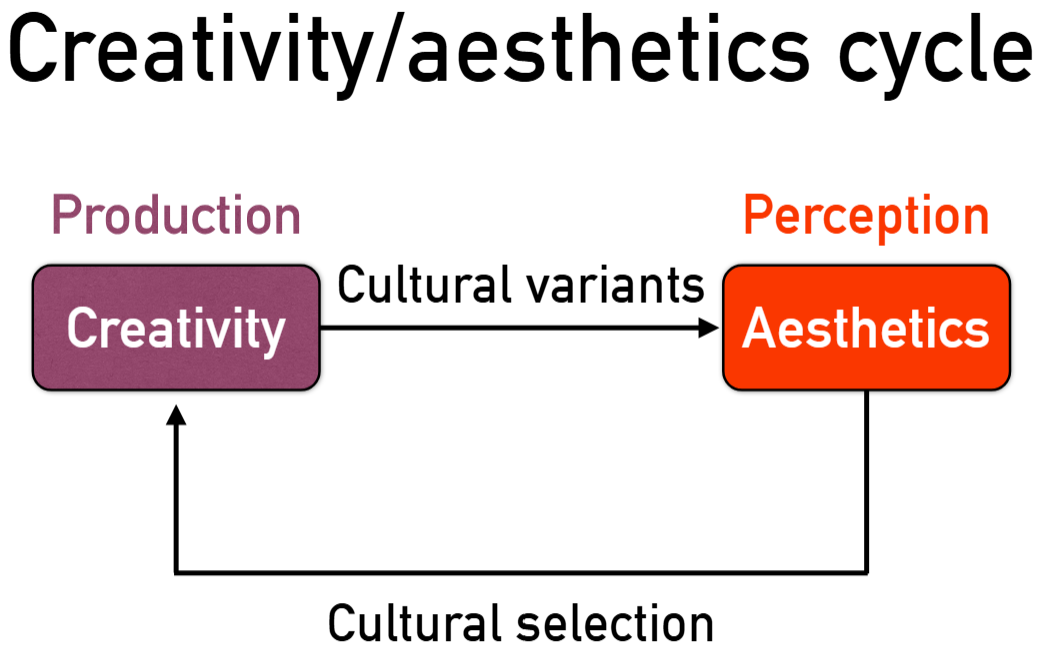
the creativity/aesthetics cycle - MAWA
creators - producers of ideas
consumers - rely on our perception of aesthetics
creators produce their work to appeal to some target audience; will see what is perceived as aesthetic (what is liked), and will use that to reinforce the next production

we create to
please
need to create appealing things so that people want to consume it
biological evolution
Natural selection favours some and disadvantages others
Selection force = nature, AKA natural selection
Leads to changes in frequencies (AKA evolution)

cultural evolution
People/consumers vary in their consumption, thereby favouring some over others
Selection force = consumers
Change in frequencies (AKA evolution)
Harry Potter: millions of prints, 8 films, etc.
Basket Weaving: out of print, no longer sold
adding to the creativity/aesthetics cycle
cultural variants → the products being made
cultural selection → done by consumers; what is bought, favoured, popular, hated, etc.
modification
builds upon existing products
of other people’s products or one’s own previous products
based on analytical thinking
an incremental change, such as a small improvement
only 1 source of idea
blending
considers 2+ source of ideas
blending - forming associations
conceptual blending - involving analogical reasoning
“he was like a fish out of water”
This is a conceptual blend; you are blending the reality of a fish out of water with a human out of place to describe a situation where you are uncomfortable and out of place
natural selection - a blend or modification
a blend
consider breeding dogs for certain features - we are blending multiple breeds
natural selection is doing this too, just slower and for diff reasons
nature + breeding =
culture + biological evolution =
natural selection
cultural evolution
in humans, much blending is based on
inter-cultural mixtures to create fusions
jazz = african + european
jewish band = middle east + european
bollywood = bombay + hollywood
parliament of france = roman structure + modern tech
tex-mex = german + mexican
spanglish = spanish + english
sweater dress
spork
creative work is driven by
a core idea, neither random or fully formed