BIO 201 EXAM 1 UNCW Latest updated questions and answers + rationales - Grand Canyon University
 Call Kai
 Learn
 Practice Test
 Spaced Repetition
 Match
 Flashcards
 Knowt Play
1/110

There's no tags or description
Looks like no tags are added yet.
111 Terms
central dogma of biology
DNA -> RNA -> Proteins
DNA
genetic material that provides a
blueprint for the development and
function of living things
DNA linear sequence of bases
DNA blueprints
DNA replicates
transcription
DNA makes RNA
RNA
linear sequences of bases (nucleotides)
Nucleotides
Monomers of nucleic acids
translation
RNA makes proteins
protein
specific amino-amino chains
that will ultimately produce the phenotype of the living organism
Mad-cow disease
example of a protein that can replicate itself and grow
genotype
genetic composition of an individual
phenotype
A manifestation of genotype: An organism's physical appearance, or visible traits.
mitosis
DNA replication. conserves ploidy.
chromosome
organized structures of DNA,RNA,
and proteins (histone proteins)
True
T/F. Different areas of the chromosome are going to code different genes
histone proteins
A simple protein bound to DNA, involved in the coiling of chromosomes

locus
particular location on a chromosome
occupied by a specific gene

homologous chromosomes
chromosomes of the same
size, shape, that code for the same genes

alleles
a variation of a gene
Meiosis
halves the ploidy. makes gametes for sexual reproduction
properties of life
Reproduction
Growth and Development
Energy use and Metabolism
Response to Environment
reproduction
generation of new individuals that includes transmission of genetic material
growth and development
increase in size or number of cells - series of
changes in the state of a cell, tissue, organ, organism
Energy use and metabolism
set of chemical reactions that happen in the
cells of living organisms to sustain life. respiration. photosynthesis. chemosynthesis
repiration
chemical reactions that convert sugars in to ATP
photosynthesis
process of converting light energy into sugars
chemosynthesis
process of converting inorganic molecules (chemicals CHO) into sugars
response to environment
cells in an organism being able to adapt to a changing environment
cells
internal order and in multicellular organisms have specific arrangement and functions
maintains homeostasis
maintenance of relatively stable environment
despite fluctuating external environment
evolution
changes in the genetic composition of a population of time
Big bang theory
13.7 BYA
Earth formed
4.55 BYA
Water appeared
4 BYA
stromalites appear
3.5-3.7 BYA
stomalites
Layered calcium carbonate
structures formed by
cyanobacteria
how did life originate
1. Nucleotides and amino acids were produced
2. Nucleotides were polymerized to form RNA and/or DNA; amino acids were polymerized to form proteins
3. Polymers became enclosed in membranes
4. Cellular characteristics arose
Nucleotides and amino acids were produced
early atmospheric conditions made is very easy for amino acids (organic molecules) and nucleotides (ACGTU) to form naturally
Miller and Urey
showed that the synthesis of organic molecules
(amino acids) was possible given early atmosphere conditions (water, hydrogen, ammonia, methane)
Nucleotides were polymerized to form RNA and/or DNA; amino acids were polymerized to form proteins
Charged clay surface attracts nucleotides and increased local concentration of nucleotides causes bond formation, forming polymer of RNA
Polymers became enclosed in membranes
Cell-like structures may have originated when polymers were enclosed by a boundary
Formation of a boundary that separated the internal polymers, such as RNA from the environment.
Liposomes
spherical vesicle with at least 1 lipid bilayer

Micelles
tiny spheres of fatty acids

Protobiont
prebiotic molecule that acquired a boundary that allows formation of internal chemical environment that is distinct from external environment
Cellular characteristics arose
Cellular characteristics may have evolved via chemical selection, beginning with an RNA world
chemical selection
when a chemical within a mixture has characteristics that cause it to increase in number relative to other chemicals
adaptation
any heritable behavioral, morphological, physiological trait of an organism that has evolved by natural selection that maintains or increase fitness of an individual in a particular environment
natural selection
differential survival and or reproduction of an individual caused by interactions between the individual and other organisms and its abiotic environment that maintains or increase the fitness of an individual in a particular environment
trait
distinct variant of a physical characterisitics
Fitness
proportionate genetic contribution an individual
makes to future generations
diversification requires
Heritable traits
variation in trait in population
trait affects fitness
LaMark
inheritance of acquired characteristics
Epigenetic
Refers to heritable changes in gene expression that are not the result of changes in DNA sequence. Rat afraid of smell and so were their offspring.
Darwin
1859 On the Origin of Species. Formulated a theory of evolution by natural selection
How are traits inherited?
by passing of factors from parent to offspring
Mendel
worked with peas to discover how traits are passed down and inherited
homozygous
GG gg

heterozygous
Gg

Qualitative (mendelian) traits
traits that occur in a small number of categories

Codominant
both alleles are expressed
quantitative traits
traits that are continuously distributed and determined by multiple genes and interactions with the environment

Natural Selection Adaptions
Variation and Heritable
Variation
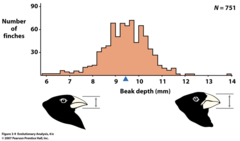
Heritable

selective agent
the cause of fitness differences among organisms with different phenotypes. the environmental factor acting on the population.

target of selection
phenotypic trait that selection operates on
directional selection
Selection in favor of one extreme. phenotype characteristics. allele frequently shift over time

stabilizing selection
Selection against both extremes. reduces the amount of variation in population phenotype. Ex. Baby weight (too small-lose heat. too big-complications in giving birth)

distributive selection
Selection for both extremes (against average) Both sides of the stabilizing extremes are favored. When the norm is no longer favored.

balancing selection
selection that maintains genetic diversity within a population. Multiple alleles or circumstances (different versions) are being maintained within a gene pool of a population. Found at larger quantities than expected.
Heterozygote advantage
heterozygotes have higher fitness. By having genetic differences in a population, you have a better chance of survival. Ex. In the presence of malaria, only homozygotes would be effected.

Negative frequency dependent selection
fitness of a genotype decreases over time as that
genotype becomes more common. Ex. accents
Sexual Selection
Selection for mates. Natural selection based on the choice or access to mates
Intrasexual selection
Members of the same sex will directly compete with each other.
Intersexual selection (mate choice)
the opposite sex will choose to mate based on characteristics and actions of the other sex.
What can change populations over time
natural selection and sexual selection
Mutation
Random change in the DNA of an organism
Drifts
Small population sizes, random fluctuations can
influence genetic composition over time
Migration
Movement of individuals from one population to another
Hardy Weinberg
They both created a null model. Whats the expectation of something when its absent?
evolution would not occur in the absence of the
above 5 factors
Bottleneck Effect
the sharp reduction in the size of a population due to environmental or anthropogenic factors
Founder Effect
the loss of genetic variation in a new population was established by a very small number of individuals
Biological Species concept
a species that has the ability to interbreed and produce viable offspring
Allopatric Speciation
occurs when some members of a population/species occupy a habitat that is isolated from others. This will then result in genetic changes and possibly a new species. Accumulation of sufficient differences to generate different
species when some members of species occupy a habitat that is isolated from other individuals
Adaptive radiation
a single ancestral species has evolved into a wide array of descendant species

RIng species
a series of connected populations, each capable of interbreeding with neighboring populations, but there exists at least two "end" populations that are too distantly related to interbreed. Ex. Salamanders will separate into water and mountains and there will be a genetic drift among the 2 populations which will no longer allow them to breed together anymore.

Sympatric Speciation
Speciation within same range - no
geographical barrier.
Polyploidy
organisms that are more than 2N - tetraploid, triploids.
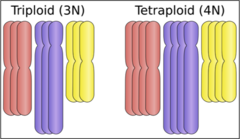
Autopolyploid
polyploid made from the same species

Isolating mechanisms
mechanisms to prevent interbreeding
Prezygotic
prevent formation of a zygote through habitat isolation, temporal isolation, and behavior isolation

habitat isolation
species occupy different habitats never come into contact
temporal isolation
different mating seasons. sexually mature at different times.
behavioral isolation
sexual attraction between a male and female is limited due to differences in behavior. Ex. a bird of paradise trying to attract a seagull
attempting to mate externally
External way to prevent a zygote from forming though mechanical isolation
mechanical isolation
morphological features prevent successful mating (external)
Gametic Isolation
gametic transfer occurs but fails to unite (internal)
Postzygotic
after fertilization, there are mechanisms to prevent development of a fertile offspring
hybrid inviability
the gametes combine and forms the zygote but it doesn't make it past the embryonic stages. The body aborts the zygote.
hybrid sterility
the interspecies hybrid survives birth but can not reproduce

hybrid breakdown
the gametes are going to combine, the zygote will survive birth, and be able to have offspring but the offspring will eventually become sterile.