Chapter 15: Surveying the Stars
 Call Kai
 Learn
 Practice Test
 Spaced Repetition
 Match
 Flashcards
 Knowt Play
1/29

Earn XP
Description and Tags
Vocabulary practice flashcards covering the properties of stars, spectral classification, binary star systems, the Hertzsprung-Russell diagram, variable stars, and star clusters.
30 Terms
Luminosity
Slide: The total amount of power (energy per second, measured in watts) that a star radiates into space.
Simple: This is how much light and heat a star actually makes all by itself, like the wattage on a lightbulb. It never changes, no matter where you are.
Luminosity and Area of sphere rel: the total amount of starlight never disappears or gets used up, so the exact same total energy passes through every sphere it just spreads out thinner as the spheres get bigger.
Example: Imagine shining a flashlight in a dark room through three clear plastic sheets lined up at 1 foot, 2 feet, and 3 feet away:
Sheet 1 (1 AU): The flashlight beam lights up 1 square on the first sheet. All of the flashlight's light passes through that single square.
Sheet 2 (2 AU): The exact same beam of light keeps going and hits the second sheet, where it now covers 4 squares (a 2 × 2 grid).
Sheet 3 (3 AU): That same beam reaches the third sheet and spreads out to cover 9 squares (a 3 × 3 grid).
Same Total Light: No light gets blocked by the clear plastic, so 100% of the flashlight's light passes through Sheet 1, Sheet 2, and Sheet 3.
Spreading Over the Grid: Because the exact same beam has to fill 1 square, then 4 squares, then 9 squares, each individual square gets less and less light just like the white grid squares drawn on the spheres.
Formula: Luminosity=4ℼd² x Apparent brightness

Apparent Brightness
Slide: Amount of starlight that reaches Earth (energy per second per square meter)
Simple: This is how bright a star looks to your eyes from Earth.
Formula: (Luminosity)/ 4ℿd²
Example: Imagine standing on the side of a dark road at night looking at two different vehicles:
A Bicycle Headlight 10 Feet Away: This small light has very low true power (luminosity), yet because it is right in front of you, it shines directly into your eyes and looks blindingly bright.
A Semi-Truck High-Beam 2 Miles Away: This massive headlight has way more true power (luminosity) than the bicycle light, yet because it is miles down the road, its light has spread out so much that it looks like a tiny, dim speck.
Apparent brightness depends on both power and distance.
Just like the bicycle light looks brighter than the faraway truck, our Sun has a much higher apparent brightness than Sirius (the brightest star in the night sky), even though Sirius actually produces 25 times more real power than our Sun.Because Sirius is over half a million times farther away from Earth than the Sun, its light spreads out over a massive imaginary sphere (4ℼd²) before reaching your eyes. Even though Sirius pumps out way more real energy, the Sun looks overwhelmingly brighter to us simply because it is right next door.
Area of a sphere
Slide: The surface area of a sphere depends on the square of its radius (distance from the star) so the amount of light passing through each unit of area depends on the inverse square of distance from the star.
Simple: As starlight flies through space, it spreads out in a giant invisible bubble. The bigger the bubble gets, the more the light stretches out.
Formula: 4ℼ x (radius or d) ²
example: Imagine drawing dots on a deflated balloon. When you blow the balloon up bigger and bigger, the surface stretches out and the dots move farther apart. Starlight stretches out in a 3D ball just like that as it travels through space.
Inverse Square Law for Light
Slide: The mathematical relationship stating that apparent brightness decreases with the square of the distance: Apparent Brightness=4π×(distance)2Luminosity .
Simple: The inverse square law means light gets dimmer by distance squared when you move away, and brighter by distance squared when you get closer.
Formula: Use the Shortcut (1/d²) for "How many times..." questions. If the problem says a star moves 3 times farther or 2 times closer, you only need the distance number. Square it and flip it. Ex: Star A and Star B have the exact same luminosity. If Star B is 6 times farther away from Earth than Star A, how much dimmer does Star B appear?
Formula: Use the Full Formula (Luminosity)/ 4ℼd² for "Watts" or "Meters" questions. If the problem gives you exact science numbers (like watts or meters) and asks for an exact number back, plug everything into the big equation. Ex: The Question: A star has a luminosity of 4 × 10^17 and is located 1 × 10^9 away from Earth. What is the star's apparent brightness from Earth?

Stellar Parallax
Slide: The apparent shift in position of a nearby star against a background of more distant stars as Earth orbits the Sun, used to calculate stellar distance.
Simple: Stellar parallax is how a nearby star looks like it moves slightly back and forth in the sky as Earth travels around the Sun.
Example:
What happens: Because Earth moves from one side of the Sun to the other every six months, close stars look like they "wiggle" slightly against the distant stars behind them.
What it tells us: The bigger the wiggle, the closer the star is to Earth.
Everyday example: Hold your thumb near your nose and blink one eye at a time—your thumb jumps back and forth. Hold it at arm's length and blink—it barely moves.
Formula: d=1/p (in parsecs) or d= 3.26 x (1/p) (in light years)
d is distance and p is parallax angle.
Example:
Astronomers measure a nearby star and find that it has a parallax angle of \(0.25\) arcseconds.
How far away is the star in parsecs?
How far away is the star in light-years?
Step 1: Find the distance in parsecs. Use the parallax formula d=1/p:
d=1/0.25 → d=4 parasecsStep 2: Convert parsecs into light-years. Multiply your parsec answer by 3.26:
4 × 3.26= 13.04 light years
Parsec
A unit of astronomical distance equal to 3.26light-years, defined by the formula d (in parsecs)=p (in arcseconds)1, where p is the parallax angle.
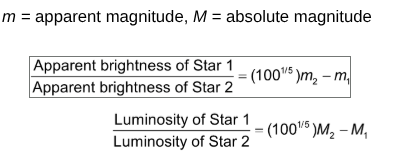
Apparent Magnitude (m)
Slide: A measure of how bright a celestial object appears to an observer from Earth on a logarithmic scale where smaller or more negative numbers correspond to brighter objects.
Simple: How bright a star looks in our sky from Earth (it matches apparent brightness).
Example: The magnitude scale works backward—smaller (or negative) numbers mean brighter stars, and larger numbers mean dimmer stars. For example, the Sun has an apparent magnitude of -26.7, while the faintest stars visible to the naked eye are around +6.
Formula kind of explained: It calculates how many times brighter one star looks compared to another based on the difference in their apparent magnitudes m2 - m1.
The number 100^1/5 equals roughly 2.512.
Absolute Magnitude (M)
A measure of a star's intrinsic luminosity, defined as the apparent magnitude the star would have if it were located at a standard distance of 10parsecs from Earth.
Thermal Radiation
Radiation emitted by any dense object with a continuous spectrum that depends solely on the object's temperature.
Law 1 of Thermal Radiation
The physical law stating that hotter objects emit more total radiation per unit surface area at all wavelengths than cooler objects.
Law 2 of Thermal Radiation
The physical law stating that hotter objects emit photons with a higher average energy, meaning their peak wavelength of emission shifts toward shorter wavelengths.
Spectral Type
A classification system based on absorption lines in a star's spectrum that reveals its surface temperature, ordered from hottest to coolest as O, B, A, F, G, K, and M.
Williamina Fleming
A Harvard 'calculator' who first classified stars alphabetically based on the strength of their hydrogen absorption lines in the 1880s, cataloging over 10,000 stars.
Annie Jump Cannon
A Harvard astronomer who recognized that stellar spectra fit a natural temperature order rather than an alphabetical one, rearranging spectral types into the sequence O B A F G K M.

Cecilia Payne-Gaposchkin
The astronomer who showed in her 1925 doctoral dissertation that differences in stellar absorption lines reflect ionization levels determined by surface temperature.
Visual Binary
A binary star system in which the two member stars can be directly resolved individually with a telescope and their orbital motions tracked over time.
Spectroscopic Binary
A binary star system revealed by periodic Doppler shifts (redshifts and blueshifts) in the spectral lines of one or both stars as they orbit each other.
Eclipsing Binary
A binary star system aligned nearly edge-on to our line of sight, such that the stars periodically eclipse one another, causing regular dips in total apparent brightness.

Hertzsprung-Russell (H-R) Diagram
A graph that plots stars according to their surface temperatures (or spectral type/color) along the horizontal axis and their luminosities along the vertical axis.
Main Sequence
The prominent diagonal band on an H-R diagram running from upper left to lower right, comprising stable stars that fuse hydrogen into helium in their cores.
Giants and Supergiants
Large, highly luminous, cool stars located in the upper right of the H-R diagram that have exhausted core hydrogen and expanded in radius.
White Dwarfs
Hot, dim, compact stellar cores located in the lower left of an H-R diagram that remain after fusion has ceased in a star.
Luminosity Class
A classification scheme designated by Roman numerals (I through V) based on spectral line sharpness, describing the size and structural class of a star.
Variable Star
A star whose brightness fluctuates significantly over time, often because it cannot achieve equilibrium between power generated in its core and power radiated from its surface.
Instability Strip
A narrow region on the H-R diagram where pulsating variable stars undergo periodic cycles of expansion and contraction accompanied by regular brightness variations.
Cepheid Variable
A highly luminous pulsating variable star situated in the upper portion of the instability strip whose brightness varies regularly over periods of days.
RR Lyrae Variable
A pulsating variable star located on the lower part of the instability strip whose brightness varies cyclically over periods of hours.

Open Cluster
A loosely bound collection of a few thousand stars that formed around the same time from the same giant molecular cloud, typically found in galactic disks.

Globular Cluster
A densely packed, spherically shaped ball of hundreds of thousands to a million or more old stars bound together by gravity.
Main-Sequence Turnoff Point
The precise position on an H-R diagram where stars in a star cluster diverge from the main sequence, used to directly determine the cluster's age.