EPI study design: intervention studies
 Call Kai
 Learn
 Practice Test
 Spaced Repetition
 Match
 Flashcards
 Knowt Play
1/14

There's no tags or description
Looks like no tags are added yet.
15 Terms
I n t e r v e n t i o n s t u d i e s :
C o n t r o l l e d t r i a l s / e x p e r i m e n t a l s t u d i e s
Differ from observational
studies in that the
researcher has control
over the allocation of the
study subjects to the
groups being compared.
Other characteristics
• Clinical trial or Field trial
• Randomised or non-
randomised
D o i n t e r v e n t i o n s t u d i e s f u l f i l
B r a d f o r d h i l l c r i t e r i a f o r c a u s a l i t y ?
ntervention studies can meet the criteria very well (i.e., demonstrate cause-
and-effect relationships) – if rigorous
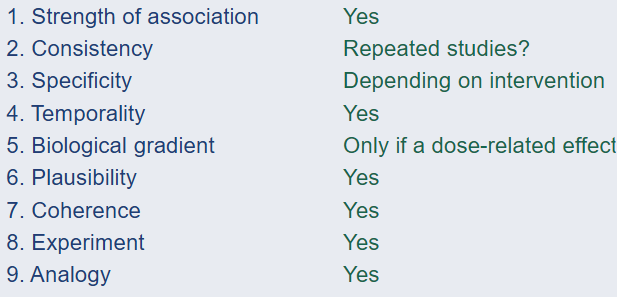
randomised clinica trial/field trial
A randomised clinical trial (RCT) or field trial is the gold standard for
demonstrating causality.
Several classifications are possible based on outcome and host:
• Therapeutic trials are conducted among individuals with a particular disease to assess the
effectiveness of an agent or procedure to diminish symptoms, prevent recurrence, or reduce
mortality from the disease.
• Preventative trials are conducted to evaluate whether an agent or procedure reduces the risk of
developing a particular disease among individuals free from that disease at the beginning of the
trial, for example, vaccine trials. Preventative trials may be conducted among individuals or among
entire communities.
—Vaccine efficacy studies.
• Individual vs community trial
phases of clinical trials
Typical approach in evaluating new human drugs, vaccines etc
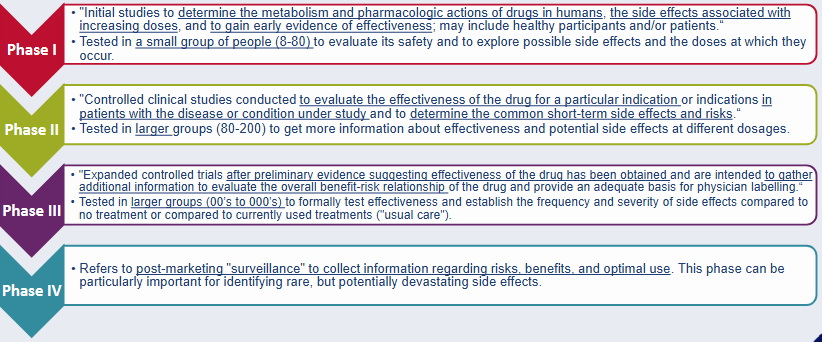
controlled trial/intervention study - when do we conduct intervention studies?
Intervention
• E.g., to test efficacy against no treatment; to compare to an existing
treatment & demonstrate equivalence; to compare to an existing product
and demonstrate superior performance.
Outcome measure
• Clinical improvement, change in a clinical test parameter, survival, time
to recovery etc.
I n t e r v e n t i o n S t u d i e s / C o n t r o l l e d
T r i a l s – K e y C o n s i d e r a t i o n s
• Background information
• Study objective
• Outcome
• Study population
— Inclusion & exclusion criteria
• Sample size
• Enrolment of animals
• Intervention
• Bias control
• Data collection & analysis
• Report of results

C o n t r o l l e d T r i a l / I n t e r v e n t i o n S t u d y
Specify intervention
Intervention/treatment group: Therapeutic (medication) or Preventative
(vaccines/management factors).
Control group: Other/placebo.
Animals grouped by researcher according to the intervention into
intervention/treatment groups or control groups
• Randomly allocated to minimise bias – groups are comparable.
• Non-randomly allocated - groups not comparable.
Follow-up and compliance
Masking/blinding: to know or not to know
• Everyone knows (e.g. change in management
strategy).
• Single blind: Observer is blind to category of
intervention.
• Double blind: Observer and researcher
(analysing the data) blind to category of
intervention.


R a n d o m i s e d F i e l d T r i a l : E x a m p l e 1
Objective: To assess the efficacy of prophylactic hoof health examination and
trimming during mid-lactation at reducing the incidence of lameness during
late lactation in Holstein cow

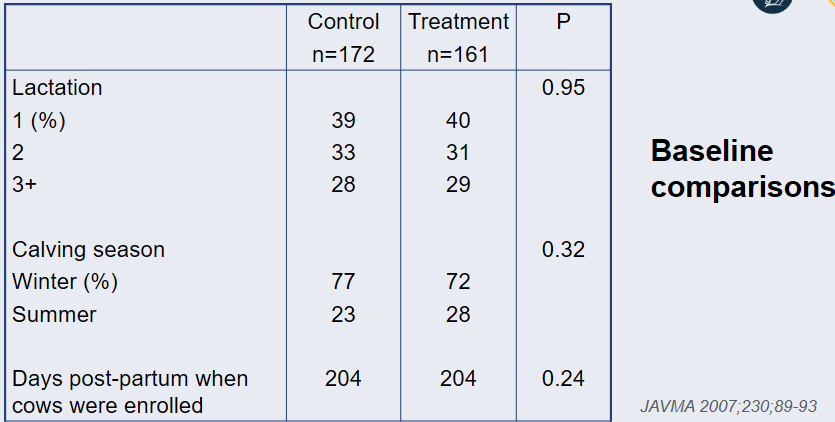
R a n d o m i s e d F i e l d T r i a l : E x a m p l e 1

I n t e r v e n t i o n S t u d i e s : L i m i t a t i o n s
• Intervention studies may be expensive – time and resource
intensive.
• Results of clinical trials (set in ‘lab’ or ‘controlled’ environment)
may not be repeatable in ‘real’ world settings.
• Informed consent & ethics issues.
• Sample size must be adequate to detect an important difference
between groups – this applies to other types of studies
Intervention study: Example 2
You have been provided with a scientific paper entitled:
Efficacy of Two Modified Nonantibiotic Formulations
(Victory) for Treatment of Papillomatous Digital Dermatitis in
Dairy Cows.
• The paper describes an intervention study in cattle.
• Students are encouraged to read the full article
ahead of the class session. The PDF article is
provided on SurreyLearn.
• Activities: Identify and explain the study population
used in the article, sampling approach, intervention,
allocation of animals to groups, outcomes of interest,
analysis – parameters of interest compared between
groups, and the study limitations.
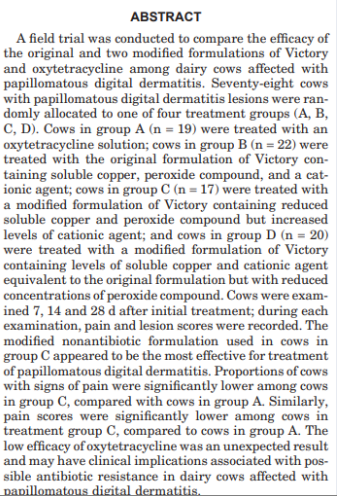
Example: Efficacy of Two Modified Nonantibiotic Formulations (Victory)
for Treatment of Papillomatous Digital Dermatitis in Dairy Cows
➢Study objective
➢Study population
➢Sampling approach
➢Intervention
➢Allocation of animals to groups
➢Outcomes of interest
➢Analysis – parameters of interest compared between groups
➢Study limitations

Example: Efficacy of Two Modified Nonantibiotic Formulations (Victory)
for Treatment of Papillomatous Digital Dermatitis in Dairy Cows
➢ Study objective
To compare the efficacy of the original and two modified formulations of Victory and oxytetracycline among dairy cows affected with Papillomatous Digital Dermatitis (PDD).
➢Study population
Dairy cattle herd with approximately 3200 lactating cows.
Herd with a history of lameness associated with PDD.
➢Sampling approach
Cows with PDD lesions enrolled
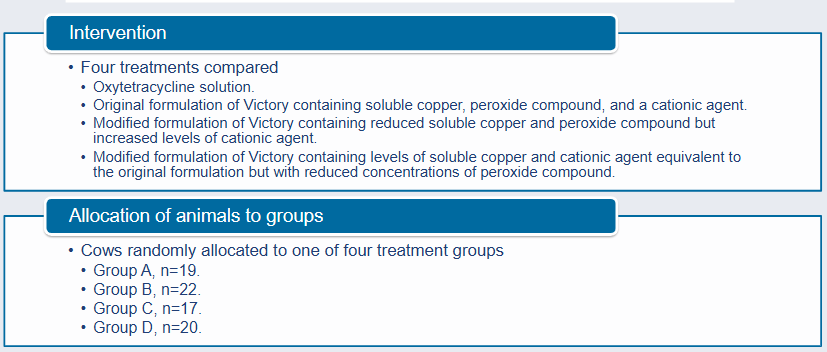
Example: Efficacy of Two Modified Nonantibiotic Formulations for Treatment of Papillomatous Digital Dermatitis in Dairy Cow

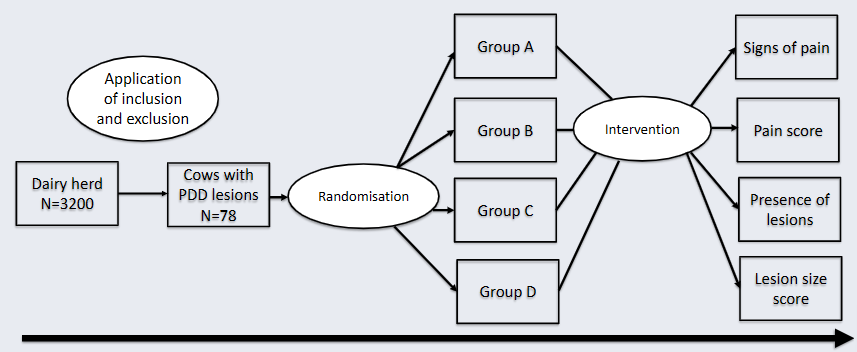
C o n t r o l l e d T r i a l / I n t e r v e n t i o n S t u d y
S u m m a r y : C o n t r o l l e d t r i a l s o r I n t e r v e n t i o n s t u d i e s
• Researcher defines intervention/treatment group and a control group
(i.e. experiment is planned).
• Random allocation of sampling units to groups.
• Comparison of intervention/treatment group and a control group.
— Study groups are comparable at start.
• Groups followed up to establish & measure outcome.
• Can provide reliable evidence for causality – if study design is rigorous.