CHEM 3105 Lab Exam Prep
 Call Kai
 Learn
 Practice Test
 Spaced Repetition
 Match
 Flashcards
 Knowt Play
1/106

There's no tags or description
Looks like no tags are added yet.
107 Terms
Exp #1 Pre-Lab:
Which has a higher vapor pressure?
hexane
Exp #1 Pre-Lab:
Which should have a higher boiling point?
nonane
Exp #1 Pre-Lab:
Simple distillation is more effective when there is a __________ difference between the boiling points of the two compounds.
large
Exp #1 Pre-Lab:
In a distillation of a hexane/nonane mixture, which compound will predominate in the first drops of distillate?
hexane
Exp #1 Pre-Lab:
Near the end of a distillation of hexane/nonane mixture, which compound will predominately remain in the boiling flask?
nonane
Exp #1 Post-Lab:
Why is it important to have a boiling chip preset in the boiling flask when distilling liquid mixtures?
The boiling chip ensures the liquid heats as well as continues to boil at an even rate. It also prevents boiling over.
Exp #1 Post-Lab:
What role does the steel wool serve in the fractional distillation setup used during the experiment?
It serves as a way to increase the surface area in the tube and can improve separation as they distill.
Exp #1 Post-Lab:
During the beginning of the distillation experiment, what compound in the starting water/ methanol mixture predominates in the distillate?
Methanol, reason being that the more volatile compounds have lower boiling points and come off first, therefore the distillate coming out into the graduated cylinder would be methanol first. After the apparatus reaches 100 degrees Celsius, water would then be present.
Exp #1 Post-Lab:
As the distillation continues eventually the observed temperature of the vapor will approach but never exceed 100 degrees Celsius. Why is 100 degrees Celsius the upper limit observable in the experiment?
Water has the higher boiling point of the two components. The presence of the boiling chip prevents boiling over, so the temperature could equal 100 degrees, but won't exceed a higher temperature.
Exp #2 Pre-Lab:
What species if formed when benzoic acid reacts with NaOH(aq)?
Compound B

Exp #2 Pre-Lab:
What is the density of water at room temperature in g/mL? Give just the number and not the unit.
1.0
Exp #2 Pre-Lab:
Which layer will be the ether layer in a separatory funnel containing diethyl ether and a saturated aqueous solution of NaCl?
The top layer
Exp #2 Pre-Lab:
Why should you vent the separatory funnel periodically when preforming an extraction involving organic solvents?
Mixing increases the evaporation of volatile organic solvents creating pressure in the closed space of a separatory funnel.
Exp #2 Pre-Lab:
How much anhydrous magnesium sulfate is required to dry a diethyl ether solution after preforming extractions involving water?
Enough such that some powder remains free flowing in solution with swirling without clumping.
Exp #2 Post-Lab:
Why is sodium benzoate more soluble in water than benzoic acid?
Sodium benzoate is more soluble in water than benzoic acid because sodium benzoate has an ionic bond, while benzoic acid has a hydrogen bond. Ionic bonds are more soluble in water than hydrogen bonds.
Exp #2 Post-Lab:
Why is biphenyl more soluble in diethyl ether than water?
Biphenyl is more soluble in diethyl ether than water, because biphenyl is a non-polar compound, which furthermore makes it insoluble in water. Diethyl ether on the other hand is non-polar as well, which allows biphenyl to dissolve in it.
Exp #2 Post-Lab:
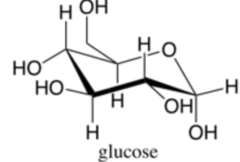
What solvent (diethyl ether or water) would glucose (shown below) be most soluble in? Briefly explain why.
Glucose would be most soluble in water because of its polarity. Diethyl ether is a non-polar compound while glucose is a polar compound. According to the "like dissolves like" principle, glucose is unable to dissolve in diethyl ether.
Exp #2 Post-Lab:
Outline a procedure for separating and isolating anthracene and 4-chloroaniline (shown below) using extraction and possibly acid/base chemistry.
Step 1: Add 10% HCl and ether to both of the compounds. (this will make an organic and an aqueous layer)
Step 2: Separate the organic and aqueous layer into different containers and label them
Step 3: Evaporate the solvent from the organic layer, and from there you will get a pure compound (anthracene)
Step 4: add %10 NaOH and ether to the aqueous layer
Step 5: Separate the aqueous and organic layer once again
Step 6: Evaporate the solvent from the organic layer, and from there you will get a pure compound (4-chloroaniline)
Exp #3 Pre-Lab:
What size filter paper should be used with a Hirsch funnel?
10 mm
Exp #3 Pre-Lab:
Which of the following will be most soluble in hot water?
o-chlorobenzoic acid
Exp #3 Pre-Lab:
What is a good temperature to set the hot plate to for safely and effectively warming a shell vial with 1 mL of ethanol for recrystallization?
100 degrees C
Exp #3 Pre-Lab:
Which of the following is halogenated?
o-chlorobenzoic acid
Exp #3 Pre-Lab:
What should the reading be on a balance displaying mass in grams be for a sample weighing 50mg?
0.050
Exp #3 Post-Lab:
Why is it important to use hot solutions during recrystallization of your compounds?
Recrystallization only works when the proper solvent is used. At higher temperatures the solute is more soluble in the solvent. Therefore, it is important to use hot solutions during crystallization.
Exp #3 Post-Lab:
Why does the addition of water to the hot ethanol solution of hydrocarbon help increase crystal growth? Hint: Which solvent is the hydrocarbon more soluble in?
If the solubility of the ethanol is too high then the crystals do not form, so adding another solvent to the ethanol in certain proportions will decrease the overall solubility of the solution, thereby initiating effective crystal growth.
Exp #3 Post-Lab:
Why does ethanol have to be added to the hot water/carboxylic acid mixture to get all of the solid carboxylic acid to dissolve?
Carboxylic acid compounds are partially soluble in water because carboxylic acids have nonpolar carbon chains. Water is a polar compound therefore carboxylic acid compounds are not fully soluble in water. On the other hand, ethanol is an organic solvent which contains a nonpolar carbon chain as its formula is CH3CH2OH. Making carboxylic acid fully soluble in ethanol. So adding ethanol to the hot water/ carboxylic acid mixture, all the solid of carboxylic acid is dissolved and forms a homogeneous mixture.
Exp #3 Post-Lab:
What effect on the melting point might be observed if the crystals of carboxylic acid are still wet when measuring the melting point of the sample.
Carboxylic acid will melt at a slightly lower temperature than its standard melting point because the presence of the liquid reduces the vapor pressure of the sample to some extent.
Exp #3 Post-Lab:
Why should the vial of hot solution be allowed to cool to room temperature slowly during crystallization rather than putting it in an ice bath to speed the process?
Gradual cooling is conducive to the formation of large, well-defined crystals. The ice bath will speed the process and create smaller crystals and not so defined.
Exp #4 Pre-Lab:
Which layer will be the organic layer during the aqueous tea dichloromethane extraction process?
bottom layer
Exp #4 Pre-Lab:
Which layer will the caffeine preferentially dissolve in during the aqueous tea dichloromethane extraction process?
the dichloromethane layer
Exp #4 Pre-Lab:
A solution is considered dry (i.e., devoid of water) when which of the following cases is true?
After treatment with an anhydrous salt, the salt may clump together significantly but also has powdery drying material that free flows when the solution is swirled.
Exp #4 Pre-Lab:
When evaporating solvent from a solution by gently blowing compressed air on it, why is it helpful to warm the solution?
Evaporating solvent removes heat energy from the solution and container, cooling it in the process and decreasing the vapor pressure of the liquid. Warming the solution counters this.
Exp #4 Pre-Lab:
Why is it important not to heat the solid caffeine left after the solvent has been evaporated in the final evaporation to long once the solvent is completely evaporated?
The caffeine can sublime decreasing your yield.
Exp #4 Post-Lab:
1. Tea contains various acidic organic molecules called tannins. Given that, why is it helpful to us Na2CO3 in this experiment?
The sodium carbonate acts as a base -When we boil tea leaves tannins dissolve in the water with the caffeine. If you do not use a base the tannins will also be extracted into the solvent (i.e. methylene chloride) used in the subsequent extraction . The base converts the tannins into their sodium salts ,Being ionic these salts are not soluble in solvents like methylene chloride (Non polar does not dissolve Polar molecules) so remain in the aqueous (Polar) layer during extraction. By using this higher purity caffeine can be extracted.
Exp #4 Post-Lab:
Why does the IR spectrum of caffeine contain two carbonyl peaks?
The C=O and N groups look like ketone and amine groups, but they are not. A C=O next to an N is an amide group. There are two amide groups in the ring. So two carbonyl groups are present which give two peaks at different wave numbers because of the different environment.
Exp #4 Post-Lab:
Why might the melting point of your isolated caffeine be lower than the literature value? What procedure involving your isolated caffeine sample might be used (other than sublimation) to get caffeine that exhibits a melting point closer to the literature value?
Apparatus, and impurities from the caffeine not being pure.
Exp #5 Pre-Lab:
How much solid material is needed to make the spotting solutions in this experiment?
a very small amount, enough to barely cover the tip of your spatula
Exp #5 Pre-Lab:
What should be used to mark the silica gel on the TLC plate?
a pencil with a soft tip to avoid gouging the thin layer of silica gel thus preventing the solvent from traveling up the plate
Exp #5 Pre-Lab:
What is the Rf value for a spot that travels 2.1 cm on a TLC plate when developed and the solvent traveled 7.2 cm?
0.29
Exp #5 Pre-Lab:
What is the first thing that needs to be done if you are the first person using the IR instrument after launching the software on the attached computer?
obtain background after cleaning the diamond crystal of the ATR
Exp #5 Pre-Lab:
What solvent is used to clean the diamond crystal of the ATR module used for collecting IR spectra of solids?
isopropanol
Exp #5 Post-Lab:
Where did you observe the O-H and/or C=O peaks (depending on which compound you used) in the IR spectrum of the compound for which you acquired a spectrum?
I observed the C=O bond at 1677.87
Exp #5 Post-Lab:
How do the O-H and/or C=O peaks in your spectrum obtained in the lab compare to the O-H and/or C=O peaks seen in the reference spectrum (located in Experiment 5 folder on Blackboard) for the same compound?
They look almost identical.
Exp #5 Post-Lab:
Which of the three compounds has a O-H group and how do the O-H peak locations in the IR spectra compare?
Benzyl alcohol has a peak at 3300-3400(longer). Benzoic Acid has a peak at 3000. Benzaldehyde has no peak.
Exp #5 Post-Lab:
Which of the three compounds has a C=O group and how do the C=O peak locations in the IR spectra compare?
Benzaldehyde and benzoic acid have peaks at 1700 (similar in size), while Benzyl alcohol has no C=O.
Exp #5 Post-Lab:
If benzyl alcohol, benzaldehyde, and benzoic acid were chromatographed using silica gel TLC plates, which should have the largest Rf value? Explain why.
Benzaldehyde should have the largest Rf because it is the least polar. The more polar a compound is, the longer it will stay on silica gel, and therefore the substance has a lower. Rf.
Exp #6 Pre-Lab:
What is the volume of 2.5 mmol of butan-2-ol (shown)? Your answer should be in mL, just give the number. Your answer should have 2 significant digits at least (2nd decimal place).
74.12 g/mol
0.806 g/mL
0.23
Exp #6 Pre-Lab:
What role does dichloromethane play in this experiment?
solvent
Exp #6 Pre-Lab:
During the washing/extraction portions of product isolation, which layer has a higher density?
organic layer
Exp #6 Pre-Lab:
Where should the solid from the initial reaction mixture that should have ended up in the bottom of your centrifuge tube be disposed?
halogenated waste
Exp #6 Pre-Lab:
What is the theoretical yield of butan-2-one (shown) if 0.30 mL of butan-2-ol is treated with TEMPO and an excess of of TCCA and is completely oxidized? Your answer should be in grams and give only the number. Your answer should have at least 2 significant digits (2nd decimal place).
butan-2-ol
74.12 g/mol
0.806 g/mL
butan-2-one
72.11 m/mol
0.24
Exp #6 Post-Lab:
What are the products (if any) of a reaction between each of the following compounds and TEMPO/TCCA in dichloromethane?
(ring with a C=O and H) The primary alcohols would not react. (4C chain with methyl and OH at carbon 2) The second compound contains a tertiary carbon, or carbon with 4 bonds already. This compound could not react further because if the carbon double-bonded to the oxygen during a reaction, it would then have 5 bonds, which is not allowed. (6C chain with OH at carbon 3) The third compound is a secondary alcohol that would react to form a ketone.

Exp #6 Post-Lab:
If the IR spectrum of a reaction product contains a broad peak near 3300 cm-1, what else could be present in the sample other than an alcohol?
A broad peak near 3300 cm-1 could indicate the presence of not only an O-H bond (alcohol) but also the presence of a N-H bond.
Exp #6 Post-Lab:
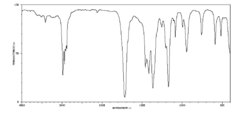
What compound (ketone, carboxylic acid, or alcohol) best matches the following IR spectrum? Explain your reasoning.
This IR Spectrum does not match an alcohol or a carboxylic acid because the peak at 3000 cm-1 is not a broad, intense one which would indicate and O-H bond. It is also not an alcohol IR because there is a narrow, prominent peak at 1700 cm-1, indicating a C=O bond which is not seen in alcohols. This spectrum most closely resembles a ketone IR spectrum because the peak at 3000 cm-1 is narrow and there are 2 long, narrow peaks seen in between 1000 cm-1 and 1500 cm-1.
Exp #6 Post-Lab:
If a small amount of carboxylic acid is produced in the oxidation reaction of a primary alcohol with the TEMPO/TCCA, why would you not likely observe it in the IR spectrum of the product mixture? Hint: What aqueous solutions are used to extract the organic layer during the product isolation portion of the experiment?
One of the aqueous solutions used to extract the organic layer, Na2CO3, would neutralize any acids present during the oxidation reaction, so carboxylic acid would not show up in the IR spectrum.
Exp #7 Pre-Lab:
What is the limiting reagent in this reaction?
acetaminophen
Exp #7 Pre-Lab:
What is the role of potassium carbonate in this reaction?
base
Exp #7 Pre-Lab:
What is the role of 2-butanone in this reaction?
solvent
Exp #7 Pre-Lab:
During the extraction procedures, which layer has the higher density?
dichloromethane layer
Exp #7 Pre-Lab:
What is the expected yield of this reaction assuming 0.230 g of acetaminophen is used along with all of the other starting amounts of reagents listed in this experiment? Your answer should be in grams and answer to the 3rd decimal place.
0.273
Exp #7 Post-Lab:
What role does the 5% NaOH(aq) extraction play in product isolation?
It reacts with the left-over Acetaminophen that was not reacted to in the mixture.
Exp #7 Post-Lab:
What additional reaction product would result if NaOH was used as a base in this reaction instead of K2CO3?
CH3CH2OH would result assuming NaOH is in the reaction mixture with iodoethane present.
Exp #7 Post-Lab:
What key feature should be present in the IR spectrum of the product if unreacted acetaminophen is present?
A peak at 3400 cm-1, indicating an O-H bond, would be seen on an IR spectrum of a sample containing unreacted acetaminophen.
Exp #7 Post-Lab:
Propose a synthesis of the following compound. Hint: Use a SN2 reaction.
The answer should include the phenol and propyl halide (or another leaving group). They need a base, if students was to propose using NaOH as a base they should have that in the 1st step and then react the resulting phenoxide with the propyl halide.

Exp #8 Pre-Lab:
What role does water play in the reaction with t-BuCl? Choose all that apply.
nucleophile
solvent
base
Exp #8 Pre-Lab:
What role does the added NaOH(aq) play in the reactions for this experiment?
reactant with HCl(aq) produced from the reaction
Exp #8 Pre-Lab:
What color is bromophenol blue under acidic conditions?
yellow
Exp #8 Pre-Lab:
How many mL is 300 µL?
0.300 mL
Exp #8 Pre-Lab:
If 3 mL of 0.1 M tBuCl in acetone is mixed with 0.9 mL of 0.1 M of NaOH and 6.1 mL of water and it takes 360 seconds for the color of the added bromophenol blue indicator to change from blue to yellow, what does this indicate?
It took 360 s for the reaction to be 30% complete
Exp #8 Post-Lab:
How would doubling the concentration of t-BuCl affect the rate of the reaction? Why?
Doubling the concentration of t-BuCl would double the rate because SN1 kinetics depend on the concentration of the substrate only (rate= k [substrate])
Exp #8 Post-Lab:
How would doubling the concentration of NaOH(aq) used in this experiment affect the rate of the reaction? Why?
Doubling the concentration of NaOH used in the experiment would not affect the rate because it is not the substrate in this SN1 reaction. First-order kinetics is used in these types of reaction, meaning only k and the concentration of the rate-determining step are considered. The NaOH concentration being doubled would not change the overall rate.
Exp #8 Post-Lab:
What would happen to the rate of the reaction if 9 mL of 0.0333 M t-BuCl in acetone and 1 mL of water were combined and mixed instead of the 3 mL of 0.1 M t-BuCl in acetone and 7 mL of water mixture used in this experiment? Why? (Hint: In addition to being a nucleophile, what other role does water have in this reaction?)
Less water present in the reaction mixture would cause the rate to be slower. Water is polar protic which helps stabilize charged intermediates of the reaction. With less water available, there is less stabilization, causing the rate to decrease.
Exp #8 Post-Lab:
Which of the following will have the fastest rate of reaction in a SN1 reaction? Why?
Tertiary alkyl halide will react fastest in SN1 because it has the greatest carbocation stability.

Exp #8 Post-Lab:
Put the following carbocations in order of increasing stability starting with the least stable.
The least stable is methyl (no Carbon groups), then primary, then secondary, and most stable is tertiary (3 carbon groups attached)

Exp #9 Pre-Lab:
Which of the following reactions will promote an E2 reaction with an alkyl halide?
sodium ethoxide
Exp #9 Pre-Lab:
Which of the following reagents can cause serious eye damage? Choose all that apply.
potassium tert-butoxide
sodium methoxide
10% potassium hydroxide solution
Exp #9 Pre-Lab:
What role does methanol and tert-butanol play in the reaction for Experiment 10?
solvent
Exp #9 Pre-Lab:
What is the leaving group in the reaction for Experiment 10?
bromide anion
Exp #9 Pre-Lab:
During the reaction work up, pentane is used as an organic solvent and there are aqueous extractions. Which layer is most dense?
aqueous layer
Exp #9 Post-Lab:
What is the major elimination product of the following reaction?
CH2=CH2 with a tert-butyl

Exp #9 Post-Lab:
List all of the elimination products of the following reaction. Indicate which one is the most stable.
trans and cis products, trans is most stable

Exp #9 Post-Lab:
What is the SN2 product of the following reaction?
7C chain with OCH3 at C2

Exp #10 Pre-Lab:
What role does the phosphoric and sulfuric acids play in this reaction?
catalyst
Exp #10 Pre-Lab:
What is the primary mechanism involved in this experiment?
E1
Exp #10 Pre-Lab:
What is the rate limiting step in this reaction?
lose of water to generate a carbocation
Exp #10 Pre-Lab:
Assuming 8 mL of cyclohexanol is used in this reaction, what is the theoretical yield in grams? Answer to two decimal places and do not include the unit.
6.27
Exp #10 Pre-Lab:
During the extraction of the distillate, which layer will be the organic phase in the separatory funnel?
top layer
Exp #10 Post-Lab:
Which of the following alcohols will undergo dehydration most readily when treated with sulfuric acid? Explain why.
A tert-butyl with an OH would undergo dehydration most readily because it is carbocation is the most stable.

Exp #10 Post-Lab:
What is the E1 product of the following compound?
CH3-double bond going up-CH3.

Exp #10 Post-Lab:
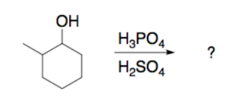
What are the elimination products of the following reaction? Which of the products is the major elimination product?
Ring with double bond b/w 1 and 2, ring with double bond b/w 1 and 6, or ring with double bond on the methyl at 6.
Exp #10 Post-Lab:
What is the product of the following reaction? Hint: This is a SN1 reaction.
Ring with Cl replacing OH.

Exp #11 Pre-Lab:
What is the role of N-bromosuccinimide in this experiment?
It reacts with the alkene to make the bromonium ion.
Exp #11 Pre-Lab:
What is the nucleophile involved in the formation of the bromohydrin product?
water
Exp #11 Pre-Lab:
Which best describes the formation of a bromohydrin from an alkene?
electrophilic addition
Exp #11 Pre-Lab:
What compound are we trying to filter out of reaction mixture with the silica gel column?
succinimide
Exp #11 Pre-Lab:
What is the theoretical yield for this reaction in grams if you start with 0.240 mL of 1-methylcyclohexene and use the reagents in the amounts described in the procedure? Report your answer to three decimal places but do not include the unit.
0.391
Exp #11 Post-Lab:
What are the expected products of the following reaction? Remember to show stereochemistry.
Br(wedged)-CH2-CH(OH dashed)-CH3
Exp #11 Post-Lab:
What key features should be present in the IR spectrum of your product if you successfully made the desired bromohydrin? What key features should be absent from the IR spectrum if the starting material was completely reacted?
Alkene IR C=C stretching frequency appears at 1680-1620 cm^-1. If Bromohydrin formation is completed then this C=C peak disappears. The Bromohydrin shows peals at O-H stretching frequency at 3400-3500 cm^-1.
Exp #11 Post-Lab:
If your isolated product has succinimide present, what key feature should be present in the IR spectrum of your product?
Both 2 peaks of Bromohydrin
Exp #12 Pre-Lab:
Which isomer of 1,2-dibenzoylethylene is most stable?
trans