Principles of Cell Signaling
 Call Kai
 Learn
 Practice Test
 Spaced Repetition
 Match
 Flashcards
 Knowt Play
1/87

There's no tags or description
Looks like no tags are added yet.
88 Terms
What is the purpose of cell signaling?
so, the cell is able to monitor and respond to the environment/external stimuli to maintain cell and organism health
How do cells interpret environmental signals?
cell signaling which is also called signal transduction
How is cell behavior regulated?
signals transduced in response to the presence of signaling molecules
What are some examples of cell behavior?
growth, differentiation, survival, and death
Why is cell signaling important to learn?
over half of FDA-approved drugs target cell signaling pathways
What are the major signaling pathway targets of drugs?
GPCR’s(most common target), kinases, ion channels and transporters, and nuclear receptors
What are the ways signaling pathways are categorized?
signal source, type of signal, and distance the signal travels
What are the forms of signaling based on signal type?
contact-dependent, paracrine, synaptic, and endocrine
What are the forms of cell signaling categorized by the distance the signal travels?
local (including autocrine, contact dependent, paracrine, and synaptic)
long distance (endocrine)
How are we categorizing cell signaling pathways?
paracrine (autocrine & synaptic), endocrine, contact-dependent (also called juxtacrine)
What is the most common form of signaling?
paracrine (includes autocrine and synaptic)
What is the big picture of paracrine signaling?
cell responds to signaling molecules locally released by a signaling cell
What are some examples of paracrine signaling?
calcium signaling, mechanisms of regulated exocytosis, apoptotic signaling, and contractile proteins and motors
What is the basic idea of autocrine signaling?
it’s a kind of paracrine signaling where the signaling and target cell are the same. the cell responds to signaling molecules that they produce
What are some examples of autocrine signaling?
immune cells trigger their own proliferation and differentiation in response to foreign antigens
cancer cells use autocrine signaling to stimulate their survival and proliferation
What is the general idea of synaptic signaling?
specialized paracrine signaling using neurotransmitters as the signals for neurons
What is an example of synaptic signaling?
neurotransmitter release by nerve cells at the synapse and their reception by receptors on the postsynaptic target cell
What is the general speed of paracrine (autocrine and synaptic) signaling?
pretty fast, for nerve impulses up to 100 meters per second
What type of signals are used in paracrine signaling?
pretty concentrated signals
What is the general idea of endocrine signaling?
cell responds to hormone (ligand) secreted by an endocrine cell and transported to act on a distant target
What is an example of endocrine signaling?
stimulation of glucose uptake by insulin
What is the speed of endocrine signaling usually?
relatively slow because it relies on diffusion and blood flow
What concentration of signal is required for endocrine signaling?
dilute/low concentrations of signal (ligand/hormone)
What is the general idea of contact-dependent signaling?
cell-cell or cell-extracellular matrix signaling that requires close contact. it can involve membrane-bound signaling molecules or signals can be shared through gap junctions
What is an example of contact-dependent signalin?
cell adhesion or ECM proteins that act as signals to promote motility
Do specific cells use only one type of signaling?
no, they have many different receptors/purposes that need a variety of signaling pathways
What is a ligand?
a biomolecule that binds to a specific receptor and changes the activity, conformation or other biological properties of the receptor, triggering a signaling event
broadly: a signaling molecule
What types of ligands are there?
growth factors, cytokines, hormones, neurotransmitters, extracellular matrix proteins, small molecules, and more
What are some examples of growth factor ligands?
epidermal growth factor (EGF), platelet-derived growth factor (PDGF), and stem cell factor (SCF)
What are some examples of cytokines?
interleukin (IL), interferon (IFN), tumor necrosis factor (TNF) families
What are some examples of hormones?
insulin, estrogen, testosterone, cortisol
What are some examples of neurotransmitters?
acetylcholine, dopamine, serotonin, enkephalin, GABA
What are some examples of extracellular matrix proteins that are ligands?
fibronectin, laminin, collagen
What is an example of a small protein ligand?
IP3
What are growth factors?
proteins, usually grouped by structure, function, and target cells
What are cytokines?
also proteins
can be interleukins, interferon, tumor necrosis factor
What are the different kinds of hormones?
peptide and protein (largest class, subtype of growth factors)
steroid
amine
Where do ligands come from?
signaling cell
What is the path of peptide and protein hormones?
release from a cell (can be endocrine), travel in the blood to their site of action, bind a receptor on a target cell to initiate signaling events
or locally to cell and receptor
Where do steroid hormones come from?
from a cholesterol precursor
synthesized within cells and released from cells into extracellular space
they are also hydrophobic
Where are amine hormones from?
aromatic amino acids by enzymes in the cytoplasm and released from cells into the extracellular space
What are receptors?
proteins that receive and bind signals
What are the 4 types of signaling receptors?
enzyme-linked, G-protein coupled, ligand-gated ion channels, and nuclear receptors
What types of signaling receptors bind extracellular signals?
enzyme-linked, g-protein coupled, and ligand-gated ion channels
What signaling receptors bind intracellular signals?
nuclear receptors
What are the 2 types of enzyme-linked receptors?
1 receptor with intrinsic enzymatic activity
2 enzyme-associated receptor (recruiter receptor)
What do enzyme-coupled receptors with intrinsic enzyme activity do?
bind extracellular ligands which activated catalytic activity on the cytoplasmic side
(ligand binding activates a kinase domain that is part of the receptor protein)
What do enzyme-associated receptors do?
bind extracellular ligands, leads to recruitment and activation of associated enzyme on the cytoplasmic side
What are some examples of enzyme-associated receptors?
tyrosine-kinase-associated receptors
-integrins via FAK
-death receptors via caspases
used for: apoptosis, cell adhesion/migration
What are the physical characteristics of GPCR’s?
7 transmembrane domains (helices) with receptors at the cell surface
What do GPCR’s do generally?
bind extracellular ligands which activates a g protein
ex. rhodopsin, beta-adrenergic receptor
What do ligand-gated ion channels do?
ligand binds and is coupled to ion movement across the membrane
What are the physical characteristics of ligand-gated ion channels (LGIC’s)?
transmembrane receptors that are present on cell surface and intracellular membranes
What is the difference between intracellular receptors and LGIC’s that are in internal membranes?
intracellular receptors are unique, they are not membrane proteins like LGIC’s and they bind hydrophobic ligands
Where are intracellular receptors in the cells?
in the cytoplasm or nucleus
What do intracellular receptors do?
ligand binding that is coupled to nuclear import
also mediate signaling by binding to DNA to alter transcription
What are the 3 basic steps of the signaling cascade?
reception, transduction, and response
What occurs during reception in the signaling cascade?
the signal binds to a receptor protein
protein changes (usually shape)
initiates series of events
What occurs during transduction in the signaling cascade?
series of events (usually biochemical) that takes signal from receptor to the target to have the response
signal is usually amplified (one ligand activates many downstream targets)
How are proteins usually activated during transduction of the signal?
phosphorylation, and second messengers (Ca2+, cAMP, inositol phosphates)
What occurs during response in the signaling cascade?
ultimate activation of effector proteins whose activities alter the behavior of the cell
ex. gene expression, cellular metabolism, cell growth and death
How is the signal cascade temrinated?
elimination or sequestering of the ligand
removal or inactivation of the receptor
shutting off the downstream switchesj
How can the ligand be eliminated or sequestered?
reuptake into the signaling or nearby cells by membrane transporters
enzymatic degradation by enzymes in the extracellular space
diffusion of the ligand away from the receptor
decoy receptors to trap the ligand before it reaches the receptor
How can the receptor be removed to terminate the signal cascade?
sequestering the receptor inside the cell
degrading the receptor (via endocytosis and proteolysis in the lysosome)
How can the receptor or downstream elements be inactivated?
reverse/remove the modifications that were made to have the response
What does termination of signaling mean in regard to signal cascade termination?
introducing new proteins that block the signaling
Do signaling pathways interact?
yes, a single cell has many different receptors signaling, the pathways can be integrated to have coordinated responses
What are the 3 categories of signal cascade interaction?
convergence, divergence, and cross-talk
What is convergent signaling?
signals from unrelated receptors converge to activate a common effector
What is an example of convergent signaling?
GPCRs, RTKs, and integrins bind different ligands but relay signals to recruit Grb2 and activate Ras and a MAP kinase cascade
What is divergent signaling?
one signal diverges to activate a variety of effectors
What is an example of divergent signaling?
activation of EGFRTK makes phosphotyrosine sites that interact with a variety of proteins with SH2 domains
What is cross-talk between signaling pathways?
signals move between pathways as a result of crosstalk
What is an example of cross-talk in signaling cascades?
activation of EGFRTK by EGF and epinephrine activation of beta-adrenergic receptor can cross talk
cAMP can block the signal otherwise transmitted through MAP kinase cascade
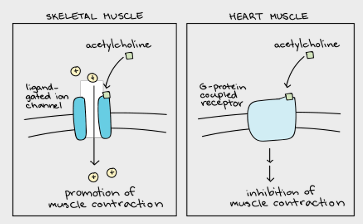
Does a ligand always produce the same results?
no, result depends on cell-type specific protein expression
ex. acetylcholine response in skeletal vs. heart muscle
What is an agonist?
a ligand/drug that binds a receptor and actiavtes it
What is an antagonist?
a ligand/drug that binds to a receptor without producing a response. reduce the ability of an agonist to stimulate the receptor
Are endogenous (natural) ligands agonists or antagonists?
most are agonists
What are the types of agonists?
full, partial, and inverse
What is a full agonist?
binds the receptor and elicits a maximum receptor response
What is a partial agonist?
binds the receptor and gives a weaker, partial response
What is an inverse agonist?
binds the receptor and produces the opposite effect (reduces baseline activity)
What is competition defined as?
two molecules can bind to the same receptor site
What is saturation?
when all available receptors become occupied and the signaling system approaches its maximum response
What is a competitive antagonist?
it reduces agonist binding by occupying the agonist binding sites
What are non-competitive antagonists?
bind allosterically (not directly on agonist site) or covalently, reducing functional receptor availability
What is desensitization/down-regualtion?
reduced receptor responsiveness or receptor internalization after prolonged agonist exposure
What is up-regulation?
increased receptor density on the cell membrane following chronic antagonist blockade