ALFS 13, L21: Cattle 4
 Call Kai
 Learn
Learn Practice Test
 Spaced Repetition
 Match
Match Flashcards
 Knowt Play
1/25

Earn XP
Description and Tags
Given term, answer w/ definition
Name | Mastery | Learn | Test | Matching | Spaced | Call with Kai | Chat |
|---|
No analytics yet
Send a link to your students to track their progress
26 Terms
List the main components of the milking machine
Good hygiene of milker
1 of the __ Stages of the Milking Routine
Reason:
Either done by
Cows move into parlor
1 of the __ Stages of the Milking Routine
Reason:
Either done by
Foremilking/striping teat
1 of the __ Stages of the Milking Routine
Definition
Reason:
Removes Bacteria from end of teat
Checks for mastitits
Stimulates milk let down
Teat preparation
1 of the __ Stages of the Milking Routine
Definition: Teats must be clean and dry
Reason:

Pre-dipping
1 of the __ Stages of the Milking Routine
Definition: Disinfection of teats before teats before usuage of milking machines. Teats are disinfected, let it sit for 20-30 seconds, and then wiped off before milking machines used
Reason:
Assists in the control of environmental mastitis
Attachment of cluster
1 of the __ Stages of the Milking Routine
Definition
Reason:
R
Automatic cluster removal
1 of the __ Stages of the Milking Routine
Definition
Reason:
R
Post-milking teat disinfection
1 of the __ Stages of the Milking Routine
Definition: Can be done via teat dip or spray, recommended to be done in figure 8 pattern to ensure coverage of all teats. This disinfectant is not wiped out, will ideally last for 12 hours, should be a long acting disinfectant. Typically has a molant, which prevents teats from drying out or cracking in addition to killing bacteria
Reason:
To prevent bacteria from cluster infecting cow

Milking Order:
Milk the cows that are the most susceptible to mastitis first, and those with suspected/confirmed mastitis last
Only feasible in large dairy herds of over 1,000 heads
Freshly calved cows
Higher yielders
Medium yielders
Low yielders
High somatic cell count cows
Cows with mastitis
2 times/day
Majorty of dairy farms in the UK milk _______ time/day
Dump bucket
Used for cows to keep their milk separate from the bulk tank
Used for cows who are receiving antibiotic treatment and those that have calved recently so colostrum can be saved

Milking in the byre
1 of the 7 Milking Parlour Designs Discussed:
Definition:
Advantages:
R
Disadvantages:
R

Static parlor with individual cow entry/exist
1 of the 7 Milking Parlour Designs Discussed:
Definition: Cows go on a raised platform, and are milked side by side; old fashioned, more popular with smaller herds
Advantages:
R
Disadvantages:
Restricted to ~12 cows per
Signficiant bending down,
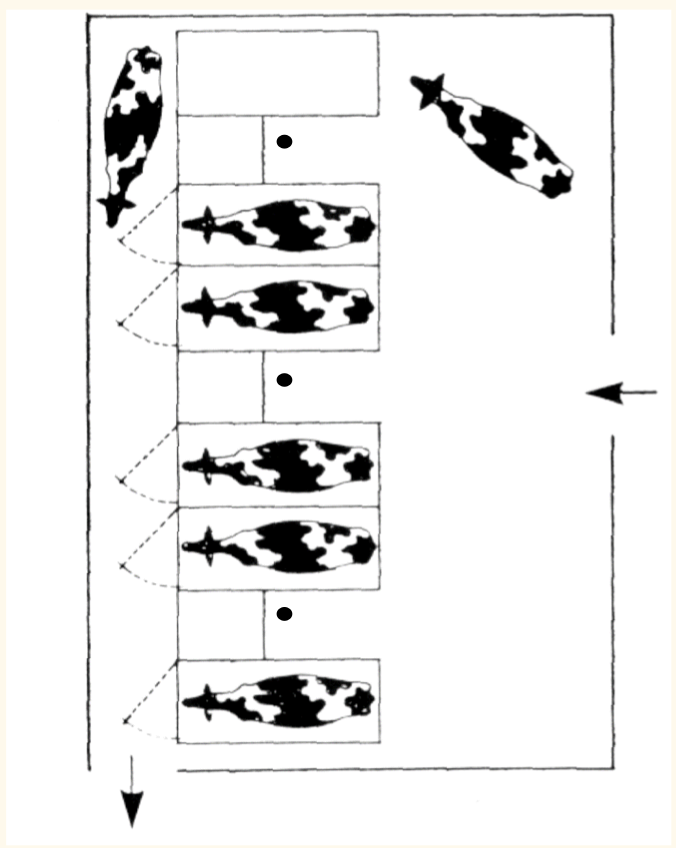
Tandem parlor
1 of the 7 Milking Parlour Designs Discussed:
Definition: cows milked nose to tail
Advantages:
Popular in continental Europe
Disadvantages:
Parlors get long, milker must walk down
limited to ~6 cows per batch

Chute parlor
1 of the 7 Milking Parlour Designs Discussed:
Definition:
Advantages:
R
Disadvantages:
R

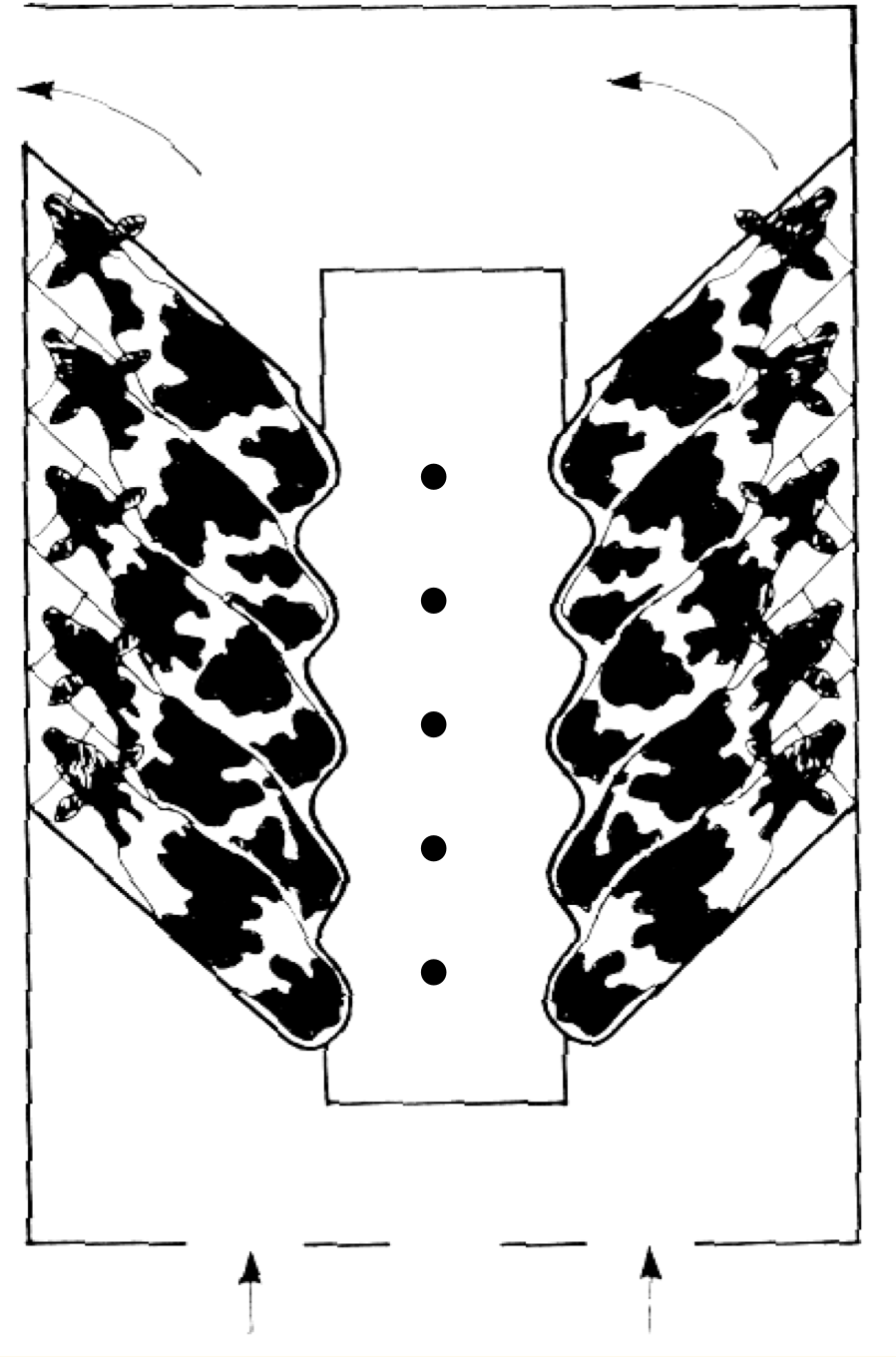
Herringbone parlor
1 of the 7 Milking Parlour Designs Discussed:
Definition: Cows are at a 45˚ angle, cows milked through their back legs; most common in the UK
Advantages:
Less walking for milker
Can be massive (20-30 cow long); but typically just designed for 1 milker (10-15 cows)
Disadvantages:
R
Variations:
Swing over parlor
Trigon - 3 sided herringbone
Polygon parlour
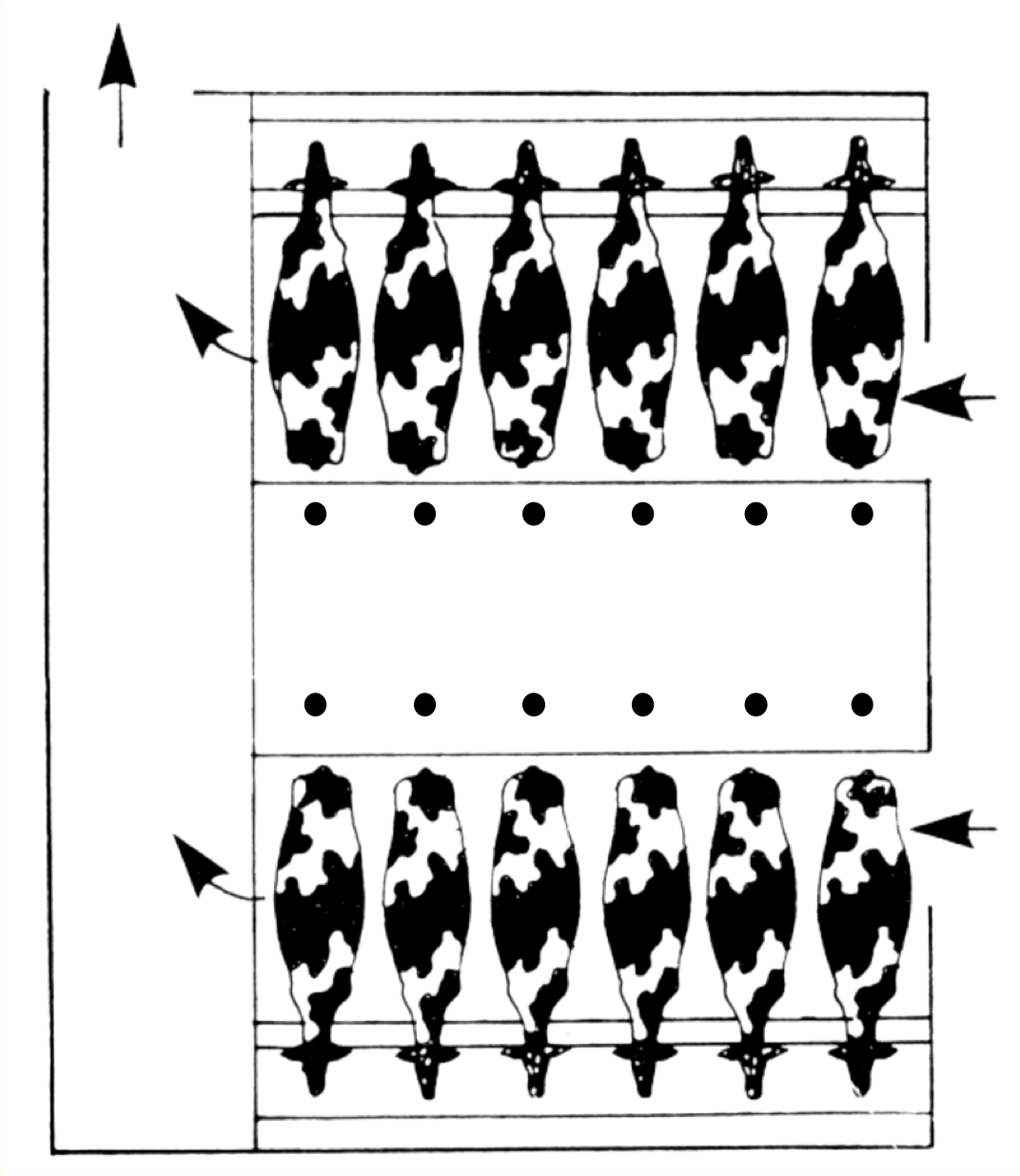
Side by side parlor
1 of the 7 Milking Parlour Designs Discussed:
Definition: Cows 90˚ to milker, milked beneath back legs
Advantages:
Less walking for milker
Can be massive (20-30 cow long); but typically just designed for 1 milker (10-15 cows)
Disadvantages:
R
Rotary parlor
1 of the 7 Milking Parlour Designs Discussed:
Definition: Highly mechanized, cows move, not milker. Typically used for larger herds (at least 400-500 head)
Advantages:
Fairly adaptable
Allow for expansion of the herd
Disadvantages:
High cost of operation and greater maintenance costs – requires ~3 people to milk (1 to disinfect teats, another to wipe teats and put on milking machine, and another to remove milking machine and disinfec
Subtypes:
Internal rotary
External rotary

Robotic milking machines
1 of the 7 Milking Parlour Designs Discussed:
Definition: Cow choose when to enter station to get milked, milked by quarter NOT by cow. about 20% of cows in UK milked with robots
Advantages:
Remove milk quickly from the udder with minimal risk to udder health
Relatively low labor
Improved welfare – cow can choose when to get milked
Increased yield – most cows will go into the stall 3 times a day, but some go in as many as 5 times/day
Modular, adaptable to herd size
Significant monitoring capabilities to monitor cow behavior, health, and milk
Disadvantages:
Impact of Milking Machine/Routine on Udder Health:
The milking machine Alternates between vacuum and massage to mimic the movement/stimulation created by calf’s tongue
The higher the vacuum you use, the more likely you are to damage the teat - most milking machine works at 50 kPA
Clusters with more weight will stretch the teat and allow milk to flow faster. Most clusters weight around 4-5 kg and the the heavier are about 0.5 lb heavier. Putting any more weight on the teat will damage it
Milking machine MUST be washed and disinfected after every milking
Liners must be changed regularly as they degrade quickly
Milking machines must be checked weekly, and tested every 6 months
static testing: testing while milking not occuring
Dynamic testing: testing while milker is occuring, put sensor on the end of the liner, to check that pulsation is working correctly
Impact of Milking Machine/Routine on Udder Health:
A cow with mastitis will transfer bacteria to the next cow if milking machine is not disinfected between cows
If milking machine has too high vacuum or has pulsation problems, it will damage to the teat end (appears like a cauliflower teat end), and make cow’s teat canall more suceptible to bacterial colonization
If the end liner slips, then it will force milk into the other 3 teats, introducing bacteria into them