RNA structure
 Call Kai
 Learn
 Practice Test
 Spaced Repetition
 Match
 Flashcards
 Knowt Play
1/12

There's no tags or description
Looks like no tags are added yet.
13 Terms
Default structure of RNA
Single-stranded RNA that forms a local helical structure to maximize base stacking.
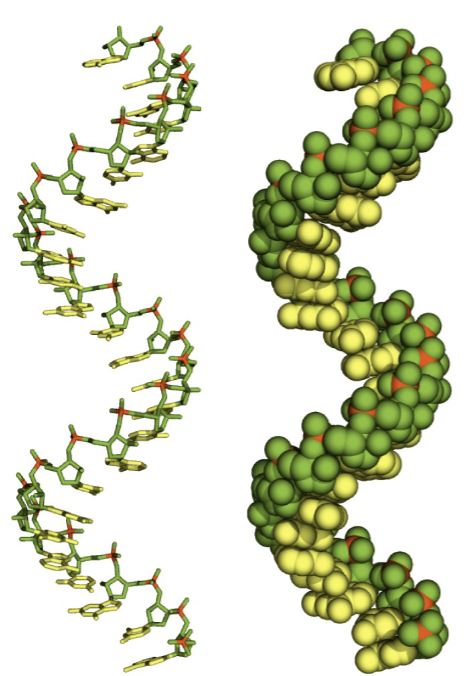
how does RNA form a Secondary Structure
RNA can base-pair with itself (intramolecular base pairing) because it is single-stranded.
what is the Secondary structure Form
Base-paired regions are called stems (forming right handed RNA) and unpaired regions form bulges and loops

Example of secondary structure of RNA
tRNA forms a 4 stem and 4 loop secondary structure. 3’CCa carries the amino acid and the anticodon loop binds to mRNA. Stabilized by h-bonding and base stacking.

Noncanonical base pairing
series of unconventional methods of base pairing made by modified bases that stabilize and drive secondary and tertiary structure
How is tertiary structure of RNA formed
Supported by bp, base stacking, noncanonical interactions, and cations. A flexible backbone supports diverse conformations. Cations neutralize backbone
Example of tertiary structure
tRNA, Riboswitch, and ribozyme

tertiary structure of tRNA. L shape to better bind to the ribosome and facilitate peptide linking

Riboswitch - bind to metabolites that alter confirmation of the RNA and affect transcription or translation. Negative feedback. ex. guanine riboswitch
Domains of the riboswitch
Aptamer domain that binds to a metabolite
Expression platform - changes structure to control gene expression
switching sequence - changes secondary structure when ligand binds
Ribozymes
RNA based enzymes that perform catalysis
Types of reactions catalyzed by ribozymes
RNA processing - breaking and joining RNA phosphodiester bonds
Peptide bond formation - linking amino acids during protein synthesis
ex. of ribozyme
Ribosomes - catalysis depends on the rRNA not the protein