Family History Taking Uses
 Call Kai
 Learn
 Practice Test
 Spaced Repetition
 Match
 Flashcards
 Knowt Play
1/24

There's no tags or description
Looks like no tags are added yet.
25 Terms
Why are family histories taken?
For diagnosis and risk assessment
For research studies
To help establish rapport with the patient
To understand psychosocial and family background
How does FH help diagnosis?
Can suggest inheritance features
What happened in the Holt-Oram case?
Male baby with upper limb abnormalities
Bilateral asymmetric radial aplasia
Family history reveals mother has a congenital heart defect and the maternal grandmother is missing a thumb
Links congenital abnormalities of upper limbs and heart of varying severities
Suggests dominant Holt-Oram syndrome
What did the clues from the FH allow for?
Appropriate molecular testing that confirms mutation and diagnosis
Cardiac investigations in the baby
Upper limb x-ray for the mother
Ongoing cardiac surveillance for mother and baby
Genetic counselling for parents as 50% of future child and wide variability in severity
Prenatal diagnosis to the parents – molecular testing to confirm presence of gene mutation
How does a pedigree show the family background?
Family structure, experience and sources of support
Simplest shows the close living relatives
If they have an understanding of the condition through a relative
Previous experiences of bereavement, illness or disability
What do genograms do?
Adds the emotional and social ties between family members
If someone is in contact to share the risks
If the young parent of an ill child is likely to be supported
What information does the pedigree have at the top?
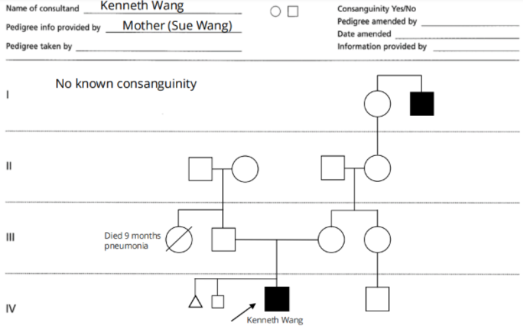
Key information includes: clinical file reference number, date (later updates too), name of consultand, name of person providing information, have an arrow to represent the consultand
What are the symbols for: affected/unaffected male/female, consangenious, identical/non-identical twins, termination of pregnancy, spontaneous miscarriage, stillborn of unknow and death

What is the first bit of the tree built?
Start by asking about first degree relatives of the consultand
Siblings, parents and offpsring if applicable

What is the second stage of the family tree?
Then ask about second degree relatives
Grandparents, aunts and uncles, and grandchildren

What is the third stage of the family tree?
Ask about first cousins and further if relevant
As a male ask about more distant males and could be X-linked
Don't need to ask about them on the fathers side

What is the forth stage of the tree?
Important to directly ask about information that may not be provided
Reproductive loss – have you lost any pregnancies
Deceased sibling or other relatives – did the parents have any other children
Consanguinity – has anyone in the family married a cousin
Can learn about infant death that might not have been disclosed if asked about other siblings
What happens in the sixth stage of the family tree?
Can then add full names, date of births and death
Causes of death and any other diagnosis
Can't ask if anyone in the family has the condition
Requires the detailed medical information

Who do you want the most information from?
Close relatives
Those who medical records may need to be requested
For those who may be at risk and may be referred at a later date
How are trees edited at a later date?
Described as a working pedigree that may need to be amended with subsequent contacts or new information
Recommended that these edits are made in a different coloured pen and clearly dated

What are obstacles for obtaining a full pedigree?
Adoption
Uncertain paternity
Little/no contact with one/both sides of the family
Health/repreoductive issues no disscussed openly in family
Lack of awareness
What should be done to overcome the information challenge?
Inform patients in advance so they can gather some evidence
Explain which evidence that would be useful and support straterigies to obtain this
What are the features of the consent of the information?
The pedigree contains information about more than one individual
Clinical genetic records: family file including pedigree
File held separately from other hospital records
How is as little information shared?
The consultand can consent for family history information to be shared with other healtcare professionals if relevant to healthcare of other members of the family
Consider if they need the full pedigree and an abridged version can be shared so as little neccesary confidential information is revealed
Do you share with another family member in clinic?
If another family member comes to the clinic initially don't share
Want to know if the relative knows the other members have attended and how much they know
This determines if it is appropriate to share the full family history with them
Such as not knowing about termiantion of preganncies even though she knows who is affected
What are the features of checking consent?
Check with the patient if they are happy to share the information with family members
Might be some information that specifically doens't want sharing such as adoptions
This is clearly recorded on the pedigree and case notes
If the private information would make a significant difference, then counsellor should support the individual how to share the information
When do you confirm family history?
Obtaining conformations can be time and resource intensive
Only do it if the information will make a difference to the diagnosis
Suspected heart issues, no immediate family history but cousin is having an investigation at another hospital
Accessing the records might give evidence to the sudden brother death and provide testing for the individual
How can you confirm a family history?
Death certificates
Cancer registry
Path report
Genetic lab report
Hospital records
Should tests be done before information?
This is preferred to performing panel in a healthy individual in the absence of a molecular diagnosis or affected family member
When is information especially important?
For cancers having the correct pathology and site can change management in 20% of families
Individuals can help by obtaining death certificates and get consent for affected relatives to have their records accessed