chem 2325 exam 2 flashcards
 Call Kai
 Learn
 Practice Test
 Spaced Repetition
 Match
 Flashcards
 Knowt Play
1/19

Earn XP
Description and Tags
my goat would've never stressed me like this
20 Terms

complete the following reaction
EAS - Halogenation of aromatic rings uses FeX3 or AlX3 (where X is Br or Cl) as a catalyst to brominate/halogenate at ortho or para positions

what is unnatural about halogens regarding their electron-donating/withdrawing status and where they add on aromatic compounds?
they are considered electron-withdrawing (well both), but add at ortho or para positions like electron donating groups

complete the reaction
EAS - nitration. replaces a hydrogen atom on an aromatic ring with an NO2 group to form a nitroaromatic compound using HNO3 and H2SO4


complete the reaction
sulfonination (EAS) - SO3 and H2SO4 react to form an SO3H group off an aromatic compound, replacing the H with SO3H


complete the reaction
Clemmenson reduction (EAS). Zn (Hg) in HCl, also called Zinc Amalgam, reduces aldehydes and ketones to their corresponding alkyl groups. this is like an acidic version of Wolff kishner


complete the reaction
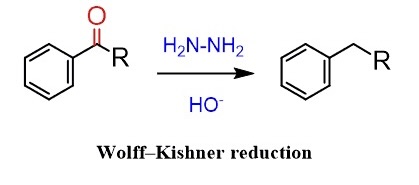
Wolff-Kishner converts aldehydes or ketones into alkanes by deoxygenating the carbonyl group. similar to Clemmenson reduction. this is like a basic version of Clemmenson.

complete the reaction
Friedel-Crafts acylation. combines a R-CO-X (where X = halogen) group with a benzene/aromatic compound to add a ketone group to it. the bond occurs where the halogen was bonded to


complete the reaction
Friedel-crafts alkylation - attaches an alkyl group to an aromatic compound using EAS. it uses AlCl3 or FeCl3 as a catalyst. bond replaces the position where the chlorine was


complete the reaction
gatterman-koch. it uses CO, HCl in AlCl3 to replace a hydrogen on a benzene carbon with a H-C=O group.

complete the following reaction
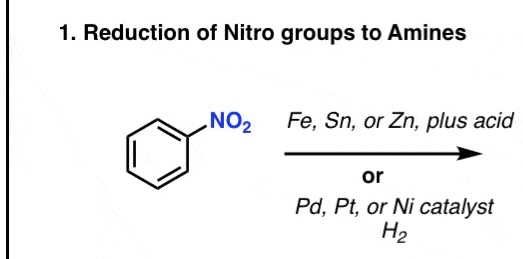
nitrobenzene reduction. uses metal (Fe, Sn, Zn) and acid or Pd, Pi, Ni catalyst H2 to convert a nitro group into various nitrogen containing groups


complete the following reaction
catalytic hydrogenation. adds H across unsaturated carbon-carbon double bonds to create a saturated alkane


complete the following reaction
witting reaction. converts an aldehyde or a ketone into an alkene using a phosphorus ylide (wittig’s reagent). it combines the two reagents where the =O used to be and forms a double bond there.


complete the following reaction
Suzuki coupling - reacts organoboron reagent and organic electrophile (like an organohalide) to form a C - C bond.


complete the following reaction
heck reaction. very similar to Suzuki, breaks the C-Br and C-H bond and bonds together the two structures in a carbon carbon bond
can also use Pd(PPh3)4


complete the following reaction
Corey-house. reacts a culi reagent with an alkyl halide to form carbon carbon bonds


complete the following reaction
while this typically performs strong/harsh oxidation and creates a carboxylic group at a benzylic position, when reacted with a phenol, it produces a 1,4-quinone structure.


complete the following reaction
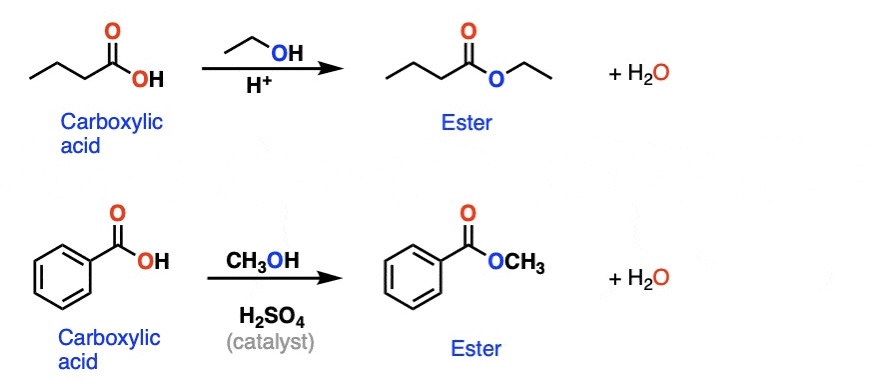
primary alcohols react with carboxylic acids to form an ester compound and h2o byproduct

complete the following reaction
kmno4 performs harsh oxidation. it identifies benzylic carbons and turns the first carbon into carboxylic acids, regardless of how long the chain is.
this only works if at least one hydrogen is present on the carbon, otherwise no reaction will occur
this can also be done with na2cr2o7


complete the following reaction
birch reduction - uses NaNH3 in tbuOH or another alcohol to create non conjugated double bonds on a formerly aromatic structure
ethanol and water can also be used instead of tbuOH, but tbuOH is ideal because of the bulkiness and steric hindrance

may be 2 or 3 minor reactions missing