Genetics Exam 2 - Full Length Questions
 Call Kai
 Learn
 Practice Test
 Spaced Repetition
 Match
 Flashcards
 Knowt Play
1/131

There's no tags or description
Looks like no tags are added yet.
132 Terms
Mendels law of dominance
In a heterozygote (an individual with two different alleles for a gene), one allele may mask the expression of the other. The dominant allele is expressed,
while the recessive allele is not. This is best illustrated by: Genotype AA= Phenotype A. Genotype Aa= Phenotype A. Genotype aa= Phenotype a
Law of Segregation
Each individual has two alleles for each gene, and these alleles segregate (separate) during the formation of gametes. Each gamete then carries only one allele for each gene. This is best illustrated by Aa X Aa —> 3A+1a
Law of Independent Assortment
The alleles for different genes assort independently of one another during gamete formation. This means the inheritance of one trait generally does not affect the inheritance of another trait, provided the genes are on different chromosomes. This is best illustrated by AaBb X AaBb —> 9AB+3Ab+3aB+1ab
Gene
A segment of DNA that contains the instructions for making a specific protein or functional RNA, influencing a particular trait.
Dominant & Recessive Trait
A trait that is expressed in the phenotype when at least one dominant allele is present in the genotype. It can mask the effect of a recessive allele.
A trait that is expressed in the phenotype only when two recessive alleles are present in the genotype. It is masked by a dominant allele
Phenotype
The observable physical or biochemical characteristics of an organism, determined by both its genotype and environmental influences
Genotype
The genetic makeup of an organism, specifically the alleles present for a particular gene or genes.
Allele
One of the different forms of a gene that can exist at a specific locus on a chromosome. Alleles can be dominant or recessive.
Homozygous
An individual with two identical alleles for a specific gene
Heterozygous
An individual with two different alleles for a specific gene
Segregation
The process by which alleles separate during gamete formation, so that each gamete carries only one allele for each gene.
Locus
The specific physical location or position of a gene on a chromosome.
Pedigree
A diagram that shows the lineage or ancestry of an individual, often used to track the inheritance of traits through generations
Incomplete Dominance
A genetic condition where the phenotype of a heterozygote is an intermediate blend of the two homozygous phenotypes
Codominance
A genetic situation where both alleles in a heterozygote are fully expressed, resulting in a phenotype that displays both traits
Epistasis
A genetic interaction where the expression of one gene is affected by one or more other genes. In this case, one gene can mask or modify the effect of another gene, influencing the phenotype
Explain the differences between the following terms:
Gene versus allele versus locus
Genotype versus phenotype
Dominant versus recessive
Complete dominance versus incomplete dominance versus codominance
Gene - specific sequence of dna that codes for a specific protein
Allele - alternate forms of a gene that have specific phenotypic effects
Locus - the position of a gene on a chromosome
Genotype - The genetic constitution of the individual
Phenotype - An observable trait
Dominant - Expressed in heterozygous conditions
Recessive - A trait not expressed in heterozygous conditions
Complete dominance - Complete dominance occurs when a dominant allele completely masks the expression of a recessive allele
Incomplete Dominance - Incomplete dominance occurs when the phenotype of the heterozygote is intermediate between the two homozygotes.
Codominance - In codominant inheritance, there is full expression of both alleles in the heterozygous condition
Suppose that organisms have the following genotypes. What types of gametes will these organisms produce, and in what proportions?
Aa - ½ A, a ½
AA - 1A
aa - 1a
Given the following matings, what are the predicted genotypic ratios of the offspring?
Aa × aa
Aa × Aa
AA × Aa
0.5 Aa, 0.5aa
0.25 AA, 0.5 Aa, 0.25 aa
0.5 AA, 0.5 Aa
Wet ear wax (W) is dominant over dry ear wax (w).
a. 3 : 1 phenotypic ratio of F1 progeny indicates that the parents are of what genotype?
b. 1 : 1 phenotypic ratio of F1 progeny indicates that the parents are of what genotype?
Aa x Aa
Aa x aa
An unspecified characteristic controlled by a single gene is examined in pea plants. Only two phenotypic states exist for this trait. One phenotypic state is completely dominant to the other. A heterozygous plant is self-crossed. What proportion of the progeny of plants exhibiting the dominant phenotype is homozygous?
Define the cross: Let's use 'A' for the dominant allele and 'a' for the recessive allele. A heterozygous plant has the genotype Aa. A self-cross is Aa × Aa.
Determine offspring genotypes: Using a Punnett square for Aa × Aa, the genotypic ratio of the offspring is:
1/4 AA (homozygous dominant)
2/4 (or 1/2) Aa (heterozygous)
1/4 aa (homozygous recessive)
Identify the dominant phenotypes: Both AA and Aa plants will exhibit the dominant phenotype.
The total proportion of offspring with the dominant phenotype is 1/4+2/4=3/41/4+2/4=3/4.
Calculate the proportion of those that are homozygous: The question specifically asks what proportion of the dominant phenotype progeny are homozygous. We only look at the "dominant" group (AA and Aa).
Out of the 3 parts that show the dominant trait, only 1 part is homozygous (AA).
The fraction is ¼ (homozygous dominant) divided by 3/4 (total dominant).
(1/4)/(3/4)=1/3
Sickle cell anemia (SCA) is a human genetic disorder caused by a recessive allele. A couple plan to marry and want to know the probability that they will have an affected child. With your knowledge of Mendelian inheritance, what can you tell them if
(1) each has one affected parent and a parent with no family history of SCA or
(2) the man is affected by the disorder but the woman has no family history of SCA?
Aa x Aa —> probability for affected child (aa) is ¼
aa x AA —> probability of affected child (aa) is 0
If you are informed that tune deafness is a heritable trait, and that a tune deaf couple is expecting a child, can you conclude that the child will be tune deaf?
You cannot conclude with certainty that the child will be tune deaf
we dont know if the trait is dominant or recessive
if it is recessive and both parents are tune deaf (tt) then there would be a 100% chance of the child being tune dead
if it is dominant the parents could either be heterozygotes or homozygotes meaning they could either have a child who is tune deaf or a child who is of normal tune hearing
Stem length in pea plants is controlled by a single gene. Consider the cross of a true-breeding long-stemmed variety to a true-breeding short-stemmed variety in which long stems are completely dominant.
If 120 F1 plants are examined, how many plants are expected to be long stemmed? Short stemmed?
Assign genotypes to both P1 varieties and to all phenotypes listed in (a).
A long-stemmed F1 plant is self-crossed. Of 300 F2 plants, how many should be long stemmed? Short stemmed?
For the F2 plants mentioned in (c), what is the expected genotypic ratio?
All F1 plants will be long stemmed.
Let S= long stemmed and s= short stemmed. The long-stemmed P1 genotype is SS, the short-stemmed P1 genotype is ss, the long-stemmed F1 genotype is Ss.
Approximately 225 long stemmed and 75 short stemmed
The expected genotypic ratio is 1/4 SS : 1/2 Ss : 1/4 ss.
Organisms have the following genotypes. What types of gametes will these organisms produce, and in what proportions?
a. Aabb
b. AABb
c. AaBb
0.5 Ab and 0.5 ab
0.5 AB and 0.5 Ab
0.25Ab , 0.25Ab, 0.25aB, 0.25ab
A woman is heterozygous for two genes. How many different types of gametes can she produce, and in what proportions?
AB: 25% (or 1/4)
Ab: 25% (or 1/4)
aB: 25% (or 1/4)
ab: 25% (or 1/4)
Two traits are examined simultaneously in a cross of two pure-breeding pea-plant varieties. Pod shape can be either swollen or pinched. Pea color can be either green or yellow. A plant with the traits swollen and green is crossed with a plant with the traits pinched and yellow, and a resulting F1 plant is self-crossed. A total of 640 F2 progeny are phenotypically categorized as follows:
360 swollen yellow
120 swollen green
120 pinched yellow
40 pinched green
What is the phenotypic ratio observed for pod shape? Pea color?
What is the phenotypic ratio observed for both traits considered together?
What is the dominance relationship for pod shape? Pea color?
Deduce the genotypes of the P1 and F1 generations.
Both are 3:1
9:3:3:1
Swollen is dominant to pinched; yellow is dominant to green
When P=swollen and p=pinched and C=yellow and c=green then P1=PPcc x ppCC and F1= PpCc
Consider the following cross in pea plants, in which smooth pea shape is dominant to wrinkled, and yellow pea color is dominant to green. A plant with smooth yellow peas is crossed to a plant with wrinkled green peas. The offspring produced peas that were all smooth and yellow. What are the genotypes of the parents? What are the genotypes of the offspring?
Genotypes of the parents: SSYY (smooth yellow) and ssyy (wrinkled green)
Genotypes of the offspring: All offspring are SsYy (heterozygous smooth and yellow)
Consider another cross in pea plants involving the genes for pea color and shape. As before, yellow is dominant to green and smooth is dominant to wrinkled. A plant with smooth yellow peas is crossed to a plant with wrinkled green peas. The peas produced by the offspring are as follows: one-fourth are smooth yellow; one-fourth are smooth green; one-fourth are wrinkled yellow; and one-fourth are wrinkled green.
What is the genotype of the smooth yellow parent?
What are the genotypes of the four classes of offspring?
Smooth yellow parent: SsYy
S= smooth, s= wrinkled
Y= yellow, y= green
Smooth yellow: SsYy, Smooth green: Ssyy , Wrinkled yellow: ssYy , Wrinkled green: ssyy
Determine the possible genotypes of the following parents by analyzing the phenotypes of their children. In this case, we will assume that brown eyes (B) is dominant to blue (b) and that right-handedness (R) is dominant to left-handedness (r).
Parents: brown eyes, right-handed × brown eyes, right-handed
Offspring: 3/4 brown eyes, right-handed
1/4 blue eyes, right-handed
Parents: brown eyes, right-handed × blue eyes, right-handed
Offspring: 6/16 blue eyes, right-handed
2/16 blue eyes, left-handed
6/16 brown eyes, right-handed
2/16 brown eyes, left-handed
Parents: brown eyes, right-handed × blue eyes, left-handed
Offspring: 1/4 brown eyes, right-handed
1/4 brown eyes, left-handed
1/4 blue eyes, right-handed
1/4 blue eyes, left-handed
BbRR × BbRR
BbRr x bbRr
BbRr x bbrr
Think about this one carefully. Albinism and hair color are governed by different genes. A recessively inherited form of albinism causes affected individuals to lack pigment in their skin, hair, and eyes. In hair color, red hair is inherited as a recessive trait and brown hair is inherited as a dominant trait relative to red hair. An albino woman whose parents both have red hair has two children with a man who is normally pigmented and has brown hair. The brown-haired partner has one parent who has red hair. The first child is normally pigmented and has brown hair. The second child is albino.
a. What is the hair color (phenotype) of the albino parent?
b. What is the genotype of the albino parent for hair color?
c. What is the genotype of the brown-haired parent with respect to hair color? Skin pigmentation?
d. What is the genotype of the first child with respect to hair color and skin pigmentation?
e. What are the possible genotypes of the second child for hair color? What is the phenotype of the second child for hair color? Can you explain this?
a. Red hair
b. bb
c. Bb for hair color and Ss for skin color (brown hair and normally pigmented)
d. AaBb
e. Possible genotypes: Bb or bb, Phenotype: Brown hair for Bb and bb for red hair
Consider the following cross:
P1: AABBCCDDEE × aabbccddee
F1: AaBbCcDdEe (self-cross to get F2)
What is the chance of getting an AaBBccDdee individual in the F2 generation?
Gene A (Aa × Aa): The probability of getting Aa is 1/2 (or 2/4).
Gene B (Bb × Bb): The probability of getting BB is 1/4.
Gene C (Cc × Cc): The probability of getting cc is 1/4.
Gene D (Dd × Dd): The probability of getting Dd is 1/2 (or 2/4).
Gene E (Ee × Ee): The probability of getting ee is 1/4.
1/2×1/4×1/4×1/2×1/4 =0.00391 1/256
In the following trihybrid cross, determine the chance that an individual could be phenotypically A, b, C in the F1 generation.
P1: AaBbCc × AabbCC
Gene A: Aa × Aa
Goal: Phenotype A (dominant).
Possible outcomes: AA (1/4), Aa (2/4), aa (1/4).
Probability of dominant phenotype A: 1/4+2/41/4+2/4 = 3/4
2. Gene B: Bb × bb
Goal: Phenotype b (recessive).
Possible outcomes: Bb (1/2), bb (1/2).
Probability of recessive phenotype b: The only way to get the recessive phenotype is to inherit a 'b' from both parents. The chance of getting bb is 1/2.
3. Gene C: Cc × CC
Goal: Phenotype C (dominant).
Possible outcomes: CC (1/2), Cc (1/2).
Probability of dominant phenotype C: Because one parent is homozygous dominant (CC), all offspring will receive at least one dominant 'C' allele. The probability is 1 (or 100%).
Final Calculation:
To find the overall probability, multiply the individual probabilities together:
3/4×1/2×1 =3/8
In pea plants, long stems are dominant to short stems, purple flowers are dominant to white, and round peas are dominant to wrinkled. Each trait is determined by a single, different gene. A plant that is heterozygous at all three loci is self-crossed, and 2,048 progeny are examined. How many of these plants would you expect to be long stemmed with purple flowers, producing wrinkled peas?
Stem Length: Long (L) is dominant, short (l) is recessive.
Flower Color: Purple (P) is dominant, white (p) is recessive.
Pea Shape: Round (R) is dominant, wrinkled (r) is recessive.
Cross: LlPpRr × LlPpRr
The cross is Ll × Ll. The probability of a dominant phenotype (LL or Ll) is 3/4.
The cross is Pp × Pp. The probability of a dominant phenotype (PP or Pp) is 3/4.
The cross is Rr × Rr. The probability of the recessive phenotype (rr) is 1/4.
¾ × ¾ * ¼ = 9/64
9/64 × 2048 =288
Discuss the pertinent features of meiosis that provide a physical correlate to Mendel’s abstract genetic laws of random segregation and independent assortment.
Segregation is physically explained by the separation of homologous chromosomes during Anaphase I.
Independent Assortment is physically explained by the random alignment of homologous chromosome pairs during Metaphase I
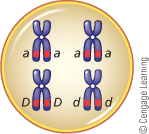
The following diagram shows a hypothetical diploid cell. The recessive allele for albinism is represented by a, and d represents the recessive allele for deafness. The normal alleles for these conditions are represented by A and D, respectively.
a. According to the principle of segregation, what is segregating in this cell?
b. According to Mendel’s principle of independent assortment, what is independently assorting in this cell?
c. How many chromatids are in this cell?
d. Write the genotype of the individual from whom this cell was taken.
e. What is the phenotype of this individual?
f. What stage of cell division is represented by this cell (prophase, metaphase, anaphase, or telophase of meiosis I, meiosis II, or mitosis)?
g. After meiosis is complete, how many chromatids and chromosomes will be present in one of the four progeny cells?
a. Homologous chromosomes are segregating
b. The homologous pairs are assorting independently of each other
c. There are 8 chromatids
d. The genotype is aaDd.
e. The phenotype is albino with normal hearing.
f. This represents Prophase I of Meiosis
g.
Chromosomes: 2. Meiosis reduces the chromosome number by half (from 4 in the diploid cell to 2 in each haploid gamete).
Chromatids: 0 (or, more accurately, 2 unreplicated chromosomes). After meiosis II, the sister chromatids are pulled apart and become individual chromosomes. A mature gamete does not have replicated chromosomes, so there are no longer chromatids present.

Define the following pedigree symbols:
a. non filled in circle
b. filled in square
c. filled in circle
d. half filled in circle
e. attached picture
Unaffected female
Effected male
Effected female
Carrier female
two unaffected brothers
Draw the following simple pedigree. A man and a woman have three children: a daughter, then two sons. The daughter marries and has monozygotic (identical) twin girls. The youngest son in generation II is affected with albinism.
Draw on your own
Construct a pedigree, given the following information. Mary is 16 weeks pregnant and was referred for genetic counseling because of advanced maternal age. Mary has one daughter, Sarah, who is 5 years old. Mary has three older sisters and four younger brothers. The two oldest sisters are married, and each has one son. All her brothers are married, but none has any children. Mary’s parents are both alive, and she has two maternal uncles and three paternal aunts. Mary’s husband, John, has two brothers, one older and one younger, neither of whom is married. John’s mother is alive, but his father is deceased.
draw on your own
A characteristic of snapdragons amenable to genetic analysis is flower color. Imagine that a true-breeding red-flowered variety is crossed to a pure line having white flowers. The progeny are exclusively pink-flowered. Diagram this cross, including genotypes for all P1 and F1 phenotypes. What is the mode of inheritance? Let F= red and f=white .
The P1 generation is FF × ff. The F1 generation is Ff. The mode of inheritance is incomplete dominance.
In peas, straight stems (S) are dominant to gnarled (s), and round peas (R) are dominant to wrinkled (r). The following cross (a test cross) is performed: SsRr × ssrr. Determine the expected phenotypes of the progeny and what fraction of the progeny should exhibit each phenotype.
SR x sr = SsRr —> straight stems, round peas (1/4)
Sr x sr = Ssrr —> straight stems, wrinkled peas (1/4)
sR x sr = ssRr —> gnarled stems, round peas (1/4)
sr x sr = ssrr —> gnarled stems, wrinkled peas (1/4)
Pea plants usually have white or red flowers. A strange pea-plant variant is found that has pink flowers. A self-cross of this plant yields the following phenotypes:
30 red flowers
62 pink flowers
33 white flowers
What are the genotypes of the parents? What is the genotype of the progeny with red flowers?
Parent Genotypes: Rr × Rr
Red flowers: RR
A plant geneticist is examining the mode of inheritance of flower color in two closely related species of exotic plants. One species may have two pure-breeding lines—one produces a distinct red flower, and the other produces flowers with no color at all, or very pale yellow flowers—however, she cannot be sure. A cross of these varieties produces all pink-flowered progeny. The second species exhibits similar pure-breeding varieties; that is, one variety produces red flowers, and the other produces an albino or very pale yellow flower. A cross of these two varieties, however, produces orange-flowered progeny exclusively. Analyze the mode of inheritance of flower color in these two plant species.
Because neither species produces progeny resembling a parent, simple dominance is ruled out. The species producing pink-flowered progeny from red and white (or very pale yellow) suggests incomplete dominance as a mode of inheritance. However, in the second species, the production of orange-colored progeny cannot be explained in this fashion—because orange would result from an equal production of red and yellow pigments. Instead, in this case, codominant inheritance is suggested, with one parent producing bright red flowers and the other producing pale yellow flowers.
What are the possible genotypes for the following blood types?
type A
type B
type O
type AB
AA or AO
BB or BO
OO
AB
A man with blood type A and a woman with blood type B have three children: a daughter with type AB and two sons, one with type B and one with type O blood. What are the genotypes of the parents?
Genotype of the Type A father: AO
Genotype of the Type B mother: BO
Many individuals with metabolic diseases are normal at birth but show symptoms shortly thereafter. Why?
The baby is normal at birth because the mother's body was acting as an external life-support system, clearing the metabolic waste. Symptoms begin shortly after birth because the baby's own defective metabolic pathways are suddenly forced to work on their own, causing toxins to accumulate or essential products to run out.
List the ways in which a metabolic block can have phenotypic effects.
Accumulation of a Toxic Substrate (can be from the block of an enzyme ex: PKU)
Deficiency of an Essential End Product (ex albinism)
Accumulation of a Toxic Byproduct
Inability to Store a Substance
Failure of Feedback Inhibition
Transport Defects (even if the enzyme is normal)

Substance A is converted to substance C by enzymes 1 and 2. Substance B is the intermediate produced in this pathway:
a. If an individual is homozygous for a null mutation in the gene that codes for enzyme 1, what will the result be?
b. If an individual is homozygous for a null mutation in enzyme 2, what will the result be?
c. What if an individual is heterozygous for a dominant mutation in which enzyme 1 is overactive?
d. What if an individual is heterozygous for a mutation that abolishes the activity of enzyme 2 (a null mutation)?
a. Buildup of substance A, no substance B or C
b. Buildup of substance B, no substance C
c. Buildup of substance B, as long as A is not a limiting factor
d. Half the amount of C

Substance A is converted to substance C by enzymes 1 and 2. Substance B is the intermediate produced in this pathway:
a. If the first individual in Question 4 married the second individual, would their children be able to convert substance A into substance C?
b. Suppose each of the adults mentioned in part a was heterozygous for an autosomal dominant mutation that prevents any enzyme function. List the phenotypes of their children with respect to compounds A, B, and C. (Would the compound be in excess, not present, and so on?)
a. Yes. Each would carry the normal gene for the other enzyme. (Individual 1 would be mutant for enzyme 1 but normal for enzyme 2. This is because two different genes encode enzymes 1 and 2.)
b.
D= dominant mutation in enzyme 1
d= normal enzyme
A= dominant mutation for enzyme 2
a= normal allele a
Ddaa x ddAa
DdAa | mutation in enzyme 1 and 2, A buildup, no C |
Ddaa | mutation in enzyme 1, A buildup, no C |
ddAa | mutation in enzyme 2, B buildup, no C |
ddaa | no mutation, normal |
Ratio would be 1 : 2 : 1 for substance B buildup, no C : substance A buildup, no C : normal
An individual is heterozygous for a recessive mutation in enzyme 1 and heterozygous for a recessive mutation in enzyme 2. This individual marries an individual with the same genotype. List the possible genotypes of their children. For every genotype, determine the activity of enzymes 1 and 2, assuming that the mutant alleles have 0% activity and that each normal allele has 50% activity. For every genotype, determine if compound C will be made. If compound C is not made, list the compound that will be in excess.
Alleles for enzyme 1: A (dominant, 50% activity)
a (recessive, 0% activity).
Alleles for enzyme 2: B (dominant, 50% activity)
b (recessive, 0% activity).
| Enzyme | Enzyme | Compound |
| |
|---|---|---|---|---|---|
| 1 | 2 | A | B | C |
1 AABB | 100 | 100 | N | N | N |
2 AaBB | 50 | 100 | N | N | N |
4 AaBb | 50 | 50 | N | N | N |
2 AABb | 100 | 50 | N | N | N |
1 AAbb | 100 | 0 | N | B | L |
2 Aabb | 50 | 0 | N | B | L |
1 aaBB | 0 | 100 | B | L | L |
2 aaBb | 0 | 50 | B | L | L |
1 aabb | 0 | 0 | B | L | L |
N, normal
B, buildup
L, less
Essential amino acids are:
a. amino acids the human body can synthesize
b. amino acids humans need in their diet
c. amino acids in a box of Frosted Flakes
d. amino acids that include arginine and glutamic acid
e. amino acids that cannot harm the body if not metabolized properly
b. amino acids humans need in their diet
Suppose that in the formation of phenylalanine hydroxylase mRNA, the exons of the pre-mRNA fail to splice together properly and the resulting enzyme is nonfunctional. This produces an accumulation of high levels of phenylalanine and other compounds, which causes neurological damage. What phenotype would be produced in the affected individual?
If untreated, the individual would display severe intellectual disability, delayed development, seizures, behavioral problems, and psychiatric disorders. They would also likely have lighter skin and hair than their unaffected family members (because the body cannot make melanin without tyrosine, the product of the blocked enzyme). They may also have a "musty" or "mousy" odor to their sweat and urine due to the alternative breakdown products of phenylalanine.
If phenylalanine was not an essential amino acid, would diet therapy (the elimination of phenylalanine from the diet) for PKU work?
No, diet therapy would not work (and would actually be harmful) if phenylalanine were not an essential amino acid.
If the body could synthesize its own phenylalanine (perhaps by converting it from another compound), then eliminating it from the diet would do nothing to lower the body's phenylalanine levels. The body would just keep making it. Therefore, the toxic accumulation in the blood would continue, and the neurological damage of PKU would still occur.
Phenylketonuria and alkaptonuria are both autosomal recessive diseases. If a person with PKU marries a person with AKU, what will the phenotype of their children be?
All of their children will be phenotypically normal (they will not have PKU or AKU). However, they will all be carriers (heterozygous) for both diseases.
Genotype: All children will be PpAa (heterozygous for both).
Phenotype: All will be normal (unaffected by either disease).
Why? The genes are on different loci and assort independently. Each parent passes on normal dominant alleles for the disease they don't have, masking the recessive alleles they do have. (Children are carriers for both).
The normal enzyme required for converting sugars into glucose is present in cells, but the conversion never takes place and no glucose is produced. What could have occurred to cause this defect in a metabolic pathway?
The enzyme may be inactive due to a missing cofactor/vitamin, a failure in activation (it's stuck as an inactive zymogen), a regulatory mutation (allosteric inhibition), or a transport defect (the enzyme and substrate are separated).
Knowing that individuals who are homozygous for the G^D allele show no symptoms of galactosemia, is it surprising that galactosemia is a recessive disease? Why?
Because the G^D allele produces a functional enzyme (dominant). The disease only appears when an individual inherits two defective alleles and lacks any functional G^D allele to compensate.
Describe the quaternary structure of the blood protein hemoglobin.
Overall Composition: Hemoglobin is a tetramer, meaning it is a multi-subunit protein made of four individual polypeptide chains (globins) bound together.
The Subunits: In adult hemoglobin (HbA), the four chains are two identical alpha (αα) chains and two identical beta (ββ) chains.
The Prosthetic Group: Each of the four polypeptide chains is tightly bound to a non-protein molecule called a heme group.
The Iron Core: At the center of each heme group is an iron ion (Fe²⁺). This iron atom is what actually binds reversibly to one oxygen molecule (O2O2).
Oxygen Capacity: Because there are four subunits and four heme groups, a single fully saturated hemoglobin molecule can carry a maximum of four oxygen molecules.
A person was found to have very low levels of functional beta globin mRNA and therefore very low levels of the beta globin protein. What problems would this cause for assembling functional hemoglobin molecules?
Low beta globin prevents the formation of the required α2β2α2β2 tetramers, leading to toxic build-up of unpaired alpha chains, premature red blood cell destruction, and severe anemia
If an extra nucleotide is inserted in the first exon of the beta globin gene, what effect will it have on the amino acid sequence of the globin polypeptides? Will the globin most likely be fully functional, partly functional, or nonfunctional? Why?
It causes a frameshift mutation, changing all subsequent amino acids and usually creating a premature stop codon. The resulting protein will be severely truncated and misfolded, making it nonfunctional (and likely quickly degraded by the cell).
Transcriptional regulators are proteins that bind to promoters (the 5’ -flanking regions of genes) to regulate their transcription. Assume that a particular transcription regulator normally promotes transcription of gene X, a transport protein. If a mutation makes this regulator gene nonfunctional, would the resulting phenotype be similar to a mutation in gene X itself? Why or why not?
Yes. If the regulator is broken, the target gene is never turned on, so the protein is never made. The result is the same as if the gene itself were mutated: a complete lack of the functional protein and the same resulting phenotype.
Skips generations? | Equal sex ratio? | Sick offspring always have sick mothers? | Sick offspring always have sick fathers? |
|
Yes | Yes | No | No | ? |
Yes | No, more males | No | No | ? |
No | Yes | No | No | ? |
No | Yes | Yes | No | ? |
No | No, more females | No | No | ? |
No | No, only males | No | Yes | ? |
Skips generations? | Equal sex ratio? | Sick offspring always have sick mothers? | Sick offspring always have sick fathers? |
|
Yes | Yes | No | No | Autosomal recessive |
Yes | No, more males | No | No | X-linked recessive |
No | Yes | No | No | Autosomal dominant |
No | Yes | Yes | No | mitochondrial |
No | No, more females | No | No | X-linked dominant |
No | No, only males | No | Yes | Y-linked |
What are the reasons that pedigree charts are used?
They visually represent inheritance patterns, track genetic traits through generations, and help identify carriers of genetic disorders.
Pedigree analysis permits all of the following except:
a. an orderly presentation of family information
b. the determination of whether a trait is genetic
c. the determination of whether a trait is dominant or recessive
d. an understanding of which gene is involved in a heritable disorder
e. the determination of whether a trait is sex-linked or autosomal
an understanding of which gene is involved in a heritable disorder

Using the pedigree provided, answer the following questions.
a. Is the proband male or female?
b. Is the grandfather of the proband affected?
c. How many siblings does the proband have, and where is he or she in the birth order?
a. Female
b. Female
c. 3 siblings. The proband is the youngest child.
What does OMIM stand for? What kinds of information are in this database?
Online Mendelian Inheritance in Man
Gene-Phenotype Relationships, Inheritance Patterns, Clinical Features, Molecular Genetics, References

What pattern of inheritance is suggested by the following pedigree?
For genotype assignment, assume that the pedigree is for an autosomal dominant trait and that the affected male in the first generation is heterozygous. Assign genotypes to all other individuals in the pedigree.
I-1 | aa | Unaffected |
I-2 | Aa | Affected |
II-1 | aa | Unaffected |
II-2 | Aa | Affected |
II-3 | Aa | Affected |
II-4 | aa | Unaffected |
II-5 | Aa | Affected |
II-6 | aa | Unaffected |
III-1 | Aa | Affected |
III-2 | aa | Unaffected |

Does the indicated individual (III-5) show the trait in question?
No
Use the following information to respond to the three questions posed below:
(1) The proband (affected individual who led to the construction of the pedigree) exhibits the trait.
(2) Neither her husband nor her only sibling, an older brother, exhibits the trait.
(3) The proband has five children by her current husband. The oldest is a boy, followed by a girl, then another boy, and then identical twin girls. Only the second oldest fails to exhibit the trait.
(4) Both parents of the proband show the trait.
a. Construct a pedigree of the trait in this family.
b. Determine how the trait is inherited (go step by step to examine each possible pattern of inheritance).
c. Can you deduce the genotype of the proband’s husband for this trait?
a. in picture
b. The mode of inheritance is consistent with an autosomal dominant trait. Both of the proband’s parents are affected. If this trait were recessive, all their children would have to be affected (aa × aa can only produce aa offspring). As we see in this pedigree, the brother of the proband is not affected, indicating that this is a dominant trait. His genotype is aa, the proband’s genotype is AA or Aa, and both parent’s genotype is most likely Aa.
c. Because the proband’s husband is unaffected, he is aa.


In the following pedigree, assume that the father of the proband is homozygous for a rare trait. What pattern of inheritance is consistent with this pedigree? In particular, explain the phenotype of the proband.
Autosomal Recessive
The Proband's Phenotype: The proband (the individual pointed to by the arrow) is unaffected (he does not show the trait).
Why? The problem states the father (generation I) is homozygous for the trait. Because the trait is recessive, the affected father has the genotype aa. He must pass one 'a' allele to all of his children. The proband is unaffected, meaning he must have received a normal dominant allele (A) from his unaffected mother. Therefore, the proband's genotype is Aa, making him a heterozygous carrier who does not express the trait.

Using the following pedigree, deduce a compatible pattern of inheritance. Identify the genotype of the individual in question.
This pedigree is consistent with autosomal recessive inheritance. If inheritance is autosomal recessive, the individual in question is heterozygous.
A proband female with an unidentified disease seeks the advice of a genetic counselor before starting a family. Based on the following data, the counselor constructs a pedigree encompassing three generations:
(1) The maternal grandfather of the proband has the disease.
(2) The mother of the proband is unaffected and is the youngest of five children, the three oldest being male.
(3) The proband has an affected older sister, but the youngest siblings are unaffected twins (boy and girl).
(4) All the individuals who have the disease have been revealed. Duplicate the counselor’s feat.
answer is in picture

Describe the primary gene or protein defect and the resulting phenotype for the following diseases:
cystic fibrosis
Marfan syndrome
Cystic Fibrosis
Primary Gene/Protein Defect
Cystic fibrosis is caused by mutations in the CFTR (Cystic Fibrosis Transmembrane conductance Regulator) gene, located on chromosome 7 . The CFTR protein functions as a chloride channel and regulator of other ion transporters on the surface of epithelial cells .
Resulting Phenotype
The defect in the CFTR channel leads to reduced chloride secretion and increased sodium absorption. This dehydrates the extracellular fluid, making mucus abnormally thick and sticky . The resulting phenotype is a multisystem disorder
Marfan syndrome
Primary Gene/Protein Defect
Marfan syndrome is caused by mutations in the FBN1 gene, which encodes the protein fibrillin-1 . Fibrillin-1 is a major component of microfibrils, which provide structural support and elasticity to connective tissue in the extracellular matrix . The mutations lead to defective or reduced amounts of fibrillin-1, impairing the assembly and function of these microfibrils .
Resulting Phenotype
Because fibrillin-rich microfibrils are abundant in the aorta, suspensory ligaments of the lens, and periosteum, the phenotype primarily affects the skeletal, ocular, and cardiovascular systems
List and describe two other diseases inherited in the following fashion:
autosomal dominant
autosomal recessive
Huntington's Disease (HD)
Primary Defect: Caused by a trinucleotide (CAG) repeat expansion in the HTTgene, which encodes the huntingtin protein. The mutation results in an abnormally long polyglutamine tract, leading to protein misfolding, aggregation, and neuronal toxicity.
Phenotype: Progressive neurodegeneration primarily affecting the basal ganglia and cerebral cortex. Symptoms typically appear in mid-adulthood and include chorea (involuntary jerking movements), cognitive decline (dementia), and psychiatric disturbances. It is fatal, usually 15–20 years after onset.
Sickle Cell Disease
Primary Defect: Caused by a point mutation in the HBB gene, which encodes the beta-globin chain of hemoglobin. The mutation substitutes valine for glutamic acid at position 6, producing abnormal hemoglobin S (HbS). Under low oxygen conditions, HbS polymerizes, causing red blood cells to become rigid and sickle-shaped.
Phenotype: Chronic hemolytic anemia, episodic severe pain (vaso-occlusive crises) due to blocked capillaries, organ damage (spleen, kidneys, lungs), increased susceptibility to infection, and delayed growth. Heterozygous carriers (sickle cell trait) are generally asymptomatic and protected against malaria.
The father of 12 children begins to show symptoms of Huntington disease.
a. What is the probability that Sam, the man’s second-oldest son (II-2), will suffer from the disease if he lives a normal life span? (Sam’s mother and her ancestors do not have the disease.)
b. Can you infer anything about the presence of the disease in Sam’s paternal grandparents?
a. The probability is 50% (or 1/2).
Huntington disease is an autosomal dominant disorder.
Let H = the dominant mutated allele (causes disease) and h = the normal recessive allele.
Because the father has begun to show symptoms, his genotype must contain at least one 'H'.
The problem states that the mother and her ancestors do not have the disease. Therefore, the mother must be homozygous recessive (hh).
The father must have inherited the disease allele from one of his parents and a normal allele from the other (since he has 12 children and presumably lived long enough to have them before severe symptoms set in). Thus, the father is heterozygous (Hh).
If the father is Hh and the mother is hh, each child has a 50% chance of inheriting the 'H' allele from the father and a 50% chance of inheriting the 'h' allele.
Since Sam is a biological child of this couple, there is a 1 in 2 (50%) chance that he inherited the Huntington allele and will develop the disease if he lives a normal lifespan. (Note: The fact that he is the second-oldest son or that there are 12 children does not change the independent probability for any single child).
b. Yes, we can infer that at least one of Sam's paternal grandparents had the disease (or carried the gene).
Explanation:
Because Huntington disease is autosomal dominant, it does not "skip" generations. A person with the disease must have inherited the dominant mutated allele from a parent who also has the allele.
Since Sam's father is affected (heterozygous, Hh), he must have received the 'H' allele from either his mother or his father.
Therefore, at least one of Sam's paternal grandparents must have had the Huntington disease allele.
Because the father is heterozygous, we also know that the other grandparent must have been unaffected (homozygous recessive, hh) and passed on a normal 'h' allele. (If both grandparents had the disease, the father could have been homozygous dominant, but typically in these problems, we assume the trait is rare. Even so, it guarantees at least one grandparent was affected).
Huntington disease is a rare, fatal disease that usually develops in the fourth or fifth decade of life. It is caused by a single autosomal dominant allele. A phenotypically normal man in his twenties who has a 2-year-old son of his own learns that his father has developed Huntington disease. What is the probability that he himself will develop the disease? What is the chance that his young son will eventually develop the disease?
Due to the rarity of the disease, we will assume that the paternal grandfather is heterozygous for the allele responsible for Huntington disease. His son, now in his twenties, has a 50% chance of inheriting the mutant allele. In turn, should he carry the HD allele, his son would have a 50% chance of inheriting it. Therefore, at present, the child has a ½ * ½ = ¼ chance of having inherited the HD allele.
The X and Y chromosomes are structurally and genetically distinct. However, they do pair during meiosis at a small region near the tips of their short arms, indicating that the chromosomes are homologous in this region. If a gene lies in this region, will its pattern of transmission be more like that of a sex-linked gene or an autosomal gene? Why?
If a gene lies in the pairing region (the pseudoautosomal region) of the X and Y chromosomes, its pattern of transmission will be more like that of an autosomal gene because the homology between the X and Y in this region allows for crossing over during meiosis, meaning alleles can be swapped between the two sex chromosomes just as they are between autosomes. Furthermore, because the gene is present on both the X and Y chromosomes, a father can pass it to both his sons (via the Y) and his daughters (via the X), resulting in a pattern of inheritance that affects both sexes equally and does not exhibit the sex-specific transmission ratios characteristic of classic sex-linked genes.
What is the chance that a color-blind male and a carrier female will produce:
a color-blind son?
a color-blind daughter?
a. 50% chance for sons, 50% for all children
b. 50% for daughters, 50% for all children
A young boy is color-blind. His one brother and five sisters are not. The boy has three maternal uncles and four maternal aunts. None of his uncles’ children or grandchildren is color-blind. One of the maternal aunts married a color-blind man, and half of her children, both male and female, are color-blind. The other aunts married men who have normal color vision. All their daughters have normal vision, but half of their sons are color-blind.
a. Which of the boy’s four grandparents transmitted the gene for color blindness?
b. Are any of the boy’s aunts or uncles color-blind?
c. Is either of the boy’s parents color-blind?
a. The maternal grandmother transmitted the gene.
b. Yes, one maternal uncle is color-blind.
c. No, neither parent is color-blind.
Describe the phenotype and primary gene or protein defect of the X-linked recessive disease muscular dystrophy.
Muscular dystrophy (most commonly Duchenne and Becker types) is an X-linked recessive disorder caused by mutations in the DMD gene, leading to a deficiency or absence of the dystrophin protein, which normally stabilizes the muscle cell membrane. This defect results in progressive proximal muscle weakness and wasting, typically appearing in early childhood with delayed motor milestones and calf pseudohypertrophy; Duchenne patients are usually wheelchair-dependent by age 12 and die of respiratory or cardiac complications in their twenties, while Becker patients have a later onset and slower progression due to a partially functional truncated protein.
Suppose a couple, both phenotypically normal, have two children: one unaffected daughter and one son affected with a genetic disorder. The phenotype ratio is 1 : 1, making it difficult to determine whether the trait is autosomal or X-linked. With your knowledge of genetics, what are the genotypes of the parents and children in the autosomal case? In the X-linked case?
In the autosomal case, the parents are Aa and Aa and the disorder is inherited as a recessive trait. They can have an affected (aa) son or daughter, or unaffected (AA or Aa) children. If the trait is inherited in an X-linked recessive manner, the parents would be XAXa x XAY . Daughters would be X^A X^a and unaffected
sons would be affected and be X^a Y . Because an unaffected daughter and an affected son are possible in each case, this limited information is not enough to determine the inheritance pattern.

The following is a pedigree for a common genetic trait. Analyze the pedigree to determine whether the trait is inherited as:
autosomal dominant, x-linked dominant

As a genetic counselor investigating a genetic disorder in a family, you are able to collect a four-generation pedigree that details the inheritance of the disorder in question. Analyze the information in the pedigree to determine whether the trait is inherited as:
autosomal dominant
autosomal recessive
X-linked dominant
X-linked recessive
Y-linked
Strictly speaking, this trait could be inherited in the following ways:
autosomal dominant
autosomal recessive; or
X-linked recessive.
Some possibilities are more probable than others, depending on the frequency of the trait in a population.
In the eighteenth century, a young boy with a skin condition known as ichthyosis hystrix gravior was identified. The phenotype of this disorder includes thickening of skin and the formation of loose spines that are sloughed off periodically. This man married and had six sons, all of whom had the same condition. He also had several daughters, all of whom were unaffected. In all succeeding generations, the condition was passed on from father to son. What can you theorize about the location of the gene that causes ichthyosis hystrix gravior?
Based on the pedigree information provided, you can theorize that the gene causing ichthyosis hystrix gravior is located on the Y chromosome.
Here is the reasoning:
Exclusive Father-to-Son Transmission: The condition was passed from the affected father to all six of his sons but to none of his daughters. In all succeeding generations, it continued to be passed only from father to son.
Male-Specific Inheritance: The only chromosome a father passes exclusively to his sons is the Y chromosome (he passes his X chromosome to his daughters). If the gene were on an autosome or the X chromosome, it would not exhibit this strict, exclusive male-to-male pattern across multiple generations.
Lack of Female Affecteds: Because females do not inherit the Y chromosome, they cannot inherit or express a Y-linked trait. This perfectly matches the observation that none of the daughters were affected.
What are the unique features of mitochondria that are not present in other cellular organelles in human cells?
Mitochondria contain DNA carrying genetic information and are maternally inherited.
How is mitochondrial DNA transmitted?
Mitochondrial DNA (mtDNA) is transmitted almost exclusively through maternal inheritance.
Here is how it works:
Maternal Origin: A child inherits their mitochondria (and therefore their mtDNA) solely from the mother, because the egg cell provides the cytoplasm and organelles for the zygote, while the sperm contributes essentially only its nuclear DNA.
Define penetrance and expressivity.
Penetrance refers to the proportion of individuals with a particular genotype who actually express the associated phenotype. It is typically expressed as a percentage: if 80 out of 100 people carrying a dominant disease allele show symptoms, the penetrance is 80%. Penetrance is an all-or-none concept—an individual either expresses the trait or does not.
Expressivity refers to the degree or severity to which a phenotype is expressed in individuals who do show the trait. Unlike penetrance, expressivity is a matter of gradation: among affected individuals with the same genotype, one may have mild symptoms while another has severe symptoms. For example, in a disorder with variable expressivity, one patient might have only slight skeletal abnormalities while another has life-threatening cardiovascular complications.
Explain how camptodactyly is an example of expressivity.
Camptodactyly is a classic example of variable expressivity because individuals carrying the same disease-causing mutation can exhibit a wide range of phenotypic severity, from a barely noticeable flexion contracture of the fifth finger to a severe, disabling bend that significantly impairs hand function, and the trait may even affect additional fingers in some individuals but not others; this continuum of severity among affected carriers defines expressivity, which is distinct from incomplete penetrance (where some carriers show no signs at all)—camptodactyly demonstrates both phenomena, as some gene carriers have completely normal hands while those who are affected vary widely in how severely the trait manifests.
Hardy-Weinberg law
Allele and genotype frequencies remain constant unless there are evolutionary forces
Population
local groups of individuals occupying a given space at a given time
gene pool
the set of genetic information carried by a population
allele frequency
the frequency of occurrence of particular alleles in the gene pool of a population
genotype frequency
the frequency of occurrence of particular genotypes among the individuals of a population
The MN blood group is a single-gene, two-allele system in which each allele is codominant. Why are such codominant alleles ideal for studies of allele frequencies in a population?
Codominant alleles like those in the MN blood group are ideal for population studies because each genotype (MM, MN, NN) produces a distinct, directly observable phenotype, so heterozygotes can be identified without ambiguity. This allows allele frequencies to be calculated directly by counting: the M allele frequency equals the frequency of MM individuals plus half the frequency of MN individuals, and similarly for N. In contrast, dominant/recessive systems require indirect estimation via the Hardy-Weinberg equation and assumptions about mating patterns, introducing potential error. Codominant systems like MN, ABO, and HLA thus enable accurate, assumption-free studies of genetic variation in populations.
Explain the connection between changes in population allele frequencies and evolution, and relate this to the observations made by Wallace and Darwin concerning natural selection.
Changes in population allele frequencies are the genetic definition of evolution: evolution occurs when the relative frequencies of alleles in a population's gene pool change over time. This can happen through mutation, gene flow, genetic drift, and natural selection. Wallace and Darwin independently observed that individuals vary in heritable traits, that more offspring are produced than can survive, and that individuals with traits better suited to their environment survive and reproduce more successfully. This differential reproductive success—natural selection—means that advantageous alleles increase in frequency across generations while deleterious alleles decrease, producing the gradual adaptive change in populations that Darwin and Wallace described as descent with modification.
Can populations evolve without changes in allele frequencies?
No
Design an experiment to determine if a population is evolving.
Hypothesis: If the population is evolving, allele frequencies will change significantly between generations. If it is not evolving (Hardy-Weinberg equilibrium), allele frequencies will remain constant.
Materials: A sample of at least 100 individuals from the population (e.g., blood samples or cheek swabs), antisera for M and N antigens (or PCR primers for the MN locus), and a statistical software or calculator.
Procedure:
Genotype each individual as MM, MN, or NN using the antisera (or PCR).
Count the number of each genotype and calculate the observed allele frequencies: p(M) = (2×MM + MN) / (2×total), and q(N) = 1 − p.
Repeat the sampling and genotyping on a second cohort from the same population one generation later (or sample parents and their offspring).
Compare allele frequencies between the two time points using a chi-square test or a simple proportion test.
Prediction: If the allele frequencies differ significantly between generations (p < 0.05), the population is evolving. If they remain statistically unchanged, the population is consistent with Hardy-Weinberg equilibrium and shows no detectable evolution at this locus.
What are four assumptions of the Hardy–Weinberg law?
No mutation — no new alleles are introduced into the gene pool.
No migration (gene flow) — no individuals move into or out of the population, so alleles are not added or lost.
Random mating — individuals mate without regard to genotype or phenotype (no assortative mating, inbreeding, or sexual selection).
No natural selection — all genotypes survive and reproduce equally, so no allele is favored.
Drawing on your newly acquired understanding of the Hardy–Weinberg equilibrium law, point out why the following statement is erroneous: “Because most of the people in Sweden have blond hair and blue eyes, the genes for blond hair and blue eyes must be dominant in that population.”
it confuses phenotype frequency with allele dominance. The Hardy–Weinberg law makes clear that a trait can be very common in a population without the underlying allele being dominant.
In a population where the females have the allelic frequencies A=0.35 and a= 0.65 and the frequencies for males are A=0.1 and a=0.9 , how many generations will it take to reach Hardy–Weinberg equilibrium for both the allelic and the genotypic frequencies? Assume random mating and show the allelic and genotypic frequencies for each generation.
Let p = frequency of allele A and q = frequency of allele a.
The overall allele frequency in the population (averaging the sexes equally) is:
p̄ = (0.35 + 0.10) / 2 = 0.225
q̄ = (0.65 + 0.90) / 2 = 0.775
Alleles in offspring come from mothers and fathers:
p₁ = (p_female + p_male) / 2 = (0.35 + 0.10) / 2 = 0.225
q₁ = 0.775
Genotypic frequencies in Generation 1 are not yet at Hardy–Weinberg equilibrium because the allele frequencies differed between the sexes in the parents. They are calculated as:
AA = p_female × p_male = 0.35 × 0.10 = 0.035
Aa = (p_female × q_male) + (q_female × p_male) = (0.35 × 0.90) + (0.65 × 0.10) = 0.315 + 0.065 = 0.380
aa = q_female × q_male = 0.65 × 0.90 = 0.585
(Check: 0.035 + 0.380 + 0.585 = 1.000 ✓)
At this point, allele frequencies are equal in both sexes (p = 0.225 in males and females), so the allelic frequencies are at equilibrium.
Generation 2 (Hardy–Weinberg equilibrium)
Because allele frequencies are now equal in both sexes, random mating produces Hardy–Weinberg genotypic frequencies:
AA = p² = (0.225)² = 0.0506
Aa = 2pq = 2(0.225)(0.775) = 0.3488
aa = q² = (0.775)² = 0.6006
(Check: 0.0506 + 0.3488 + 0.6006 ≈ 1.000 ✓)
Allele frequencies remain:
p = 0.225, q = 0.775