Core organic Chem
 Call Kai
 Learn
 Practice Test
 Spaced Repetition
 Match
 Flashcards
 Knowt Play
1/84

There's no tags or description
Looks like no tags are added yet.
85 Terms
What is a homologous series?
A series of organic compounds with the same functional group, where each successive member differs by CH₂.
What are structural isomers?
Molecules with the same molecular formula but different structures
or
Compounds with the same molecular formula but different structural formulae (different arrangements of atoms).
What is homolytic fission?
covalent bond breaks equally so each product receives one of the shared pair of electrons to form radicals
What is heterolytic fission?
covalent bond breaks unequally so one atom gets both the electrons from the shared pair and the other gets nothing, producing ions
What is the prefix for ketones?
oxo-
What is the prefix for alcohols?
hydroxy-
What is a radical?
A species that contains an unpaired electron.
What does a curly arrow represent?
The movement of an electron pair
What happens to the boiling point as chain length increases and why?
boiling point increases
greater surface contact and IDDI
more energy required to overcome the stronger IDDI
How does branching affect the boiling point and why?
branched chain isomers have lower boiling points than straight chain
the IDDI between branched chained molecules are less than in straight chained.
surface contact is less than in straight chains decreasing intermolecular force strength further
less energy required to overcome the intermolecular forces
What happens during the complete combustion of alkanes?
Alkanes burn in a plentiful supply of oxygen to produce carbon dioxide (CO₂) and water (H₂O).

What happens during the incomplete combustion of alkanes, and why is it dangerous?
Alkanes burn in a limited supply of oxygen to produce carbon monoxide (CO) and/or carbon (soot) as well as water.
CO is toxic because it’s a toxic, colourless, odourless gas
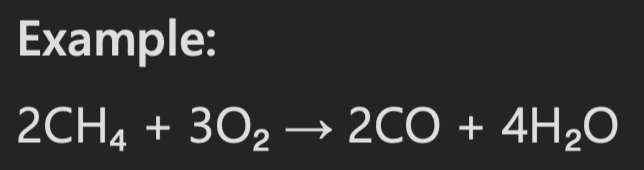
State two limitations of using radical substitution in organic synthesis
- further substitution/s
- substitution at different positions along chain
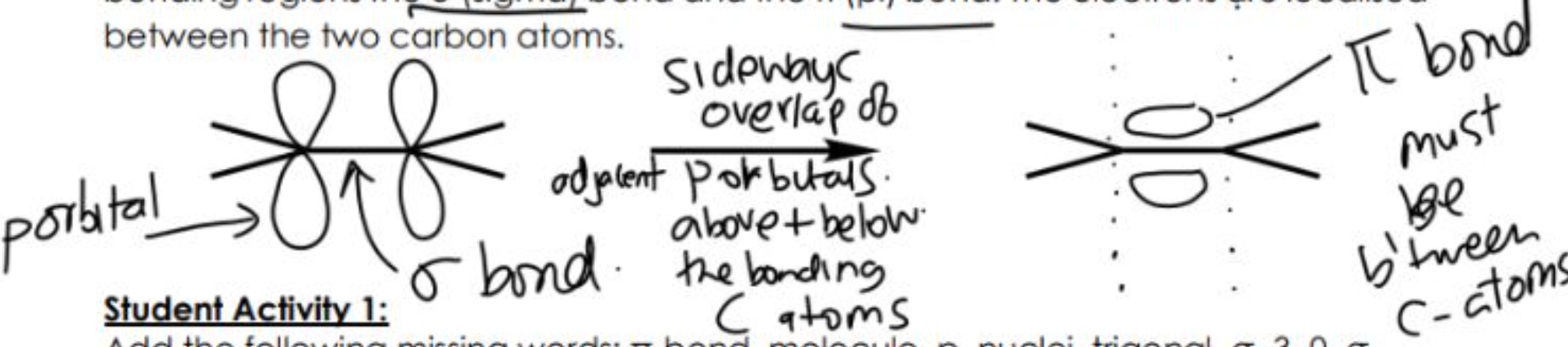
σ bond definiton
direct overlap of p-orbitals
π bond definiton
Sideways overlap of p-orbitals
What bonds make up a C=C double bond in alkenes?
A double bond consists of one σ bond (direct overlap of p-orbitals) and one π bond (sideways overlap of p-orbitals above and below the carbon atoms).
What are aromatic compounds?
compounds containing benzene rings
What is the name of the mechanism when a H atom in an alkane is substituted by a halogen atom?
radical substitution
What are the conditions required for radical substitution?
UV light
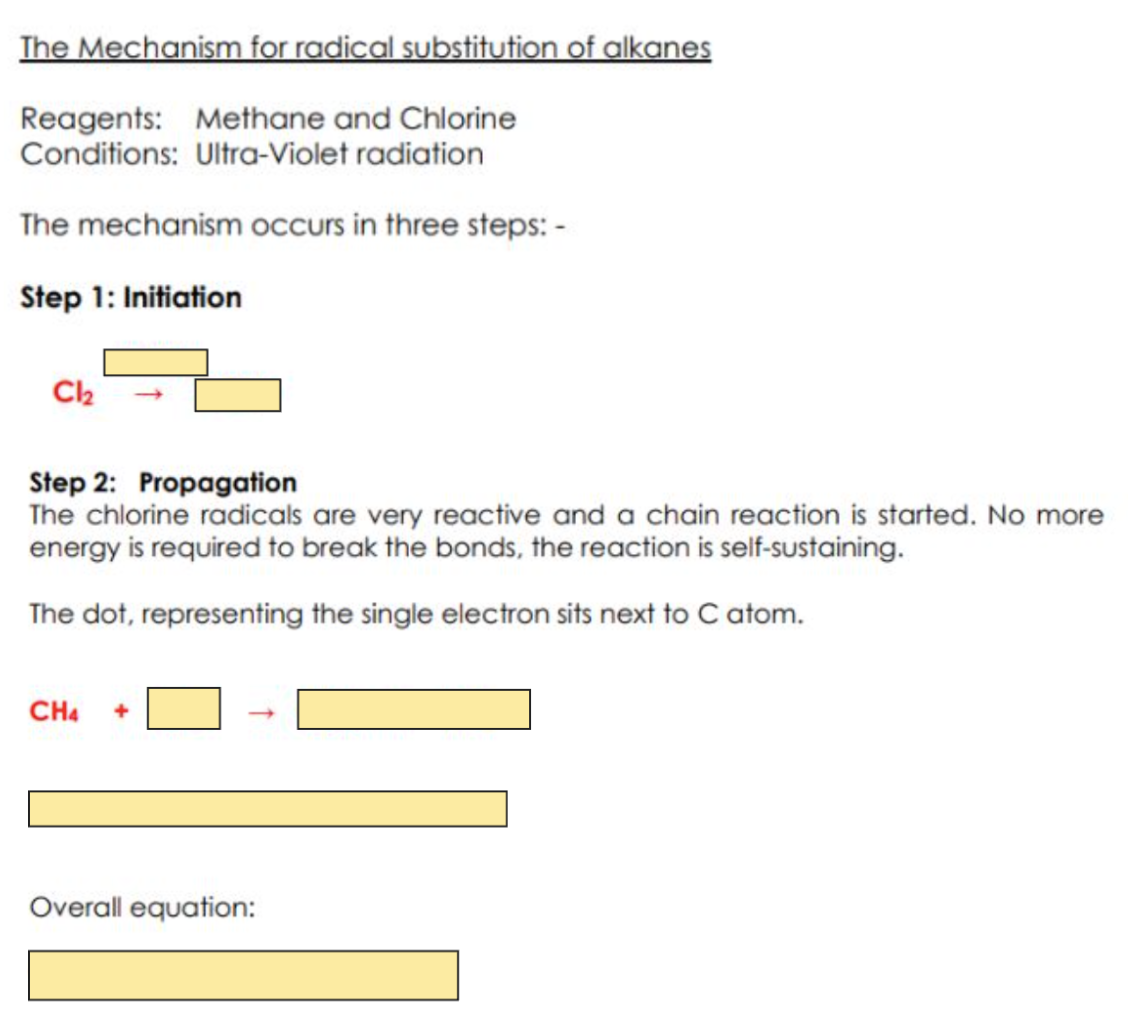

What is termination?
when two radical combine, e.g.

Which property explains the low reactivity of alkanes?
high C-C bond enthalpy
Solution to incomplete combustion?
supplying more oxygen for complete combustion to occur
What are the disadvantages of processing waste polymers?
Combustion produces toxic products e.g. CO2 and HCl
CO is formed as a result of incomplete combustion
What are the sustainability benefits for processing waste polymers?
combustion for energy production
removes toxic waste products (e.g. HCl)
Why are biodegradable and photodegradable polymers better for the environment?
They reduce plastic waste and use fewer finite resources.
What is the purpose of addition polymerisation?
To convert alkenes into saturated polymer chains with no C=C double bonds.
What is the major product formed from?
the most stable carbocation intermediate


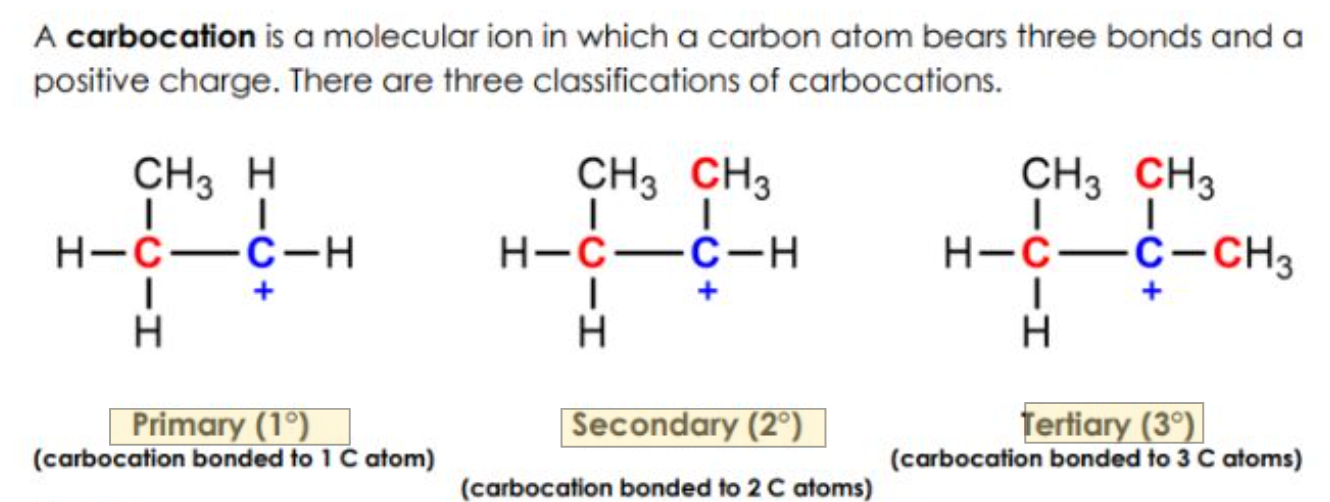
What type of curly arrow mechanism occurs here?

What type of reaction is this?

How does the reactivity of hydrogen halides change from HF to HI and why?
reactivity increases
because bond strength decreases
What are the reagents and conditions required for hydration?
steam
phosphoric acid H₃PO₄ catalyst
Alkene + H₂O (steam) → alcohol.
Alkene + H₂ → ? Conditions?
Alkane; Ni catalyst
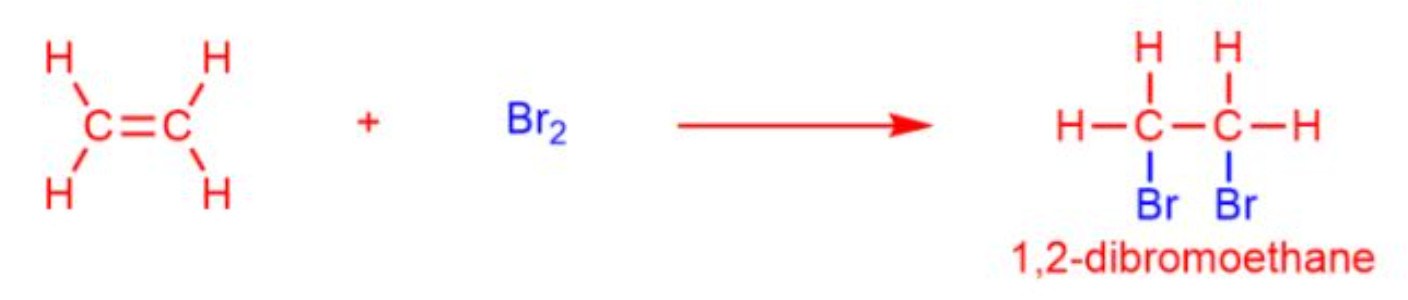
Alkene + X₂ → ? Conditions? (X=halogen)
Dihaloalkane; no catalyst
Br₂ is decolourised, so it tests for unsaturation.
Alkene + HX → ? Conditions? (X=halide)
Haloalkane; no catalyst

How to test for alkenes?
Bromine water turns colourless if alkene is present
electrophile
an electron pair acceptor
What are the 5 ways alkenes can react? (do not necessarily need to remember)
Electrophilic addition:
Halogenation
Addition of hydrogen halides
Hydration
Addition reactions but not usually classified as electrophilic addition:
Hydrogenation (catalytic addition of H₂)
Addition polymerisation
Explain why pent-2-ene has stereoisomerism?
restricted rotation around the C=C
2 different groups on each C of the C=C
How to know if a group is the priority group for E/Z isomerism
the higher the atomic number, the higher the priority (go along the attached group)
Define stereoisomerism
same structural formula
different arrangement of atoms in space
What is a pi bond comprised of?
a sigma bond and a pi bond
Draw the structure and bonding for alkenes
When is cis-trans isomerism a special case of E/Z isomerism?
When each carbon in the C=C bond has the same group attached, allowing cis and trans forms to exist.
How do you deduce the repeat unit from an alkene monomer?
Remove the C=C bond and place the structure in brackets with continuation bonds.
How do you identify the monomer from an addition polymer?
Take the repeat unit and add a C=C bond between the two carbon atoms in the polymer chain.
What is formed when you heat a secondary alcohol under reflux in the presence of acidified dichromate?
ketone and water
How many times do you need to oxidise a primary alcohol to a carboxylic acid when heated under reflux and in the presence of acidified dichromate ions?
2
Primary alcohol → aldehyde (first oxidation)
Aldehyde → carboxylic acid (second oxidation)
In tertiary alcohols, does any oxidation occur?
no
What would you form if you oxidised a primary alcohol with conditions of heat under reflux and in the presence of acidified dichromate?
carboxylic acid and water
What would you form if you oxidise an aldehyde under conditions of heat under reflux and with acidified dichromate?
carboxylic acid (not + water)
What alcohol can be oxidised if you heat under distillation with presence of acidified dichromate ions?
primary alcohols only
What colour are chromium ions?
green
What colour are dichromate ions?
orange
Draw a distillation apparatus

Draw a reflux apparatus

What are the reagents and conditions for substitution reactions for alcohols?
heated under reflux
in presence of halide compound e.g.(NaCl) and dilute sulfuric acid

What are the reagents and conditions for dehydration?
concentrated sulfuric acid or concentrated phosphoric acid
heat under reflux

Where are the H and OH taken from during dehydration reaction?
two adjacent carbon atoms
What are the 4 reactions of alcohols that we need to learn? (do not necessarily need to remember)
combustion
dehydration/elimination
substitution
oxidation
What happens to the solubility of alcohols as the hydrocarbon chain increases in size?
Solubility decreases because the non-polar hydrocarbon chain becomes larger, so the molecule is less able to interact with water.
Do alcohols tend to be soluble in water and if so, why?
yes, they can form hydrogen bonds with water
Volatile means
evaporates easily (changes from a liquid to a gas easily).
Why are alcohols less volatile than alkanes?
Alcohols form hydrogen bonds between molecules, so more energy is needed to separate the molecules, making them less volatile.
What type of bond breaking occurs to form radicals?
homolytic fission
Where is the ozone layer found?
upper atmosphere
Write the equation showing nitric oxide radical catalysing the decomposition of the ozon layer and the overall equation for the reaction

Write the equations showing chlorine radicals catalysing the decomposition of the ozone layer and show the overall equation

What happens when CF2Cl2 absorbs UV light?
radicals form

nucleophile
an electron pair donor
Benefits of CFCs?
Non-toxic, non-flammable and unreactive.
Why are CFCs bad?
They cause ozone depletion (thinning of the ozone layer).
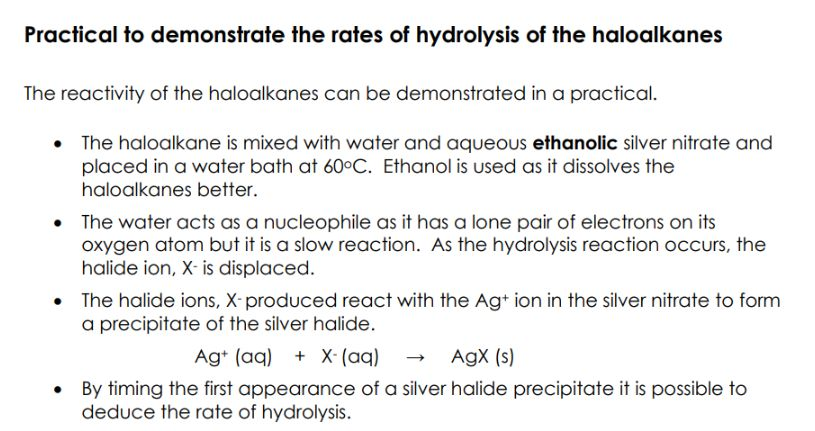
purpose of heating in a water bath at 60 degrees?
purpose for water?
purpose of silver nitrate?
purpose of ethanol?
increases rate of reaction
acts as a nucleophile
produces a precipitate of silver halide to determine which halide is present
a better solvent for the haloalkane


How does the reactivity of halogenoalkanes change from C–F to C–I?
From C–F → C–I, bond enthalpy decreases (bonds get weaker), so it becomes easier to break the C–X bond and lose the halide ion. Therefore, halogenoalkanes become more reactive.
How are amine groups produced through haloalkanes?
Haloalkane reacts with excess ethanolic ammonia to produce the amine

How are nitriles formed with nucleophilic substitution?
haloalkane reacts with an ethanolic solution of potassium cyanide (KCN)
nucleophilic substitution of cyanide ion (CN-) replaces the halo group
What are the reagents and conditions for this nucleophilic substitution?
aqueous NaOH
warm (or reflux)

Draw the mechanism for the reaction of bromoethane with OH-

Define the term electronegativity
the ability of an atom to attract an electron pair within a covalent bond
The intermolecular forces between a haloalkanes and water would be
a) Hydrogen bonding
b) permanent dipole-dipole
c) induced dipole-dipole
permanent dipole-dipole (and iddi technically)
Are haloalkanes often soluble in water? Explain answer.
no because they cannot form hydrogen bonds with water