AP Chem Unit 2: Ionic and Covalent Structures and Properties
 Call Kai
 Learn
 Practice Test
 Spaced Repetition
 Match
 Flashcards
 Knowt Play
1/41

There's no tags or description
Looks like no tags are added yet.
42 Terms
ionic bonds
very strong, a lot of energy is required to melt the solids, very endothermic
+ΔH lattice
energy absorbed to break the lattice, endothermic
-ΔH lattice
energy released when the lattice is formed, exothermic
stronger Foa and melting point
a stronger Foa = more energy needed to break it = HIGHER MELTING POINT
atomic radius and melting point
smaller atomic radius = larger Foa = higher melting point (LiF is higher over LiI)
distance and melting points
the smaller distance between the nuclei = stronger Foa = higher melting point
the larger the gap between two nuclei and their electrons…
the greater the potential energy
bond energy
the energy released during the formation of a bond (= energy necessary to break a bond)

atomic radius and bond energy
lower Foa = atomic radius increases = bond length increases = bond energy decreases = easier to break
bond length and bond energy are…
inversely proportional
number of bonds and bond energy
when number of bonds increases (single, double, triple), bond length decreases, and bond energy increases
definition of ionic bonds
cations and anions form electrostatic bonds based on opposite charges
properties of ionic bonds
very strong Foa
high melting points
hard
high vaporization points (low volatility)
strength is about ratio (Na6N2 = very strong)
properties of ionic solids
cleave along planes
ions line up in a repetitive pattern to maximize attractive forces and minimize repulsion
not malleable or ductile
conduct electricity in a solvent (high concentration = high electricity)
crystalline solids
ionic compounds do not exist as individual units, unit cells = simplest part of a structure that has all the properties of that crystal

covalent bonds
one non-metal atom shares one or more pairs of electrons with another non metal atom to form a compound
properties of covalent compounds
lower melting and boiling points than ionic
soft and flexible
do not conduct electricity when dissolved in water (acids are an exception)
molecules
two or more non metals bonded to form a compound
metallic solids
bonding from the attractions between nuclei and delocalized valence electrons moving throughout the structure (bond strength increases as number of electrons increases)
electron sea model
nuclei and inner core electrons are localized and valence electrons are free to move throughout the solid

properties of metallic bonds
conduct electricity
conduct heat
malleable and ductile
lacks directional bonds
alloy
a solid solution composed of two or more metals, or one or more metals and one or more non metals
interstitial alloy
atoms with a small radius occupies the spaces between atoms with a larger radius (ex. steel = Fe + C)

substitutional alloy
the radii of the solute and solvent atoms are similar (ex. brass - Zn + Cu)
properties of steel
more rigid, less malleable, and less ductile than pure iron, and steel has a higher density than pure iron
polyatomic ions
combination of non metals other metals and non metals bonded to form a polyatomic ion (nonpolar covalent or non polar covalent)
electronegativity
element’s ability to attract bonding electrons toward itself in a chemical bond
electronegativity number line
non polar covalent - 0.5 and under, polar covalent -1.9 and under (after 0.5), ionic bond 3.5 and under (after 1.9), but PHYSICAL PROPERTIES GET PRIORITY
polar covalent bonds
the atom with a higher electronegativity gets a partial negative (partial positive charges increase as electronegativity differences decrease)
expanded octet
non metals with empty d sub shells in periods 3 or higher can have more than 8 e-
electron deficient atoms
Boron and Aluminum: protons can’t attract more than 6 e-, always in the middle
formal charge
used to calculate the most likely lewis structure, the most EN element should have the negative charge (±2 is BAD), oxygen = use formal charge
calculating formal charge
valence electrons - # or dots/bonds (1 BOND is 1 E- ASSIGNED TO THE ATOM), if ion, all charges would add up to the ionic charge
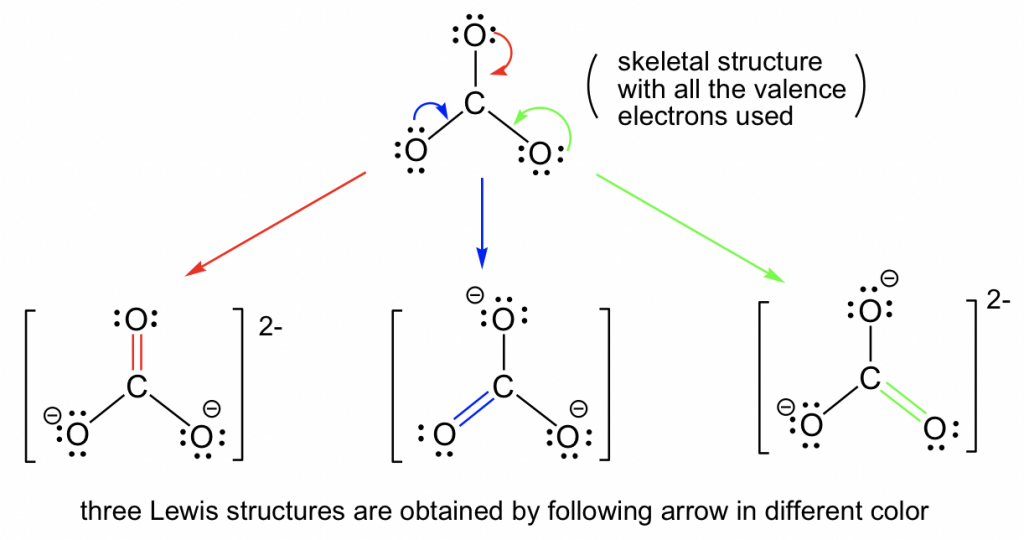
resonance structures
bonds are always moving if the bonds are identical (1.33 bonds in the example)
odd numbers of valence electrons
the octet rule fails when there are odd numbers of valence electrons
hybrid orbitals
atomic orbitals around the central atom in a molecule must hybridize in order for bonding to occur
2 c.c. hybridization
sp, 180 degrees
3 c.c.
sp2, 120 dgrees
4 c.c.
sp3, 109.5 degrees
sigma bonds
hybridized bonds, first between two atoms, stronger than pi bonds, can’t move
pi bonds
bond(s) after the sigma bond, delocalized
bond polarity
have a slightly negative and a slightly positive end (MUST have bond polarity AND asymmetry)