CP2
 Call Kai
 Learn
 Practice Test
 Spaced Repetition
 Match
 Flashcards
 Knowt Play
1/27

There's no tags or description
Looks like no tags are added yet.
28 Terms
What does “Euler’s relation” refer to ?
ei theta = cos theta + i sin theta
What is Euler’s Identity?
ei theta +1 = 0
What is De Moivre’s theorem?
( r (cos theta + i sin theta))n = rn (cos(n theta)+ i sin(n theta))
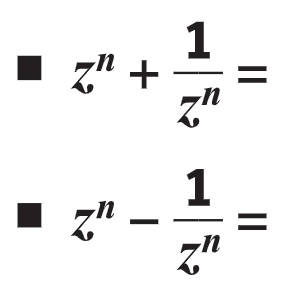
Complete these


Where would the 2i sin(n theta) trig identity show up / be helpful in this question?
The denominator will be of the form e(pi i / n) - 1
If we multiply top and bottom by e( - pi i / 2n) the denominator will be of the form epi i / 2n - e - pi i / 2n
Which is the same as 2 i sin ( pi / 2n )
What is -1 / i
i

Will i appear in Q ? Why / Why not?
Q is essentially the coefficient of the imaginary part
therefore DO NOT include i
Is this the general form for the nth roots of unity?
No
It is only 1 root
The power should be 2 k pi i / n

What is the sum of the n roots of unity? Why?
0
Adding complex number is like adding vectors.
The vectors are equally spaced so cancel each other out.
When we sum them, the imaginary parts all cancel (conjugate pairs) and the real parts will also lead us to 0
If we have one root of a complex number, e.g. z1 , how do we find the remaining roots of zn ?

The nth roots of a complex number form the vertices of a regular n-gon centered where?
The origin
When is the Maclaurin series expansion invalid?
If at least one of the derivatives at x=0 is undefined.
If the series does not converge to the true value of the function
What can you use to signify an alternating sequence?
(-1)n
True or False? You must use radians for the trig Maclaurin series expansions
True!
In terms of Improper integrals, what does convergent refer to and mean in context?
The limit of the integral,
The improper integral exists
An improper integral exists if the limit converges, and does not exist if the limit diverges.
In terms of the function, what determines if the area converges/ diverges?
The rate at which the function grows near the boundary
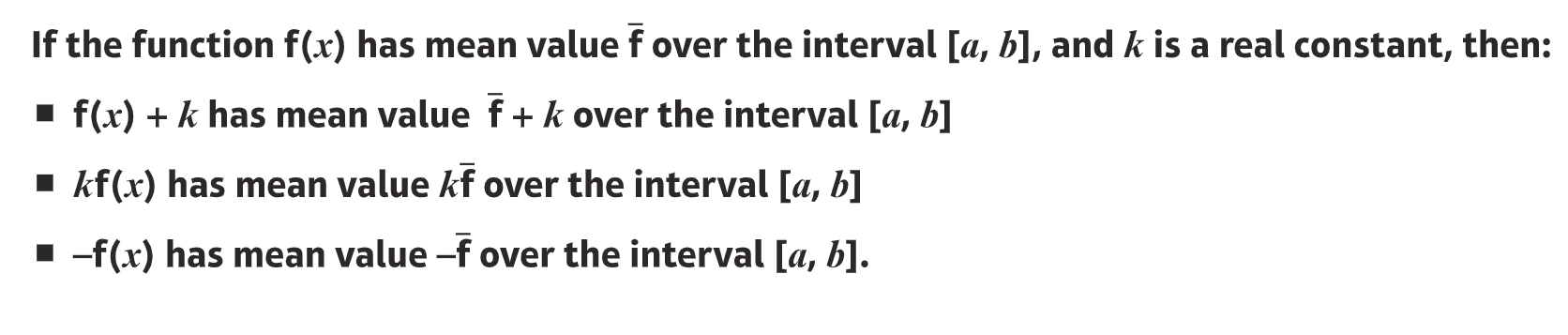
How does the mean value of the function change if we:
add some constant to the function
Multiply the function by some constant
Reflect the function in the x-axis
What do the inverse trig graphs look like and why would this be relevant in the methods in calculus topic?
The domain and range is important for integrating and differentiating the inverse trig functions


What did you forget on this question?
You need to mention that arc cos x has a range of 0 to pi
and sin is positive in this interval
hence we have the positive square root

When we let x = a sin u in this question, what is the implication for the range of u?
Why is this important?
-pi/2 < u < pi/2
When we get to sqr cos2 u we know to take cos u to be positive because cos is positive over the given domain
Give THREE examples of odd functions and TWO examples of even functions
EVEN: cos, cosh
ODD: sin, sinh, tan
What is the name of the rule used to find hyperbolic identities from trig identities?
What is this rule?
Osborn’s rule
Change cos to cosh and sin to sinh,
If there is a explicit or implicit product of two sinh then change the sign
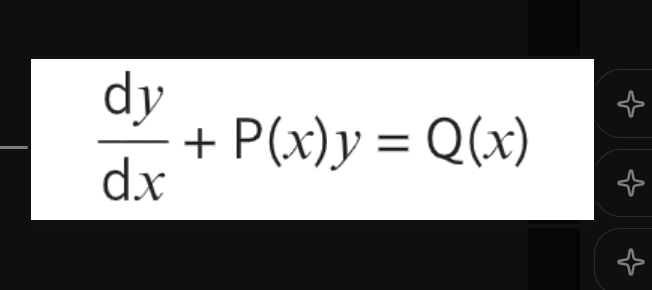
What form does the differential equation have to be in before you find the integrating factor?

What does a “linear first order differential” look like?
What does a “Linear homogeneous second-order differential equation” look like?
How does a non-homogeneous differ?
With a non-homogenous the RHS is not 0

How do you solve a Linear homogeneous second-order differential equation ?
Rearrange the differential equation so that you can
Solve auxiliary equation
which determines the general solution
What is the general solution if the roots of the auxiliary equation are imaginary?


What are the particular integrals if the general solution is of these forms
