Lecture 19 - Electroanalytical Continued
 Call Kai
 Learn
 Practice Test
 Spaced Repetition
 Match
 Flashcards
 Knowt Play
1/15

There's no tags or description
Looks like no tags are added yet.
16 Terms
Nernst Equation
connects thermodynamics, chemical equilibrium, and electrochemical measurements
Unit→ V (Volts)
the potential of an electrochemical cell is related to the activities of the reactants and products of the cell reaction
approximation: actovoty equal to molar concentration [X] with activity coefficient, Approachinh unity: a(x) = γ(x) [X]
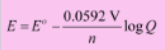
Derivation of the Nernst Equation

Electrode Potentials
no method can determine the absolute potential of a single electrode because voltage measurements always measure potential difference
relative half-cell potentials are always measured against a common reference electrode
Standard Hydrogen Electride
uses the oxidation fo hydrogen gas (reduction of hydrogen ions)
Platinized platinum electrode pH2= 1 atm, aH+ = 1
pH sensitive electrochemical cell
standard reduction potentials are relative to this electrode

Magnitude of Current in electroanalytical chemistry
performed in the absence of appreciable current, as all other methods involve electrical currents and current measurements
When the current is small, all you have to worry about is Ohms law: V= IR(Volts - amperes* ohms)
When the current is large, you have to worry about ohmic resistance, polarization, charge transfer, reactiion, diffusion, and crystallization
Ohmic Resistance (IR Drop)
ion movement through the solution encounters resistance, which requires energy to overcome
this dissipative loss causes the actual potential of a galvanic cell to be lower than the potential predicted by the nernst equation

How is polarization a non-ideal effect in a cell
ideally, you want non-polarized electrodes due to internal resistance of the cell
electrolytic cell → higher potential required to achieve a given current
galvanic cell → lower potential produced at a given current

Ideal polarized and non-polarized electrodes
you ideally want a linear relationship, but because of polarization effects, it’s usually not
Idealy polarized/non-polarized electrodes:
ideally polarized electrodes: current independent of potential
ideally non-polarized electrode: potential independent of current
Where does polarization occure (rate limiting steps)
mass transfer
slow conversion between species
adsorption, desorption, crystallization
electron transfer
Overpotential
magnitude of the polarization in an electrolytic cell
Concentration Polarization
For redox reactions with fast electron transfer, ion concentrations at the electrode surface can be assumed to be in equilibrium and therefore follow the Nernst equation
however, Surface concentrations may differ from the concentration in the bulk solution
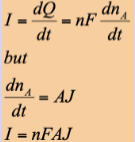
What determines mass flux
diffusion
ionic migration
convection
Conditions in diffusion limited regimes
in this region, the electrode behaves as an ideally polarized electrode

What influences Concentration Polarization
reactant concentration → polarization becoming more pronounced at lower concentrations
total electrolyte concentration → polarization becoming more pronounced at higher concentrations
mechanical agitation
electrode size
Charge Transfer Polarization
Occurs when the oxidation or reduction rate at one or both electrodes is not fast enough to yield currents by the demand of Ohm’s Law
What are the variables of charge transfer polarization
Increases with current density (current per unit area of electrode surface).
Decrease with increase in T.
Varies with composition of electrode, particularly problematic with “softer” metals such as Zn and Hg.
Is larger when gaseous products are produced, but negligible when metals are deposited.