COMM1000 M1: Studying Communication as a Science
 Call Kai
 Learn
 Practice Test
 Spaced Repetition
 Match
 Flashcards
 Knowt Play
1/5

There's no tags or description
Looks like no tags are added yet.
6 Terms
Communication is a _______ science
Social (Political science, sociology, anthropology, etc.)
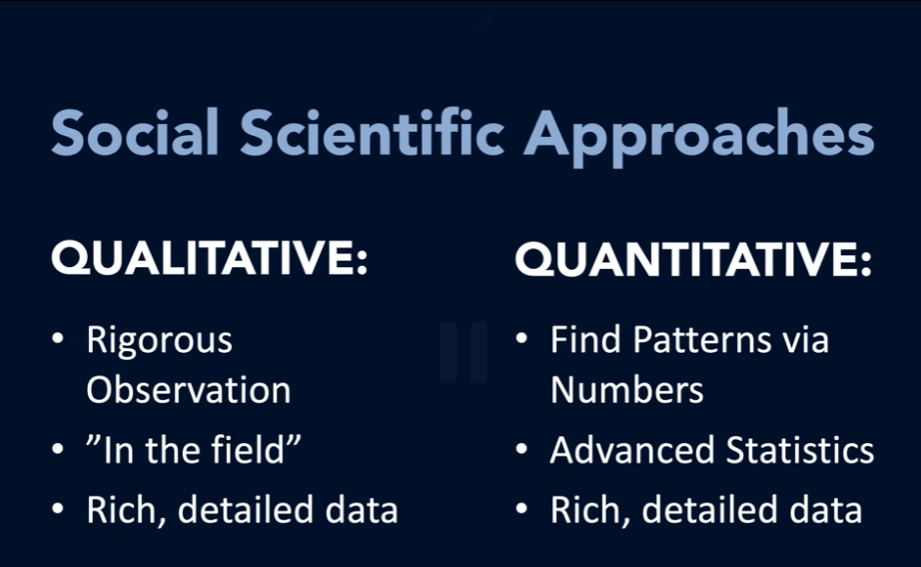
2 types of social scientific approaches
Qualitative
Rigorous observation
“In the field”
Less participants
Rich, detailed data
Quantitative
Patterns through numbers
Advanced Statistics
More participants
Rich, detailed data
Scientific Method
Empirical (objective) process to explore observations, test ideas, and answer questions
Ask question
Hypothesize
Refine hypothesis
Design & conduct observation, measurement, or experiment
Analyze & interpret data
Increasing data and patterns
3 types of research design
Content Analysis = patterns or statistics in specific content
Ex. Violence in video games → study amount of violence in each game of specific franchise
Survey = self reports → examine what people do/think
Relationship b/w variables
Ex. How often do you ________?
Experiment = manipulation of variables to observe response
Ex. Move classroom to VR format + control → which group learns better
Feels artificial
Heisenberg’s Uncertainty Principle
All measurement contains error = No type of measurement is perfect

2 ways to analyze error
Reliability = Precision = consistency of measurement
Validity = Accuracy of measurement