Bio 1101 Evolution
 Call Kai
 Learn
 Practice Test
 Spaced Repetition
 Match
 Flashcards
 Knowt Play
1/78

There's no tags or description
Looks like no tags are added yet.
79 Terms
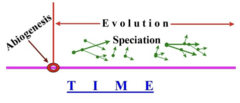
What three distinct subjects are often grouped under evolutionary biology?
Abiogenesis, evolution, and speciation.
Why is biological evolution different from everyday uses of the word evolution?
It concerns changes in living populations, not any kind of change.
What is the difference between abiogenesis and evolution?
Abiogenesis concerns life's origin; evolution concerns change after life exists.
What is speciation?
The formation of new species from existing populations.
In what sequence are abiogenesis, evolution, and speciation placed over time?
Origin (Abiogenesis) of life first; evolving lineages later; branching can produce new species.
What does abiogenesis seek to explain?
How life first arose from nonliving matter.
About how old is Earth?
4.6 billion years.
About how old are the oldest rocks containing evidence of life?
3.5 billion years.
Is there one fully established explanation for abiogenesis?
No; several hypotheses have been proposed.
How long ago did versions of evolutionary thinking exist before Darwin?
Around 2,500 years, among Greek philosophers.
What did the Greek philosophers says about evolution?
Had very simple and primitive explanations - around 500 BCE
Who proposed inheritance of acquired characteristics?
Lamarck.
What did Thomas Malthus emphasize about populations?
Populations can grow rapidly and outstrip available resources.
How did Malthus's population ideas help explain natural selection?
More individuals are produced than resources can support, creating competition.
What does spontaneous generation claim?
Fully formed organisms can arise directly from nonliving material.
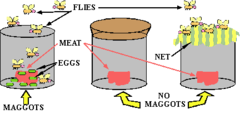
Who performed the swan-neck flask experiments against spontaneous generation?
Louis Pasteur.
What principle did Pasteur support?
Living cells come from preexisting cells.
What did Pasteur's results argue against?
Spontaneous generation of microorganisms.
What was Lamarck's inheritance of acquired characters hypothesis?
Traits acquired during life could be passed to offspring.
What classic animal example illustrates Lamarck's idea?
Giraffes stretching their necks and passing longer necks to offspring.
Why does an athlete's training not illustrate genetic inheritance?
Acquired strength or skill does not alter DNA in offspring.
What book did Lamarck publish in 1809?
Philosophie Zoologique.
Which part of Lamarck's proposed mechanism is rejected?
Routine inheritance of acquired physical changes or learned skills.
What is natural selection?
Differential survival and reproduction of heritable variants.
The mechanism that drives evolution!
Which two scientists independently developed natural selection?
Darwin and Wallace.
Was Darwin the first person ever to suggest that organisms change over time?
No; there were earlier different proposed forms of evolutionary change.
How were Darwin's and Wallace's contributions related?
They independently arrived at the same basic natural-selection mechanism.
In what year were Darwin's and Wallace's ideas on natural selection jointly presented?
1858.
Which scientist published a major book detailing natural selection in 1859?
Charles Darwin.
Which islands were important to Darwin's observations?
The Galápagos Islands.
What famous book did Darwin publish in 1859?
On the Origin of Species.
Did Darwin understand chromosomes or the molecular basis of inheritance?
No
What important idea about offspring could Darwin infer despite lacking genetics?
Traits are transmitted from parents to offspring.
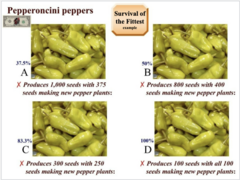
Which pepperoncini plant produced the most seeds? Which had the highest percentage of seeds grow into new plants? Which had the highest evolutionary fitness, and why?
A produced the most seeds: 1,000.
D had the highest seed survival percentage: 100% (100 out of 100).
B had the highest evolutionary fitness: It produced the most surviving offspring, with 400 new plants.
What does evolutionary fitness measure?
Reproductive success: contribution of surviving offspring to future generations.
Is simply surviving enough to have high evolutionary fitness?
No; reproduction matters.
A spider lives a long time but never reproduces. What is its fitness?
Zero reproductive fitness.
A spider barely survives but leaves many surviving offspring. Is it fit?
Yes it has high evolutionary fitness.
In natural selection, what does "survival of the fittest" actually emphasize?
Survival AND successful reproduction in a given environment.
What must be present in a population for natural selection to act?
Heritable variation among individuals.
Why do members of a population differ genetically?
They carry different combinations of alleles.
Why is overproduction of offspring important for natural selection?
More offspring are produced than can survive - competition!
What creates a struggle for survival in nature?
Limited resources, predators, and other environmental pressures.
Which individuals are most likely to pass their alleles to the next generation?
Those whose inherited traits help them survive and reproduce.
What happens to beneficial heritable traits over generations?
They tend to become more common in the population.
What does "selected against" mean?
A variant has lower reproductive success in that environment.
Does natural selection change individuals or allele frequencies across generations?
It changes allele frequencies across generations in populations.
What is artificial selection?
Humans control breeding to favor desired traits.

How does artificial selection differ from natural selection?
Humans choose breeders instead of environmental conditions determining reproductive success.
Why breed two Pomeranians to maintain a purebred Pomeranian line?
To preferentially retain traits characteristic of that breed.
What requirement do artificial and natural selection share?
Heritable variation that can be passed to offspring.
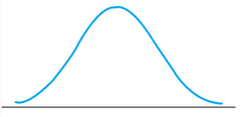
What does a normal distribution tell you about variation in a trait? How could natural selection change it?
Most have intermediate traits, fewer have extreme traits. If more individuals at one end leave more offspring, the distribution can shift over generations.
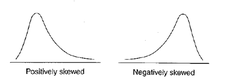
What makes a distribution skewed, and how can directional selection change a trait distribution over time?
A longer tail on one side, more offspring are left and, that end becomes more common over generations.
What do the two peaks in a bimodal distribution tell you, and how could natural selection change their relative heights?
Two ranges of trait values are common, with fewer individuals in between. If individuals near one peak leave more offspring and the trait is inherited, that peak can grow relative to the other over generations.

If most individuals lie near one extreme of a trait range, what shape may the distribution have?
A skewed distribution.

What is directional selection?
Selection consistently favors one end of a trait range, shifting population frequencies.

What happens to a trait distribution under directional selection?
Its peak shifts toward the favored extreme.
How can human activity create strong directional selection?
Antibiotics or pesticides kill susceptible individuals, favoring resistant ones.
Does a change in allele frequencies count as evolution?
Yes
This is evolutions most basic defintion!
Why can an insect population become resistant after pesticide exposure?
Individuals with resistance traits survive and reproduce disproportionately.
What happens to susceptible insects after effective pesticide application?
Many die, leaving a more resistant set of survivors.
What happens to resistance-allele frequency after repeated selection?
It tends to increase.
What is species immutability
Species stay the same over generations
What was the central question of the fruit fly selection experiment?
Can fruit flies evolve greater resistance to starvation?
What organism was used to test rapid evolutionary responses to starvation?
Fruit flies.
What was the approximate initial average starvation survival in the fruit fly experiment?
20 hours.
What intermediate average starvation survival was observed?
About 23 hours.
What starvation survival time evolved after repeated selection?
160 hours.
How many days is 160 hours?
About 6.7 days.
How did the starvation-survival distribution change during selection?
It shifted to longer survival times.

How did the fruit fly starvation experiment test whether a population could evolve greater starvation resistance? Describe the setup, how the researchers chose which flies would breed, and what changed over generations.
5,000 fruit flies survived 20 hours without food. When 80% of flies died, food was restored and eggs laid by the surviving 20% started the next gen. This was repeated over generations until survival without food rose to 160 hours

What does the fruit fly experiment directly demonstrate?
Strong selection can cause substantial evolution in a population.
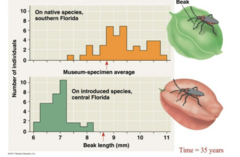
What insect was studied for beak evolution in Florida?
The soapberry bug

Which native fruit did Florida soapberry bugs originally use?
Which introduced fruit did some soapberry bugs begin using?
Balloon vine fruit. - Large and inflated
Golden rain tree fruit. - Small and non-inflated
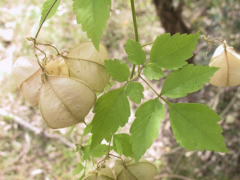
How does golden rain tree fruit differ from native balloon vine fruit?
It is smaller, angled, and not inflated.
Why can soapberry bug beak length evolve?
Beak length is heritable and affects use of different fruits.
How do soapberry bug beak lengths differ on native versus introduced fruits?
Native balloon vine populations generally have longer beaks; introduced fruit populations have shorter beaks.
What caused shorter beaks to be favored on the introduced fruit?
Its smaller, flatter fruit structure.
What is the key evolutionary conclusion from soapberry bugs after about 35 years?
A heritable trait shifted rapidly in response to a new environment.