Module 4 Imperfections in Solids and Diffusion
 Call Kai
 Learn
Learn Practice Test
 Spaced Repetition
 Match
Match Flashcards
 Knowt Play
1/26

There's no tags or description
Looks like no tags are added yet.
Name | Mastery | Learn | Test | Matching | Spaced | Call with Kai | Chat |
|---|
No analytics yet
Send a link to your students to track their progress
27 Terms
Types of Imperfections
Defined in terms of dimensionality: 0D, 1D, 2D
0D point defects
1D line defects
2D interfacial defects
Point defects - 0D
Vacancies
interstitials
Substitutions

Line Defects - 1D
Dislocations
Interfacial Defects - 2D
Grain boundaries
How do you determine the number of Vacancies?
Nv/N = exp(-Qv/kT)
Nv_ Number of vacancies
N_ Number of tot. lattice sites
Qv_ activation energy
k_ Boltzmann’s constant
T_ temperature
*Each lattice site is a potential vacancy *
How is the activation energy determined?
Experimentally
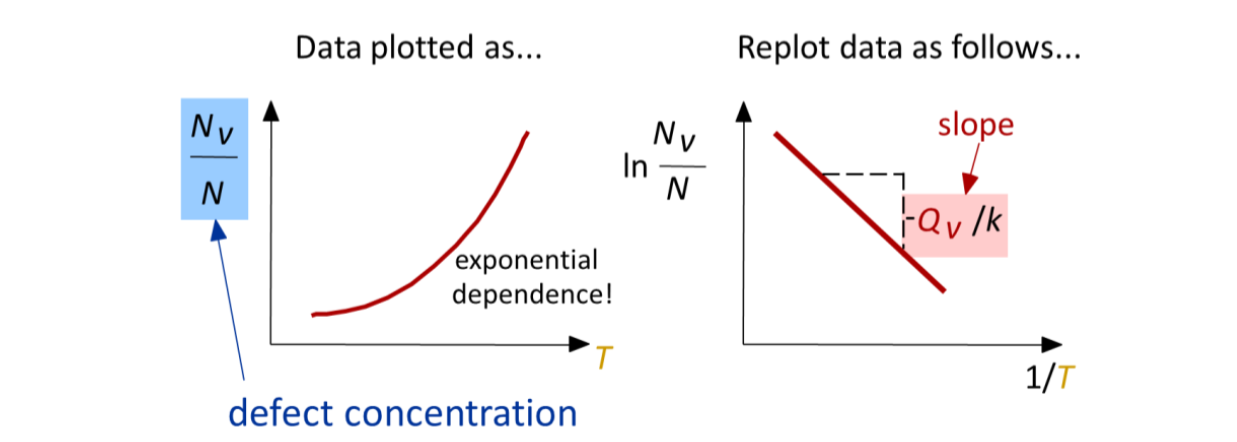
As temperature increases…
So does the number of vacancies withing the lattice
Dislocations
1D defects where atoms are misaligned
Move when stresses are applied
Can be permanent (plastic results from dislocation motion)
Burger’s Vector (b)
Used as a measure of distortion in the lattice
Edge Dislocation
Extra half- plane of atoms inserted into a crystalline structure
b is perpendicular to the dislocation line

Screw Dislocation
Spiral planar ramp resulting from shear deformation
b is parallel to the dislocation line

Mixed dislocation
A dislocation with both edge and screw components
Twin Boundaries
2D Planar defect
Mirror reflections of atom positions of one side
of twin plane to the other side

Stacking Faults
2D Planar defect
Occur when there is an error in the planar
stacking sequence
Grain Boundaries
2D Planar defect
Misalignments between (single crystal) regions / grains.
Critical for ceramics and many metals, the defects promote:
High mobility
High chemical reactivity
Dopants
Purposeful impurity that turns glass into different colors.
Impurities in metals
Substitutional Solid Solution
Interstitial Solid solution
Solid solution plus particles of a new phase
What makes the second phase in a material unique?
Different composition
Different structure
Hume - Rothery Rules (for formation of solid solutions
Δr (atomic radius) < 15%
Similar electronegativities (close on periodic table)
Same crystal structure for pure metals
Valences: a metal will have a greater tendency to dissolve a metal with a higher valence
Hume Rothery Suggestions Example
Would you predict more Al or Ag to dissolve in Zn?

Solution solubility Example
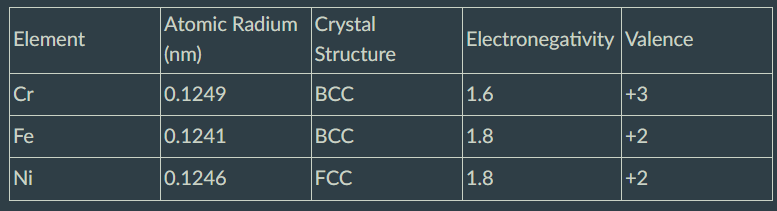
Given the following information, what can you predict about the solubility of Cr and Fe in nickel?
Diffusion
Atoms tend to migrate from regions of high concentration to regions of low
concentration
*Nature abhors a gradient *
Self Diffusion
Migration of host atoms in pure metals
Vacancy Diffusion
Atoms and vacancies exchange positions
applies to host and substitutional impurity atom
What does vacancy diffusion rates depend on?
Number of vacancies
Temperature
Activation energy
Interstitial Diffusion
Small interstitial atoms move from one position to an adjacent one
Faster than vacancy diffusion b/c there’s always an opening
Diffusion coefficient
D = D0exp(-Qd / RT)
