Lab Study Guide (copy)
 Call Kai
 Learn
 Practice Test
 Spaced Repetition
 Match
 Flashcards
 Knowt Play
1/73

There's no tags or description
Looks like no tags are added yet.
74 Terms
2CoCl2*6H2O + 2NH4Cl + 8NH3 + H2O2 → 2[Co(NH3)5Cl]Cl2 + 14H2O
This is a redox-reduction reaction. What is being reduced?
The H2O2 is the oxidizing agent that is being reduced.
- reaction side = -1 ox state
- product side = -2 ox state
The cobalt is being oxidized from +2 to +3
2CoCl2*6H2O + 2NH4Cl + 8NH3 + H2O2 → 2[Co(NH3)5Cl]Cl2 + 14H2O
Could the redox-reduction reaction be performed in pure water with no NH3?
No, the Ecell potential is -0.07 eV. The negative cell potential implies Gibbs Free energy is positive, and the reaction is non-spontaneous.
- Ecell = Ered + Eox
2CoCl2*6H2O + 2NH4Cl + 8NH3 + H2O2 → 2[Co(NH3)5Cl]Cl2 + 14H2O
In aqueous NH3 _______.
the cell potential is positive, meaning it’s a spontaneous process
2CoCl2*6H2O + 2NH4Cl + 8NH3 + H2O2 → 2[Co(NH3)5Cl]Cl2 + 14H2O
The combination of NH4Cl and NH3 form what type of aqueous solution?
Forms a buffered solution
- What happens if it becomes too acidic? Protons will complete with Cobalt ion forming NH4Cl
- What happens if it becomes too basic? Too much OH- present → will complete with NH3 and form Co(OH)3 → high insoluble and will remove Cobalt(III) from reaction medium
For the synthesis of the [Co(NH3)5Cl]Cl2, the following reagents were added in this order: ammonia to dissolve the NH4Cl, and 30% H2O2 followed by the 12M HCl. What is the significance of this order of the reagents?
1. The NH4Cl dissolving in the 15 M NH3 creates a buffer. It ensures an optimal pH for the binding of the NH3 ligand to the cobalt ion.
2. 30% H2O2 oxidizes the cobalt ion in the coordination complex from Co2+ to Co3+. Adding the H2O2 after the binding of ammonia to the cobalt ion increases the oxidation potential, as the new complex wants to lose another electron more readily, thus allowing the oxidation of the cobalt ion to occur.
3. 12M HCl is added last, as it neutralizes any remaining excess ammonia and drives the substitution of the chloro ligand
What were the different reaction conditions for [Co(NH3)5Cl]Cl2 and their relevance to the final product?
Temperature of 80-85℃ for 25 minutes in a water bath and then was cooled to room temperature for filtration
- Due to the reaction mixture being heated, the Cl- ion is able to displace the weakly bound water molecule from the complex. This locks the chloro ligand inside the complex to form the final product.
For the synthesis of the cobalt complexes what is the role of the 30% H2O2?
Acts as an oxidizing agent to oxidize cobalt from the +2 oxidation state to the +3 oxidation state
What is the white vapor formed when the concentrated HCl is added to the reaction mixture containing ammonia?
Ammonium Chloride
For the filtration washes, why are the distilled water, ethanol, and acetone kept ice cold?
To minimize product loss due to the dissolution due to the washing steps, as [Co(NH3)5Cl]Cl2 is slightly soluble in water at room temperature.
Why is [Co(NH3)5Cl]Cl2 specifically washed with water, then ethanol, and finally acetone?
1. Ice-cold water removes water-soluble ionic impurities (like excess NH4Cl and HCl)
2. Ethanol removes residual water.
3. Acetone removes residual ethanol and evaporates very quickly under vacuum due to its high volatility, helping dry the product faster.
Point group of the cation in [Co(NH3)5Cl]Cl2 and [Co(NH3)5H2O]Cl3
C4v
What were the different reaction conditions for [Co(NH3)5H2O]Cl3 and their relevance to the final product?
- The reaction occurred at room temperature during the aspiration of the excess ammonia.
- The reaction mixture was cooled in an ice bath before and after the addition of 12M HCl.
- The complex is heat sensitive. The lower temperature ensures the water molecule remains in the coordination sphere. Cooling the reaction mixture in the ice bath reduces the heat generated by the reaction with the 12M HCl. Maintaining a lower temperature ensures the correct final product.
Differences in the Synthesis of [Co(NH3)5H2O]Cl3 compared to [Co(NH3)5Cl]Cl2?
1. Temperature is lower
2. Order of addition of HCl (added after excess NH3 is aspirated is removed from reaction mixture and cooled)
3. Quantities of reactants are slightly different
4. Water is used as a reactant
5. No aqueous washing step in the work-up
When two products are possible in a chemical reaction, one is ________.
considered kinetic and the other is thermodynamic
- The kinetic product is the one that forms the fastest, while the thermodynamic product is the more stable product.
Which complex is the thermodynamic product?
[Co(NH3)5Cl]Cl2
It withstood the heating process and is considered more stable than [Co(NH3)5H2O]Cl3
Which complex is the kinetic product?
[Co(NH3)5H2O]Cl3
It formed rapidly at room temperature without heating → has a lower energy of activation
Why was a greater amount of 12M HCl used for the synthesis of the pentaammineaquacobalt(lll) chloride compared to the pentaamminechlorocobalt(III) chloride?
- pentaammineaquacobalt(III) chloride = the charge of the inner coordination sphere is 3+. To balance out the charge, it requires three chloride counter ions. This means the reaction will consume more chloride. Highly soluble in water → requires a greater volume of 12M HCl to force the complex to precipitate out of the solution. A greater volume of HCl can also neutralize the remaining residual ammonia.
- pentaamminechlorocobalt(III) chloride = only requires two chloride counter ions to balance the charge.
For the pentaammineaquacobalt(III) chloride, why was there aqueous wash?
Highly soluble in water and would cause a significant loss of product
The limiting reagent of the cobalt complexes
CoCl2*6H2O
For the pentaammineaquacobalt(lll) chloride, why must the excess NH3 be aspirated?
- Excess NH3 may react with the HCl, forming NH4Cl and contaminating the product.
- Excess NH3 keeps the pH basic → high concentration of OH- ions → strong ligands that compete with water, leading to the formation of [Co(NH3)5(OH)]2+. This results in an unwanted product.
For the molar conductivity investigation, what was the purpose of the experimental set-up (3 test tubes and the water bath)?
two tubes containing the solution of interest were placed on clamps outside of the water bath to rinse the conductance cell with the solution before a measurement is taken → washes away any contaminants that could affect our “main sample”.
The third tube in the 25℃ water bath holds the “main sample” that the conductance will be recorded from → placed into the water bath because electrical conductivity is sensitive to temperature variations → inaccurate results. Thermally equilibrating the sample in the third tube ensures a stable and uniform temperature in the solution.
These factors are important for an accurate conductance measurement.
For the molar conductivity investigation, what was the purpose of the preparation of the cobalt complex solutions?
Samples of the cobalt complexes are diluted in a 250 mL volumetric flask to create a 0.00100M solution.
Electrical conductance relies on the movement of free ions. In the solid forms of the cobalt complexes, the ions in the coordination complex are locked and cannot move.
By dissolving the cobalt solids in a liquid solvent, the complex will dissociate into free-moving cations and anions that will migrate to the conductance probe and generate an electrical current.
Why was the conductance reading of the 0.00100M KCl recorded first and how does it connect to determining the electrolyte type of each cobalt complex?
The rinses and conductance reading of the 0.00100M KCl is performed first as the solution serves as the calibration standard. At 25℃, this solution has a specific recorded conductance value of 1.469 x 10⁻⁴ cm-1Ω-1.
With our experimental conductance value of the 0.00100M KCl solution, we can calculate the cell constant, which helps account for differences between the experimental and standard conductance. It’s also required for the molar conductivity calculations of the cobalt complexes.
Lastly, comparing the calculated molar conductivity values to the standard reference ranges allows us to identify their electrolyte type.
What does the electrolyte type of a coordination compound reveal about the n-coordinate geometry of the cobalt coordination complexes?
The electrolyte type is the ratio of cations to anions in a solution. It tells us the number of ions a compound dissociates into, which correlates to the number of ligands inside the coordination sphere and the outside counterions.
pentaamminechlorocobalt(III) chloride = a 1:2 electrolyte type. Based on this, we know that it has one cation (cobalt and ligands in square brackets) and the two chloride counterions as the anions. By counting the number of ligands within the inner coordination sphere bound to the cobalt, we can determine the n-coordination geometry. It will be 6-coordinate, which means it has an octahedral geometry.
pentaammineaquacobalt(lll) chloride = electrolyte type is 1:3, meaning it has one cation and 3 chloride counterions as the anions. The complex is also 6-coordinate, meaning that it will be octahedral.
CoCl2*6H2O = electrolyte type is 1:2 and is 6-coordinate and will be octahedral
Electrolytic solutions
Aqueous solution that involve ionic compounds → dissolve in water and conduct electricity
why molar conductivity experiment works for cobalt complexes

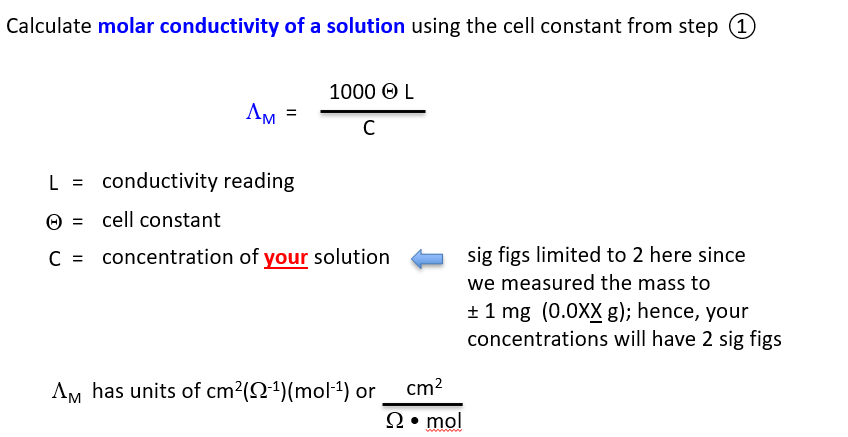
Order of Calculations for molar conductivity experiment
Record conductance values to 10-6 mho for all of the prepared solutions including the calibration standard
Using the conductance reading of the KCl solution, calculate the cell constant. (units = cm-1)
Calculate molar conductivity, AM of the solutions using the cell constant and recorded conductance of each coordination compounds
Compare the experimental molar conductivity values with the standard electrolyte type ranges.
How does molar conductivity distinguish between ions inside versus outside the coordination sphere?
Ligands bonded directly to the metal center aka inside coordination sphere do not dissociate in water and do not carry charge independently.
Counterions outside the coordination sphere dissociate completely in solution and contribute directly to the measured conductance.
For the molar conductivity experiment, why were the solutions prepared at a low concentration, 0.00100M?
Interionic attractions (ion pairing) are minimized, allowing the ions to move independently so the measured molar conductivity approaches its limiting value
For the spectrophotometric determination of cobalt, why is the preparation of the cobalt coordination compounds relevant for determining the mass percentage of cobalt?
Heating the samples on the Bunsen burner at the highest setting thermally decomposes them into several compounds, such as ammonium, nitrogen, ammonium chloride, and water (for the aqua complex).
During the process, it converts the Co3+ into Co2+. Dissolving the samples in 3M H2SO4 and diluting with distilled water in a 25 mL volumetric flask, converts the starting cobalt ions into hexaaquacobalt(II). This allows the absorbance of the solution to be measured at a single wavelength.
Using the y=mx+b equation of the standard calibration curve from the five solutions of CoSO4, we can solve for the concentrations of Co2+ in our coordination compounds. The concentration is crucial for determining the number of moles of Co2+ in each sample and eventually the mass percentage.
For the spectrophotometric determination of cobalt, why is a homogenous blue color important for our samples and how does this relate to coordination geometry?
A homogeneous color of our samples is essential as it guarantees a full thermal decomposition of the Co3+ into Co2+, which is crucial for accurate measurements in our spectrophotometric analysis.
The homogenous blue color of our samples shows a shift from an octahedral geometry to a tetrahedral geometry ([CoCl4]2-). The octahedral shape has an inversion center, and electrons cannot jump between orbitals of the same symmetry type (Laporte-forbidden). Due to this, fewer photons are absorbed, causing low light absorption. However, a tetrahedral shape lacks an inversion center allowing the molecule to absorb light more intensely, resulting in the bright blue appearance of our samples (Laporte-allowed).
For the spectrophotometric determination of cobalt, why is the wavelength set at 510 nm? What color of light is absorbed at this wavelength and how does it relate to the color of the aqueous cobalt solutions?
The wavelength is set to 510 nm, as it’s the analytical wavelength of maximum absorbance (𝜆max)for the hexaaquacobalt(II) compound, or [Co(H₂O)₆]2+ in the aqueous cobalt solutions.
At 𝜆max, the compound absorbs the most light per unit concentration and has the highest measurement sensitivity, allowing you to detect small quantities of a sample.
The color of light absorbed at this wavelength in the visible light spectrum is green. When light passes through our cobalt solutions, the complex absorbs the green wavelengths to promote d-d electronic transitions. The complementary color to green is a pinkish-red. As a result, the wavelengths that pass through unabsorbed are perceived by the human eye as a red-pink or coral solution.
For the spectrophotometric determination of cobalt, why were five standard solutions of CoSO4 prepared?
To construct a calibration curve (Beer’s Law plot) of absorbance vs concentration (absorbance on y-axis and concentration on x-axis)
Using the calibration curve, we can obtain the “A= mC+b” formula and rearrange it to [Co(II)] = abs/slope (see previous page) to solve for the Co(II) concentrations in the six cobalt samples.

Spectrophotometric determination of cobalt Calculations
Given the molar concentration of the Co2+ ion in each solution and the volume of the solution (25.00 mL), determine the moles of Co2+ present from the sample. → mole Co2+ = [Co2+] x volume (L)
Determine the grams of Co2+ present in each sample → grams of Co2+= moles of Co2+ x 58.93 g
Calculate the experimental percentage of Co2+ present in each sample → %Co2+ = (grams of Co2+ / original mass of sample in grams) * 100
For the duplicate samples, take the average of %Co2+
Calculate the theoretical yield → %Co (theor) = (molar mass Co2+ /molar mass of compound) x 100
Calculate the percent error → [(theoretical %Co2+ - experimental Avg %Co2+ / theoretical %Co2+) x 100
For the kinetics of aquation, there are ________.
two possible mechanisms for when the aqua ligand replaces the chloro ligand
Associative and Dissociative
Associative Mechanism
Sn2 like
The first step (slow) is the rate determining step
Mechanism may be unlikely because slow step is 7 coordinate → hard to get 7 ligands around the metal ion

Dissociative Mechanism
Sn1 like
Only 1 species in rate determining step
Correlate to first order with respect to the starting material

A linear straight line suggests a ________.
first order rate law: Rate = k x ([Co(NH3)5Cl]2+)

For aquation kinetics, We cannot measure the concentration of [Co(NH3)5Cl]2+ directly but we can use _________.
UV-visible spectroscopy and relate it’s concentration to it’s absorbance by Beer’s Law.
[Co(NH3)5Cl]2+ α A (where A is the absorbance).
Issue with the operating absorbance in Aquation kinetics
Both the reactant and the product absorb at the operating wavelength of 550 nm → solution: we can use the adjusted absorbance which is: At – AP, ∞ where At is the absorbance at times “t” and AP, ∞ is the Absorbance of the product at the completion of the reaction
For aquation kinetics, the term AP, ∞ can be determined by _______.
the following equation: AP, ∞ = ebC
Where “e” is the molar extinction coefficient for the absorbing species, “b” is the cell path length and “C” is the molar concentration at times infinity.
AP, ∞ = (25.4 Lmol-1cm-1) x (1.00 cm) x (~1.20 x 10⁻² M) = ~0.304
For aquation kinetics, the term AP, ∞ will be subtracted from ________.
from all of your absorbance data. The resulting absorbance in each will be proportional to the concentration of [Co(NH3)5Cl]2+ at the corresponding time.
Then, take the natural log of these values for plotting.
For aquation kinetics, the rate constant, “k” will be equal to the ________.
opposite of each slope of each straight line
Determine for all of the different reaction temperatures
Unit = min-1
Determining the activation energy for the aquation kinetics
At the conclusion of this study, we will have three coordinate pairs involving the rate constants and their corresponding temperatures.
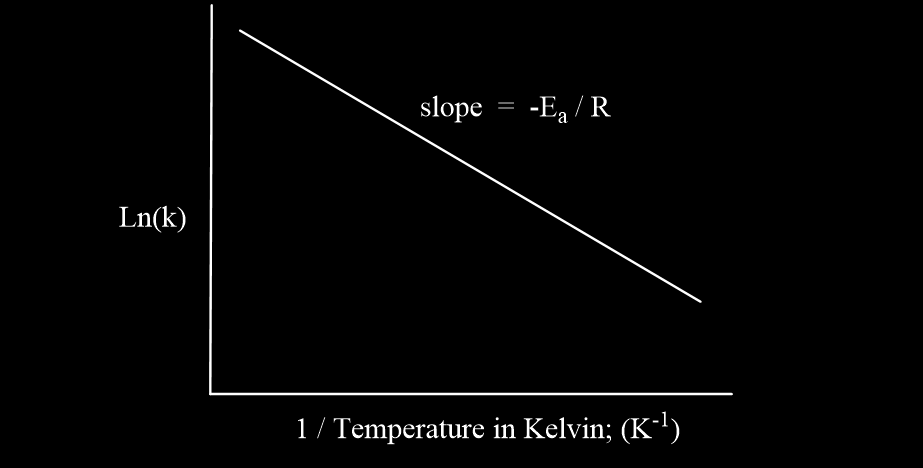
Arrhenius showed that when the Ln(rate constant) is plotted versus the 1 / (Absolute Temperature; K), a straight-line plot with a negative slope results.
Use the formula: Ea = (-) slope of Arrhenius plot (units K) x R (where R = 1.987 cal mol-1 K-1)
Units = calmol-1
To determine if the Aquation reaction acid catalyzed, we used a _______.
a distinct temperature bath in which one kinetic run was conducted in 0.1 M HNO3 and another kinetic run which was conducted in 0.3 M HNO3
To see if a higher concentration of acid accelerates the aquation reaction.
To solve for “n”, the order with respect to [H+], we compare the two different reaction conditions by taking a ratio of the two observed rate constants
Formula: Log3= (observed rate constant for 0.30M/observed rate constant of 0.10M at same temperature)
n will be unitless
For the aquation reaction, if the “n” is close to zero ______.
we can conclude that the aquation reaction is not acid catalyzed. If it is closer to one, then it should be included as part of the rate law and the reaction is acid catalyzed.
For aquation kinetics, Why must the flask with the 0.30 M or the 0.100 M HNO3 be returned to the water bath immediately after mixing with the weighed samples of the pentaamminechlorocobalt(II) chloride?
If the flask is not in the water bath, the solution will rapidly cool to room temperature. A drop in temperature will drastically slow the reaction in the first minutes.
Since kinetics calculations rely on tracking concentration changes over time, an uncontrolled drop in temperature will slow the reaction, making the calculated rate constant lower and affecting the linearity of the first-order kinetics plot.
For aquation kinetics, why was the spectrophotometer specifically set to a wavelength of 550 nm?
The starting material/product (the penta cobalt) is a deep purple, while the aquation product [Co(NH3)5(H2O)]3+ is a red-pink/fuschia color.
In a kinetic study, the ideal analytical wavelength yields the largest difference in molar absorptivity between the reactant and the product. At 550 nm, both the starting complex and the product have significantly different molar absorptivities. This guarantees that we see a visible change in absorbance as the reaction progresses.
From a practical perspective, what does it mean if the aquation reaction is acid catalyzed (closer to 1)?
The reaction rate is highly sensitive to pH. This means increasing the concentration of nitric acid will speed up the reaction and increase the observed rate constant. Minor variations in acidity will directly skew the kinetic measurements.
From a practical perspective, what does it mean if the aquation reaction is not acid catalyzed (closer to zero)?
Changing the concentration of the nitric acid will have no noticeable effect on the reaction. The calculated observed rate constants will be nearly similar for both the 0.1M and 0.3M solutions at the same temperature. In this context, nitric acid is a chemical buffer that prevents base hydrolysis.
From a practical perspective, what is the significance of the magnitude of the energy of activation?
The magnitude of the activation energy, Ea, dictates how sensitive your observed reaction rate is to temperature changes.
High Activation Energy
Means that even a slight fluctuation in your water bath temperature will drastically alter the rate constant. Maintaining a stable temperature in the water bath is crucial for accurate calculations.
Reaction will go slower
Low Activation Energy
The observed reaction rate will not drastically change at different temperatures. As a result, temperature control in the lab is less critical, as temperature fluctuations will not affect calculations.
Reaction will go faster
For the aquation of kinetics, why were different temperature water baths used for the 0.10N HNO3?
To generate individual plots of ln(At – AP, ∞) vs time (min)
This will help determine the rate constants and then generate an Arrhenius plot to solve for the activation energy. Also, to determine if the reaction is acid catalyzed from the ratio of the rate constants for 0.1M and 0.3M HNO3.
Synthesis of Hexaamminecobalt(III) Chloride
1.Mix Co, NH4Cl, in hot water
2.Add decolorizing charcoal
3.Add NH3
4. Cool mixture, then oxidize
5.Heat in water bath
6. Cool then filter (no washes)
7.Mix HCl and H2O, heat, then add filtered solid to hot acid solution
8.Filter hot mixture (no washes)
9.Add HCl to filtrate
10.Chill mixture, filter (wash)
11. Wash filtered solid:
Do NOT wash w/ ice cold water (Still discard aqueous Co waste here!!) 20 mL wash with ice cold 95% ethanol
20 mL wash with ice cold acetone
Aqua complex synthesis
1. Mix Co, NH4Cl, water
2. Add NH3
3. Oxidize <- Key step
4. Aspirate excess NH3 (use a trap, have both flasks secured to ring stand) – do
not stir while aspirating. (see image)
Note: No heating! We are using different reagents than in the chloro
synthesis!
5. Place reaction Erlenmeyer in ice bath
6. Add HCl
7. Filtration:
Do NOT wash w/ ice cold water (Still discard aqueous Co waste here!!)
4 x 5 mL wash with ice cold 95% ethanol
4 x 5 mL wash with ice cold acetone
Reaction Conditions for the hexaammine complex synthesis
Heat to 65-70 degrees Celsius for 30 minutes
Same reagents, but why a different product for the hexaammine complex synthesis?
Temperature of water bath is lower
Order of addition of HCl - Not adding HCl until after heating
Quantities of reagents are slightly different (more acid to ensure less hydroxide is present)
No aqueous washing step (product is highly soluble in water)
For the synthesis of the hexaammine complex, what is the specific role of the activated/decolorizing charcoal?
Acts as a heterogenous catalyst.
When cobalt is oxidized to cobalt(III), ligand exchange becomes extremely slow as Co3+ complexes form a stable d6 low-spin electron configuration.
The activated charcoal lowers the activation energy for ligand substitution on the inert Co3+ center, as the cobalt ions and NH3 ligands are adsorbed onto the carbon surface of the charcoal.
This allows the water molecules bound to cobalt to be replaced by the six NH3 ligands. Without charcoal, the reaction is kinetically hindered and will not have six NH3 ligands.
Compared to the synthesis of Pentaamminechlorocobalt(III) Chloride, why is the water bath for the Hexaamminecobalt(III) Chloride maintained at a lower temperature?
To ensure all six coordination sites around the cobalt center are occupied by ammine ligands, a high concentration of dissolved ammonia must be maintained in the solution. Heating the solution to a higher temperature would drive the ammonia out of the solution, resulting in volatile ammonia gas. This would prevent full substitution from completing.
Furthermore, at higher temperatures, water molecules and chloride ions from the solution can compete with ammonia, displacing it from the coordination sphere. Maintaining a lower temperature ensures the reaction pathway leads to the hexaammine complex.
For the hexammine complex, why must the hot suspension be filtered immediately during the recrystallization step?
The hexaammine complex dissolves completely in boiling water, but precipitates out very quickly as the temperature drops. If the mixture cools down slightly during the filtration process, the product will crystallize prematurely on the filter paper. This means the final product will be stuck with the charcoal waste and be accidentally thrown away.
Filtering immediately, while the suspension is hot, ensures that most of the cobalt complex will remain dissolved and be in the filtrate. This is crucial for the next precipitation steps of the synthesis.
After the hot suspension is filtered for the hexaammine synthesis, what is the purpose of adding an additional 6 mL of 12M HCl to the filtrate?
It increases the concentration of chloride ions in the filtrate. This shifts the equilibrium, where the dissolved [Co(NH3)6]3+ cations recombine with the chloride anions and precipitate out as a pure solid.
Additionally, the concentrated HCl is highly ionic. The influx of chloride ions and hydronium (H3O+) interacts with the water molecules in strong ion-dipole hydration spheres.
The HCl reduces the amount of free water molecules available to bind and dissolve the cobalt complex, lowering the solubility and ensuring precipitation of the final product.
For the spectrophotometric determination of cobalt, why use CoSO4 as the stock solution?
Has the same oxidation state for the cobalt (2+) making it a good standard
d-Electron Count for the Three Cobalt Coordination Compounds

Possible Splitting patterns for [Co(NH3)5Cl]Cl2

Unpaired electrons are perceived as spinning on an axis. When a charged unpaired electron spins on an axis, it generates a magnetic field. This magnetic field gets drawn into an applied external magnetic field. Therefore, compounds that are paramagnetic appear to _________.
weigh heavier in the presence of a magnetic field.
Paired electrons are repelled in an applied external magnetic field. Therefore, compounds that are diamagnetic appear to ________.
weigh slightly less in the presence of a magnetic field. The magnitude of the repulsion is much less dramatic than the attraction observed with paramagnetic substances.
Step 1 of Solving for the Magnetic Moment
Calibrate the MS balance and determine the cell constant using the standard Hg(SCN)4Co.

Step 2 of Solving for the Magnetic Moment
Determine the gram susceptibility, Xg of the three Cobalt coordination compounds

Step 3 of Solving for the Magnetic Moment
Determine the molar susceptibility, Xm of the three Cobalt coordination compounds.


Step 4 of Solving for the Magnetic Moment
Determine the molar susceptibility, XA of only the lone valence electrons in each of the three Cobalt coordination compounds.
When extracting the diamagnetic corrections for the metal ion and the ligands from the table, you must take the opposite of the value provided and multiply this value by 10-6.
Substitute the value found for Fe2+ for Co3+ as these two are isoelectronic.

Step 5 of solving for the Magnetic Moment
Determine the experimental effective dipole moment, meff in each of the three Cobalt coordination compounds.
Units BM

Step 6 of solving for the Magnetic Moment
Compare the experimental effective dipole moment, meff with the theoretical magnetic dipole moment, mtheor based upon the number of electrons expected. The theoretical dipole moment is calculated as shown below. Alternatively, you can consult the table on page 7 of your lab manual.
The best agreement between your experimental and theoretical values will help you determine if the complexes are high spin (weak field) or low spin (strong field) splitting patterns
Units BM

What is the importance/relevance of the packing of the MSB tubes?
If a sample is packed poorly or inconsistently, the mass-to-volume ratio inside the magnetic field changes, directly introducing error into the gram susceptibility calculation. When a sample is poorly packed, it leaves air gaps in the tube. As a result, the balance registers a weaker magnetic force because of fewer metal ions sitting directly in the magnetic field. This low reading causes the gram susceptibility to be incorrectly low.
Overall, incorrect packing will skew the corrections, resulting in a false conclusion about whether a complex is high-spin or low-spin.
Why is Co(CNS)4Hg commonly used as a calibrant for magnetic susceptibility balances?
The Co(CNS)4Hg possesses a moderately large paramagnetic susceptibility. This allows the complex to scale the balance, so it can accurately read the typical ranges found in transition metal coordination complexes.
Additionally, the reading of the standard is necessary for calculating the cell constant. Without the cell constant value, the calculations and comparisons for determining whether the cobalt complexes are high or low-spin cannot be performed.
Other primary standards, such as water, have very small diamagnetic susceptibilities and using it for calibration would result in significant experimental error.